
基于英国 2 型糖尿病风险的种族特异性 BMI 切点与肥胖:一项基于人群的队列研究。
Ethnicity-specific BMI cutoffs for obesity based on type 2 diabetes risk in England: a population-based cohort study.
机构信息
Nuffield Department of Population Health, University of Oxford, Oxford, UK; Warwick Medical School, University of Warwick, Coventry, UK.
Warwick Medical School, University of Warwick, Coventry, UK; Warwickshire Institute for the Study of Diabetes, Endocrinology and Metabolism, University Hospitals Coventry and Warwickshire NHS Trust, Coventry, UK.
出版信息
Lancet Diabetes Endocrinol. 2021 Jul;9(7):419-426. doi: 10.1016/S2213-8587(21)00088-7. Epub 2021 May 11.
BACKGROUND
National and global recommendations for BMI cutoffs to trigger action to prevent obesity-related complications like type 2 diabetes among non-White populations are questionable. We aimed to prospectively identify ethnicity-specific BMI cutoffs for obesity based on the risk of type 2 diabetes that are risk-equivalent to the BMI cutoff for obesity among White populations (≥30 kg/m).
METHODS
In this population-based cohort study, we used electronic health records across primary care (Clinical Practice Research Datalink) linked to secondary care records (Hospital Episodes Statistics) from a network of general practitioner practices in England. Eligible participants were aged 18 years or older, without any past or current diagnosis of type 2 diabetes, had a BMI of 15·0-50·0 kg/m and complete ethnicity data, were registered with a general practitioner practice in England at any point between Sept 1, 1990, and Dec 1, 2018, and had at least 1 year of follow-up data. Patients with type 2 diabetes were identified by use of a CALIBER phenotyping algorithm. Self-reported ethnicity was collapsed into five main categories. Age-adjusted and sex-adjusted negative binomial regression models, with fractional polynomials for BMI, were fitted with incident type 2 diabetes and ethnicity data.
FINDINGS
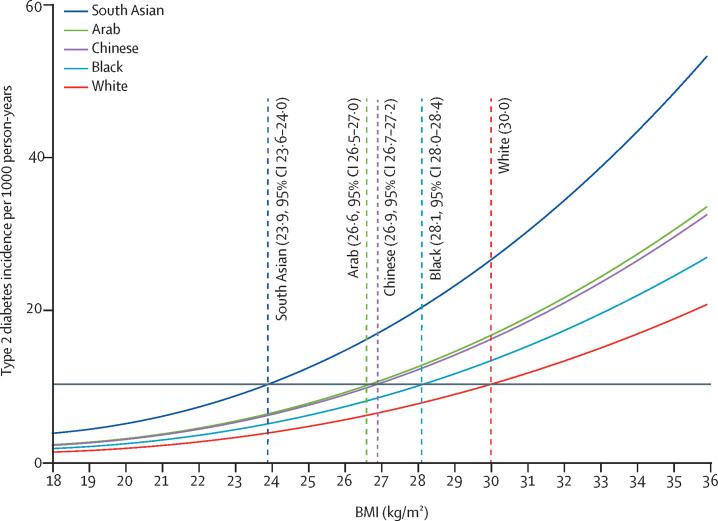
1 472 819 people were included in our study, of whom 1 333 816 (90·6%) were White, 75 956 (5·2%) were south Asian, 49 349 (3·4%) were Black, 10 934 (0·7%) were Chinese, and 2764 (0·2%) were Arab. After a median follow-up of 6·5 years (IQR 3·2-11·2), 97 823 (6·6%) of 1 472 819 individuals were diagnosed with type 2 diabetes. For the equivalent age-adjusted and sex-adjusted incidence of type 2 diabetes at a BMI of 30·0 kg/m in White populations, the BMI cutoffs were 23·9 kg/m (95% CI 23·6-24·0) in south Asian populations, 28·1 kg/m (28·0-28·4) in Black populations, 26·9 kg/m (26·7-27·2) in Chinese populations, and 26·6 kg/m (26·5-27·0) in Arab populations.
INTERPRETATION
Revisions of ethnicity-specific BMI cutoffs are needed to ensure that minority ethnic populations are provided with appropriate clinical surveillance to optimise the prevention, early diagnosis, and timely management of type 2 diabetes.
FUNDING
National Institute for Health Research.
背景
针对非白人群体,各国和全球建议使用 BMI 切点来采取行动预防与肥胖相关的并发症,如 2 型糖尿病,但这些切点值得怀疑。我们旨在前瞻性地确定基于 2 型糖尿病风险的、针对不同种族的肥胖 BMI 切点,这些切点与白人群体(≥30kg/m²)的肥胖 BMI 切点(≥30kg/m²)风险相当。
方法
在这项基于人群的队列研究中,我们使用了英格兰全科医生实践网络中的初级保健(临床实践研究数据链接)中的电子健康记录,并与二级保健记录(医院发病统计)相关联。符合条件的参与者年龄在 18 岁或以上,没有任何过去或当前的 2 型糖尿病诊断,BMI 为 15.0-50.0kg/m²,且具有完整的种族数据,在 1990 年 9 月 1 日至 2018 年 12 月 1 日期间的任何时候都在英格兰的全科医生实践中登记,并至少有 1 年的随访数据。使用 CALIBER 表型算法确定 2 型糖尿病患者。将自我报告的种族分为五个主要类别。使用年龄和性别调整的负二项式回归模型,结合 BMI 的分数多项式,对 2 型糖尿病和种族数据进行拟合。
结果
我们的研究共纳入了 1472819 人,其中 1333816 人(90.6%)为白人,75956 人(5.2%)为南亚人,49349 人(3.4%)为黑人,10934 人(0.7%)为中国人,2764 人(0.2%)为阿拉伯人。在中位数为 6.5 年(IQR 3.2-11.2)的随访后,1472819 人中的 97823 人(6.6%)被诊断患有 2 型糖尿病。对于白人人群中 BMI 为 30.0kg/m²时相当于年龄和性别调整的 2 型糖尿病发生率,南亚人群的 BMI 切点为 23.9kg/m²(95%CI 23.6-24.0),黑人人群为 28.1kg/m²(28.0-28.4),中国人为 26.9kg/m²(26.7-27.2),阿拉伯人为 26.6kg/m²(26.5-27.0)。
解释
需要修订针对特定种族的 BMI 切点,以确保向少数民族提供适当的临床监测,从而优化 2 型糖尿病的预防、早期诊断和及时管理。
资助
英国国家卫生研究院。



 Zotero 插件