
弓形虫 LIPIN 通过膜生物发生和脂质储存来引导宿主脂质通量,这是必不可少的。
Toxoplasma LIPIN is essential in channeling host lipid fluxes through membrane biogenesis and lipid storage.
机构信息
Apicolipid Team, Institute for Advanced Biosciences, CNRS UMR5309, Université Grenoble Alpes, INSERM U1209, Grenoble, France.
Laboratory of Pathogen Host Interactions, UMR 5235, Université de Montpellier, Montpellier, France.
出版信息
Nat Commun. 2021 May 17;12(1):2813. doi: 10.1038/s41467-021-22956-w.
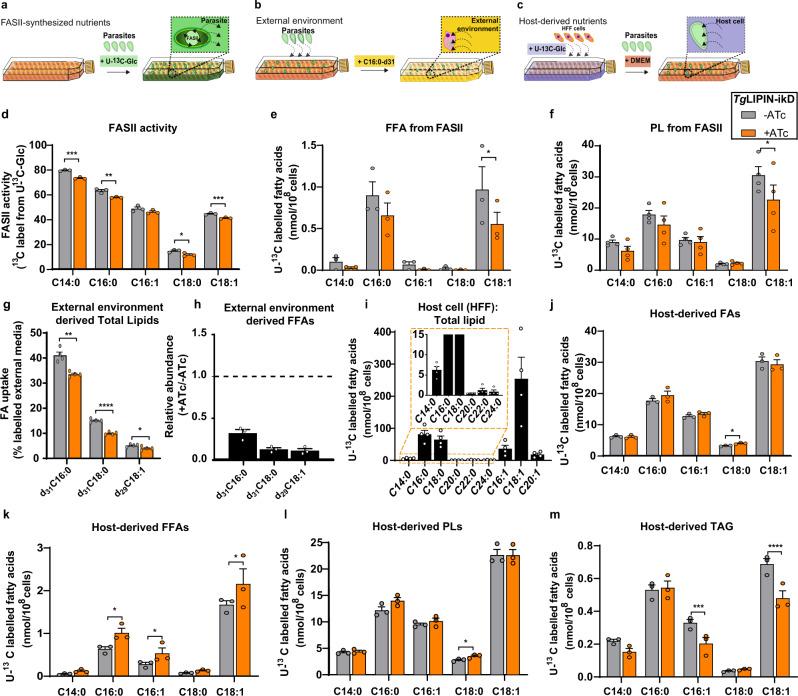
Apicomplexa are obligate intracellular parasites responsible for major human diseases. Their intracellular survival relies on intense lipid synthesis, which fuels membrane biogenesis. Parasite lipids are generated as an essential combination of fatty acids scavenged from the host and de novo synthesized within the parasite apicoplast. The molecular and metabolic mechanisms allowing regulation and channeling of these fatty acid fluxes for intracellular parasite survival are currently unknown. Here, we identify an essential phosphatidic acid phosphatase in Toxoplasma gondii, TgLIPIN, as the central metabolic nexus responsible for controlled lipid synthesis sustaining parasite development. Lipidomics reveal that TgLIPIN controls the synthesis of diacylglycerol and levels of phosphatidic acid that regulates the fine balance of lipids between storage and membrane biogenesis. Using fluxomic approaches, we uncover the first parasite host-scavenged lipidome and show that TgLIPIN prevents parasite death by 'lipotoxicity' through effective channeling of host-scavenged fatty acids to storage triacylglycerols and membrane phospholipids.
顶复门生物是专性细胞内寄生虫,可引起人类的重大疾病。它们的细胞内生存依赖于强烈的脂质合成,这为膜生物发生提供燃料。寄生虫脂质是由从宿主中掠夺的脂肪酸和寄生虫类质体中新合成的脂肪酸的必需组合生成的。目前尚不清楚允许调节和引导这些脂肪酸通量以维持细胞内寄生虫生存的分子和代谢机制。在这里,我们鉴定了刚地弓形虫中的必需磷酸脂酸磷酸酶 TgLIPIN,它是负责控制脂质合成以维持寄生虫发育的中央代谢枢纽。脂质组学揭示 TgLIPIN 控制二酰基甘油的合成和磷酸脂酸的水平,调节脂质在储存和膜生物发生之间的精细平衡。通过通量组学方法,我们揭示了第一个寄生虫从宿主掠夺的脂质组,并表明 TgLIPIN 通过将从宿主掠夺的脂肪酸有效引导到储存三酰基甘油和膜磷脂中来防止寄生虫因“脂毒性”而死亡。


 Zotero 插件