
MYCN 介导 TFRC 依赖性铁死亡,并揭示神经母细胞瘤的脆弱性。
MYCN mediates TFRC-dependent ferroptosis and reveals vulnerabilities in neuroblastoma.
机构信息
Clinical Biological Resource Bank, Guangzhou Institute of Pediatrics, Guangzhou Women and Children's Hospital, Zhongshan School of Medicine, Sun Yat-sen University, Guangzhou, China.
State Key Laboratory of Oncology in South China, Collaborative Innovation Center for Cancer Medicine, Sun Yat-sen University Cancer Center, Guangzhou, China.
出版信息
Cell Death Dis. 2021 May 19;12(6):511. doi: 10.1038/s41419-021-03790-w.
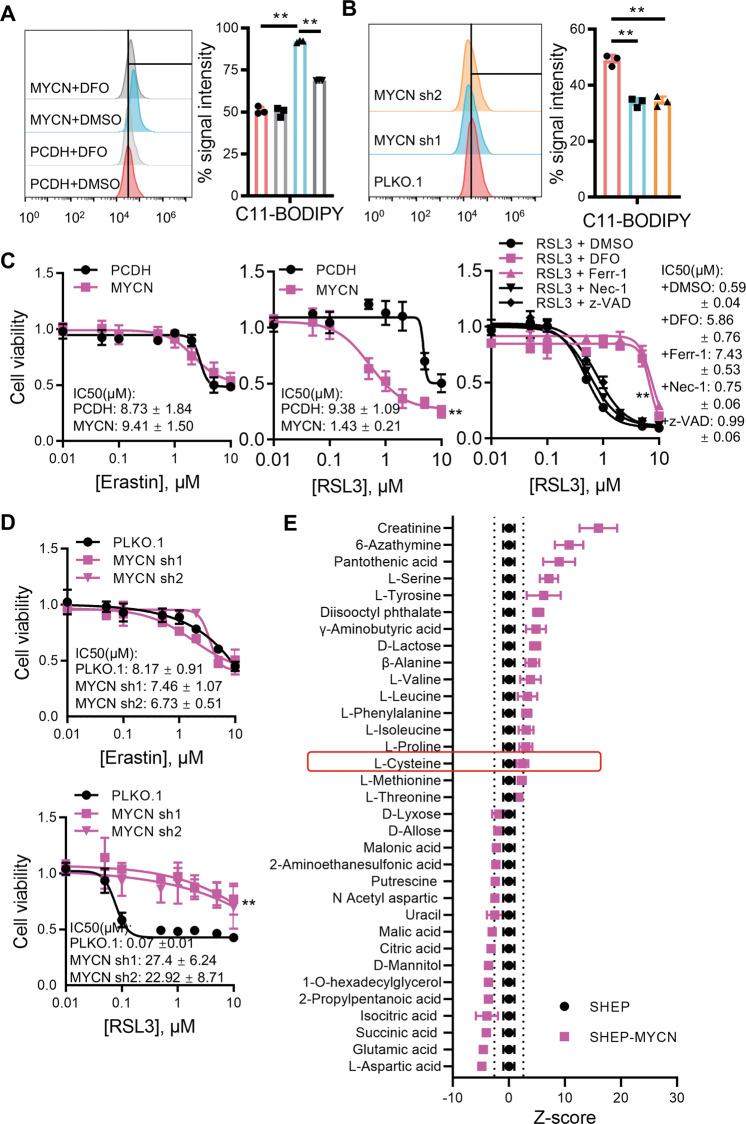
MYCN amplification is tightly associated with the poor prognosis of pediatric neuroblastoma (NB). The regulation of NB cell death by MYCN represents an important aspect, as it directly contributes to tumor progression and therapeutic resistance. However, the relationship between MYCN and cell death remains elusive. Ferroptosis is a newly identified cell death mode featured by lipid peroxide accumulation that can be attenuated by GPX4, yet whether and how MYCN regulates ferroptosis are not fully understood. Here, we report that MYCN-amplified NB cells are sensitive to GPX4-targeting ferroptosis inducers. Mechanically, MYCN expression reprograms the cellular iron metabolism by upregulating the expression of TFRC, which encodes transferrin receptor 1 as a key iron transporter on the cell membrane. Further, the increased iron uptake promotes the accumulation of labile iron pool, leading to enhanced lipid peroxide production. Consistently, TFRC overexpression in NB cells also induces selective sensitivity to GPX4 inhibition and ferroptosis. Moreover, we found that MYCN fails to alter the general lipid metabolism and the amount of cystine imported by System X(-) for glutathione synthesis, both of which contribute to ferroptosis in alternative contexts. In conclusion, NB cells harboring MYCN amplification are prone to undergo ferroptosis conferred by TFRC upregulation, suggesting that GPX4-targeting ferroptosis inducers or TFRC agonists can be potential strategies in treating MYCN-amplified NB.
MYCN 扩增与小儿神经母细胞瘤(NB)的不良预后密切相关。MYCN 对 NB 细胞死亡的调节是一个重要方面,因为它直接促进肿瘤进展和治疗耐药性。然而,MYCN 与细胞死亡之间的关系仍然难以捉摸。铁死亡是一种新发现的细胞死亡模式,其特征是脂质过氧化物积累,可被 GPX4 减弱,但 MYCN 是否以及如何调节铁死亡尚不完全清楚。在这里,我们报告 MYCN 扩增的 NB 细胞对靶向 GPX4 的铁死亡诱导剂敏感。从机制上讲,MYCN 表达通过上调 TFRC 的表达来重新编程细胞内铁代谢,TFRC 编码转铁蛋白受体 1 作为细胞膜上的关键铁转运蛋白。此外,增加的铁摄取促进不稳定铁池的积累,导致脂质过氧化物产生增加。一致地,NB 细胞中 TFRC 的过表达也诱导对 GPX4 抑制和铁死亡的选择性敏感性。此外,我们发现 MYCN 不会改变一般脂质代谢和 System X(-) 导入胱氨酸的量以用于谷胱甘肽合成,这两者都有助于其他情况下的铁死亡。总之,携带 MYCN 扩增的 NB 细胞容易发生由 TFRC 上调引起的铁死亡,这表明靶向 GPX4 的铁死亡诱导剂或 TFRC 激动剂可能是治疗 MYCN 扩增 NB 的潜在策略。




 Zotero 插件