
人类多能干细胞衍生的脑类器官作为研究神经疾病和癌症的体外模型。
Human pluripotent stem cell-derived brain organoids as in vitro models for studying neural disorders and cancer.
作者信息
Luo Juan, Li Peng
机构信息
Scientific Research Center, The Seventh Affiliated Hospital of Sun Yat-Sen University, Shenzhen, 518107, China.
出版信息
Cell Biosci. 2021 May 28;11(1):99. doi: 10.1186/s13578-021-00617-1.
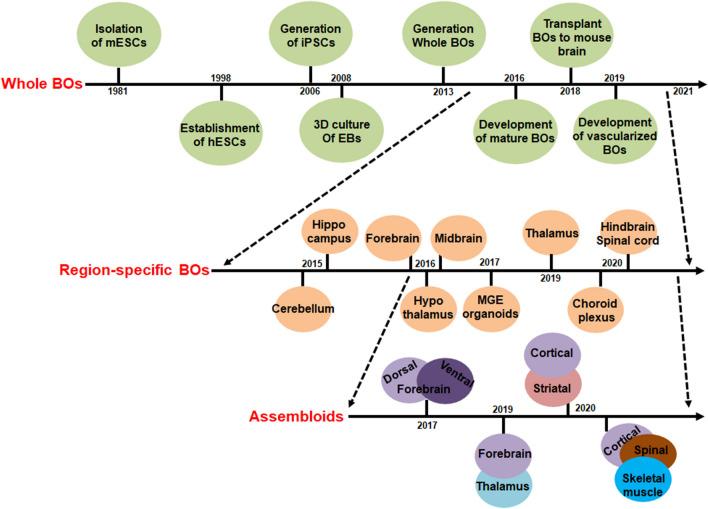
The sheer complexities of brain and resource limitation of human brain tissue greatly hamper our understanding of the brain disorders and cancers. Recently developed three-dimensional (3D) brain organoids (BOs) are self-organized and spontaneously differentiated from human pluripotent stem cells (hPSCs) in vitro, which exhibit similar features with cell type diversity, structural organization, and functional connectivity as the developing human brain. Based on these characteristics, hPSC-derived BOs (hPDBOs) provide new opportunities to recapitulate the complicated processes during brain development, neurodegenerative disorders, and brain cancers in vitro. In this review, we will provide an overview of existing BO models and summarize the applications of this technology in modeling the neural disorders and cancers. Furthermore, we will discuss the challenges associated with their use as in vitro models for disease modeling and the potential future direction.
大脑的极端复杂性以及人类脑组织的资源限制极大地阻碍了我们对脑部疾病和癌症的理解。最近开发的三维(3D)脑类器官(BOs)是在体外由人类多能干细胞(hPSCs)自组织并自发分化形成的,其在细胞类型多样性、结构组织和功能连接性方面表现出与发育中的人类大脑相似的特征。基于这些特性,源自hPSC的BOs(hPDBOs)为在体外重现大脑发育、神经退行性疾病和脑癌期间的复杂过程提供了新机会。在本综述中,我们将概述现有的BO模型,并总结该技术在模拟神经疾病和癌症方面的应用。此外,我们将讨论将其用作疾病建模体外模型所面临的挑战以及潜在的未来发展方向。


 Zotero 插件