
基于微环境免疫类型和程序性死亡受体配体1(PD-L1)的基因组分层,用于定制膀胱癌的治疗策略。
Genomic stratification based on microenvironment immune types and PD-L1 for tailoring therapeutic strategies in bladder cancer.
作者信息
Lyu Xintong, Wang Ping, Qiao Qiao, Jiang Yuanjun
机构信息
Department of Radiotherapy, First Hospital of China Medical University, Shenyang, Liaoning, China.
Department of Urology, First hospital of China Medical University, Shenyang, Liaoning, China.
出版信息
BMC Cancer. 2021 May 31;21(1):646. doi: 10.1186/s12885-021-08350-1.
BACKGROUND
The tumour microenvironment (TME) not only plays a role during tumour progression and metastasis but also profoundly influences treatment efficacy. Environment-mediated drug resistance is a result of crosstalk between tumour cells and stroma. The presence of a "stromal exhaustion" response is suggested by the T cell exhaustion signature and PD-L1 expression. The prognostic role of PD-L1 in bladder cancer has been investigated in previous studies, but the results remain inconclusive. For a more comprehensive study, we discuss potential strategies to improve effectiveness in patients with various TME statuses and PD-L1 expression levels.
METHODS
We estimated the prognostic role of PD-L1 using immunohistochemistry and identified four immune subtypes according to the type of stromal immune modulation and PD-L1 expression status.
RESULTS
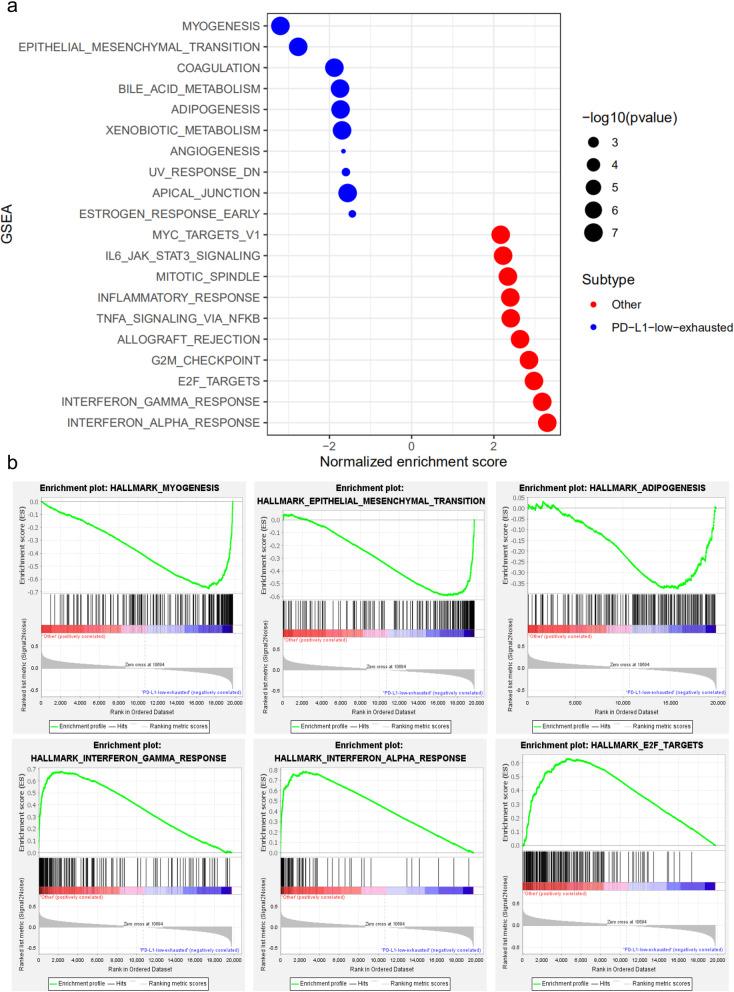
Patients in the PD-L1-low-exhausted group had the worst prognosis and showed the worst antigen-presenting cell (APC) immunosuppression status. The PD-L1-low-exhausted group showed the highest amount of infiltration by macrophage M2 cells, naïve B cells and resting mast cells. The TMB and the effectiveness of anti-PD-1 treatment were significantly increased in the PD-L1-high expression groups compared with the PD-L1-low expression groups. In the PD-L1-high groups, patients who underwent chemotherapy exhibited better overall survival rates than patients who did not undergo chemotherapy, whereas there was no significant difference in the PD-L1-low groups. We performed gene set enrichment analysis (GSEA) to explore the critical pathways that were active in the PD-L1-low-exhausted group, including the myogenesis, epithelial-mesenchymal transition and adipogenesis pathways. Copy number variations (CNVs) were related to the expression levels of differentially expressed genes upregulated in the PD-L1-low-exhausted group, including LCNL1, FBP1 and RASL11B. In addition, RASL11B played a role in predicting overall survival according to The Cancer Genome Atlas data, and this finding was validated in the PD-L1-low-exhausted group in the Gene Expression Omnibus database (GEO).
CONCLUSION
The immune environment of tumours plays an important role in the therapeutic response rate, and defining the immune groups plays a critical role in predicting disease outcome and strategy effectiveness.
背景
肿瘤微环境(TME)不仅在肿瘤进展和转移过程中发挥作用,还深刻影响治疗效果。环境介导的耐药性是肿瘤细胞与基质之间相互作用的结果。T细胞耗竭特征和PD-L1表达提示存在“基质耗竭”反应。既往研究对PD-L1在膀胱癌中的预后作用进行了探讨,但结果仍无定论。为进行更全面的研究,我们讨论了针对不同TME状态和PD-L1表达水平的患者提高疗效的潜在策略。
方法
我们采用免疫组织化学评估PD-L1的预后作用,并根据基质免疫调节类型和PD-L1表达状态确定四种免疫亚型。
结果
PD-L1低表达耗竭组患者预后最差,抗原呈递细胞(APC)免疫抑制状态最差。PD-L1低表达耗竭组巨噬细胞M2、幼稚B细胞和静息肥大细胞浸润量最高。与PD-L1低表达组相比,PD-L1高表达组的肿瘤突变负荷(TMB)和抗PD-1治疗效果显著增加。在PD-L1高表达组中,接受化疗的患者总生存率高于未接受化疗的患者,而在PD-L1低表达组中无显著差异。我们进行基因集富集分析(GSEA)以探索在PD-L1低表达耗竭组中活跃的关键通路,包括肌生成、上皮-间质转化和脂肪生成通路。拷贝数变异(CNV)与PD-L1低表达耗竭组中上调的差异表达基因的表达水平相关,包括LCNL1、FBP1和RASL11B。此外,根据癌症基因组图谱数据,RASL11B在预测总生存方面发挥作用,这一发现在基因表达综合数据库(GEO)的PD-L1低表达耗竭组中得到验证。
结论
肿瘤免疫环境在治疗反应率中起重要作用,定义免疫组在预测疾病转归和策略有效性方面起关键作用。



 Zotero 插件