
癌症与关系破裂:癌症患者伴侣的视角
Cancer and Relationship Dissolution: Perspective of Partners of Cancer Patients.
作者信息
Nalbant Bahar, Karger André, Zimmermann Tanja
机构信息
Department of Psychosomatics and Psychotherapy, Hannover Medical School, Hanover, Germany.
Medical Faculty, Heinrich-Heine University, Institute for Psychosomatic Medicine and Psychotherapy, University Hospital, Düsseldorf, Germany.
出版信息
Front Psychol. 2021 May 21;12:624902. doi: 10.3389/fpsyg.2021.624902. eCollection 2021.
PURPOSE
Cancer can be a burden on the relationship and even lead to relationship dissolution. Previous studies about the impact of cancer on close relationships almost exclusively involve cancer patients. So far, little is known about the views of spouses. Therefore, this study focuses on partners or ex-partners of cancer patients.
METHODS
In this cross-sectional study, = 265 partners or ex-partners of cancer patients are examined regarding a possible separation, the reasons for separation and the influence of the cancer on the relationship. In addition, predictors of separation and the positive or negative perception of the impact of cancer on the relationship were investigated.
RESULTS
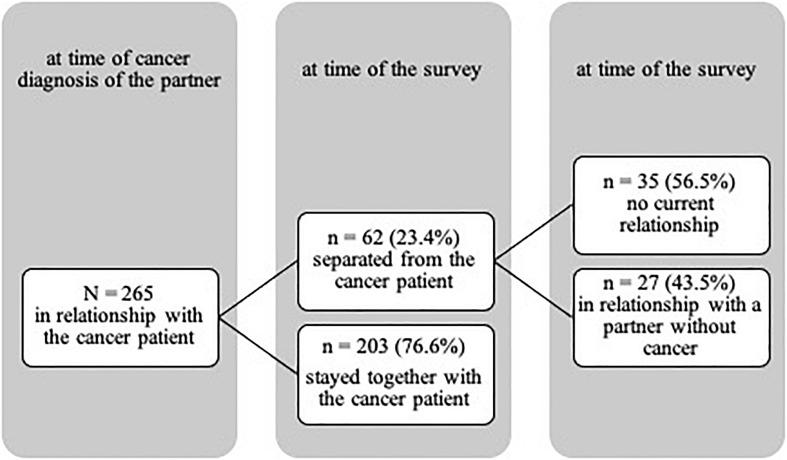
The separation rate (23.4%) was marginally lower than in the general population in Germany (35.79%). The most frequent reason for separation was the death of the cancer patient (59.6%), followed by relationship problems (26.9%), and the cancer disease itself (9.6%). Among those who were separated, 57.4% reported that cancer contributed to the separation. On average, the influence of cancer on relationship dissolution is indicated with 82.9%. Also, for those who stayed together, 83.7% reported an impact of the cancer on the relationship, of which 55.9% reported a negative impact. Logistic regressions indicated that higher levels of depression were associated with greater odds of a more negative perception of the influence of cancer on the relationship, whereas a more satisfied relationship tended to be associated with a more positive perception. Those who had no psychological treatment in the past, lower anxiety levels and lower relationship satisfaction had an increased risk of separation. Overall, relationship satisfaction was significantly lower than in the general population in Germany.
CONCLUSION
In particular, psychological factors such as depression and anxiety as well as relationship satisfaction appear to be factors influencing separation and the perception of the influence of cancer on the relationship as positive or negative. Therefore, it seems to be reasonable to consider these aspects in the psychosocial support and also to include the partners in order to achieve a stable and satisfied relationship which has a positive effect on health and psychological well-being.
目的
癌症可能给人际关系带来负担,甚至导致关系破裂。以往关于癌症对亲密关系影响的研究几乎都只涉及癌症患者。到目前为止,对于配偶的看法知之甚少。因此,本研究聚焦于癌症患者的伴侣或前伴侣。
方法
在这项横断面研究中,对265名癌症患者的伴侣或前伴侣进行了调查,涉及可能的分手情况、分手原因以及癌症对关系的影响。此外,还研究了分手的预测因素以及对癌症对关系影响的积极或消极认知。
结果
分手率(23.4%)略低于德国总人口的分手率(35.79%)。最常见的分手原因是癌症患者死亡(59.6%),其次是关系问题(26.9%),以及癌症疾病本身(9.6%)。在那些已分手的人中,57.4%报告称癌症促成了分手。平均而言,癌症对关系破裂的影响程度为82.9%。同样,对于那些仍在一起的人,83.7%报告称癌症对关系有影响,其中55.9%报告有负面影响。逻辑回归表明,抑郁程度较高与对癌症对关系影响的负面认知可能性更大相关,而关系满意度较高往往与更积极的认知相关。过去未接受心理治疗、焦虑水平较低且关系满意度较低的人分手风险增加。总体而言,关系满意度显著低于德国总人口。
结论
特别是,抑郁和焦虑等心理因素以及关系满意度似乎是影响分手以及对癌症对关系影响的积极或消极认知的因素。因此,在社会心理支持中考虑这些方面并纳入伴侣似乎是合理的,以便实现稳定且满意的关系,这对健康和心理健康有积极影响。
 Zotero 插件