
饮食诱导的炎症:来自个性化饮食反应研究(PREDICT)在 1000 名参与者中的餐后见解。
Meal-induced inflammation: postprandial insights from the Personalised REsponses to DIetary Composition Trial (PREDICT) study in 1000 participants.
机构信息
Department of Twin Research, King's College London, London, United Kingdom.
Department of Nutritional Sciences, King's College London, London, United Kingdom.
出版信息
Am J Clin Nutr. 2021 Sep 1;114(3):1028-1038. doi: 10.1093/ajcn/nqab132.
BACKGROUND
Meal-induced metabolic changes trigger an acute inflammatory response, contributing to chronic inflammation and associated diseases.
OBJECTIVES
We aimed to characterize variability in postprandial inflammatory responses using traditional (IL-6) and novel [glycoprotein acetylation (GlycA)] biomarkers of inflammation and dissect their biological determinants with a focus on postprandial glycemia and lipemia.
METHODS
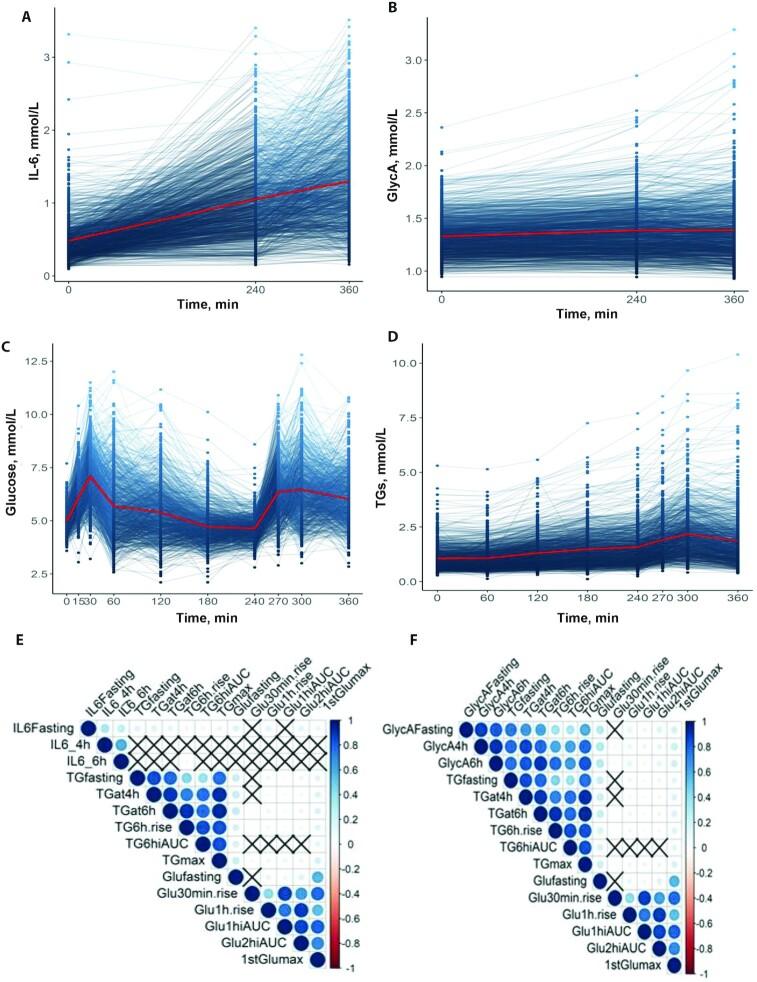
Postprandial (0-6 h) glucose, triglyceride (TG), IL-6, and GlycA responses were measured at multiple intervals after sequential mixed-nutrient meals (0 h and 4 h) in 1002 healthy adults aged 18-65 y from the PREDICT (Personalised REsponses to DIetary Composition Trial) 1 study, a single-arm dietary intervention study. Measures of habitual diet, blood biochemistry, gut microbiome composition, and visceral fat mass (VFM) were also collected.
RESULTS
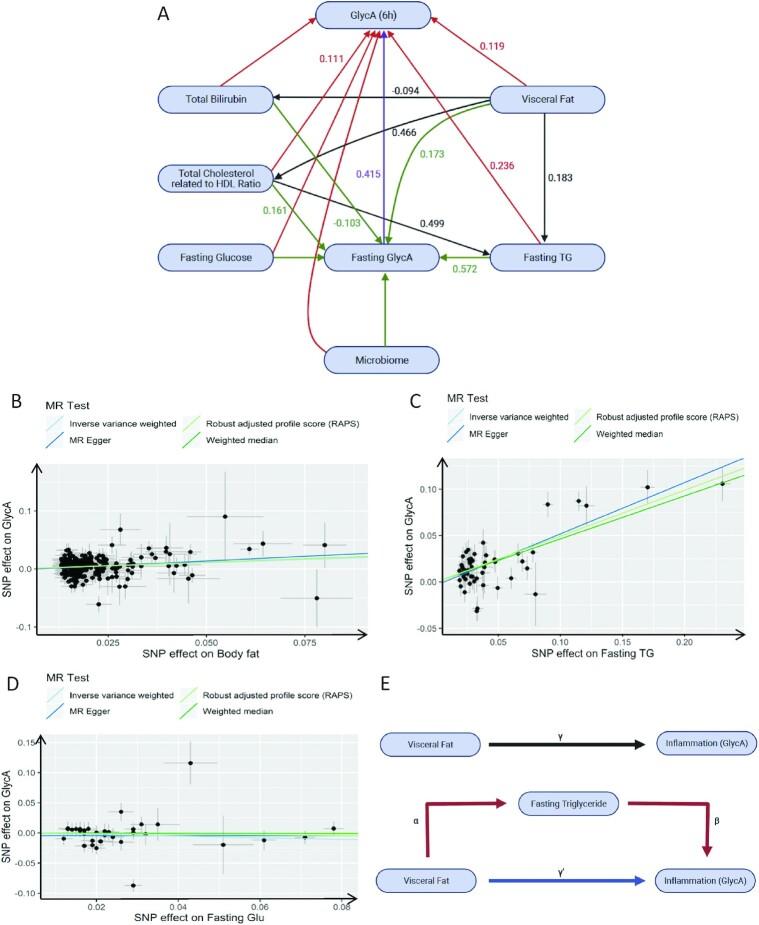
The postprandial changes in GlycA and IL-6 concentrations were highly variable between individuals. Participants eliciting an increase in GlycA and IL-6 (60% and 94% of the total participants, respectively) had mean 6-h increases of 11% and 190%, respectively. Peak postprandial TG and glucose concentrations were significantly associated with 6-h GlycA (r = 0.83 and r = 0.24, respectively; both P < 0.001) but not with 6-h IL-6 (both P > 0.26). A random forest model revealed the maximum TG concentration was the strongest postprandial TG predictor of postprandial GlycA and structural equation modeling revealed that VFM and fasting TG were most strongly associated with fasting and postprandial GlycA. Network Mendelian randomization demonstrated a causal link between VFM and fasting GlycA, mediated (28%) by fasting TG. Individuals eliciting enhanced GlycA responses had higher predicted cardiovascular disease risk (using the atherosclerotic disease risk score) than the rest of the cohort.
CONCLUSIONS
The variable postprandial increases in GlycA and their associations with TG metabolism highlight the importance of modulating TG in concert with obesity to reduce GlycA and associated low-grade inflammation-related diseases.This trial was registered at clinicaltrials.gov as NCT03479866.
背景
饮食引起的代谢变化会引发急性炎症反应,导致慢性炎症和相关疾病。
目的
我们旨在使用传统(IL-6)和新型(糖蛋白乙酰化(GlycA))炎症标志物来描述餐后炎症反应的可变性,并深入研究其生物学决定因素,重点关注餐后血糖和血脂。
方法
在 PREDICT(个性化饮食反应研究)1 研究中,对 1002 名年龄在 18-65 岁的健康成年人进行了连续混合营养素餐后(0 小时和 4 小时)多次间隔测量,以评估餐后(0-6 小时)血糖、甘油三酯(TG)、IL-6 和 GlycA 反应。还收集了习惯性饮食、血液生化、肠道微生物群组成和内脏脂肪量(VFM)的测量值。
结果
个体之间 GlycA 和 IL-6 浓度的餐后变化差异很大。GlycA 和 IL-6 增加的参与者(分别占总参与者的 60%和 94%)的 6 小时平均增加分别为 11%和 190%。餐后 TG 和葡萄糖浓度的峰值与 6 小时 GlycA 显著相关(r=0.83 和 r=0.24,均 P<0.001),但与 6 小时 IL-6 无关(均 P>0.26)。随机森林模型显示,最大 TG 浓度是餐后 TG 预测餐后 GlycA 的最强指标,结构方程模型显示,VFM 和空腹 TG 与空腹和餐后 GlycA 关系最密切。网络孟德尔随机化表明,VFM 和空腹 GlycA 之间存在因果关系,由空腹 TG 介导(28%)。GlycA 反应增强的个体比队列中的其他人有更高的心血管疾病风险预测(使用动脉粥样硬化疾病风险评分)。
结论
GlycA 的餐后变化差异很大,其与 TG 代谢的关联突出了在控制肥胖的同时调节 TG 以降低 GlycA 和相关低度炎症相关疾病的重要性。这项试验在 clinicaltrials.gov 上注册为 NCT03479866。

 Zotero 插件