
I 型干扰素信号通过调节 CD11bLy-6C 单核细胞的先决感染限制日本脑炎病毒感染后的类似出血性疾病。
Type I IFN signaling limits hemorrhage-like disease after infection with Japanese encephalitis virus through modulating a prerequisite infection of CD11bLy-6C monocytes.
机构信息
College of Veterinary Medicine and Bio-Safety Research Institute, Jeonbuk National University, Iksan, 54596, Republic of Korea.
Department of Pharmacology, School of Medicine, Pusan National University, Yangsan, 50612, Republic of Korea.
出版信息
J Neuroinflammation. 2021 Jun 15;18(1):136. doi: 10.1186/s12974-021-02180-5.
BACKGROUND
The crucial role of type I interferon (IFN-I, IFN-α/β) is well known to control central nervous system (CNS) neuroinflammation caused by neurotrophic flaviviruses such as Japanese encephalitis virus (JEV) and West Nile virus. However, an in-depth analysis of IFN-I signal-dependent cellular factors that govern CNS-restricted tropism in JEV infection in vivo remains to be elucidated.
METHODS
Viral dissemination, tissue tropism, and cytokine production were examined in IFN-I signal-competent and -incompetent mice after JEV inoculation in tissues distal from the CNS such as the footpad. Bone marrow (BM) chimeric models were used for defining hematopoietic and tissue-resident cells in viral dissemination and tissue tropism.
RESULTS
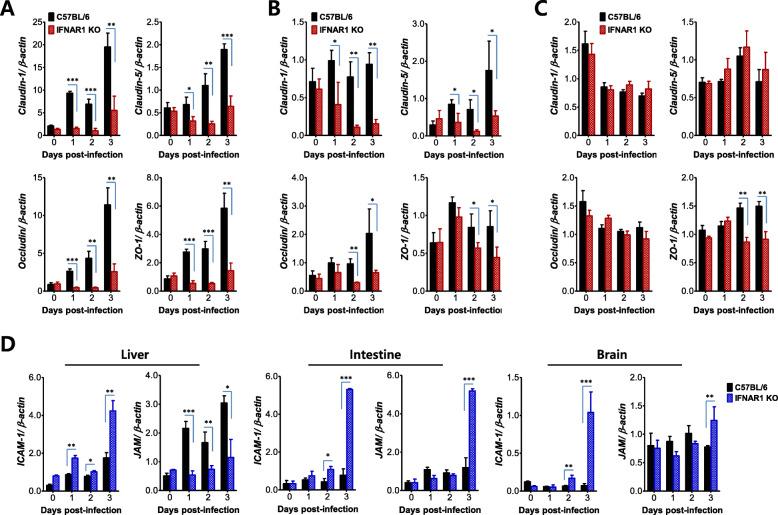
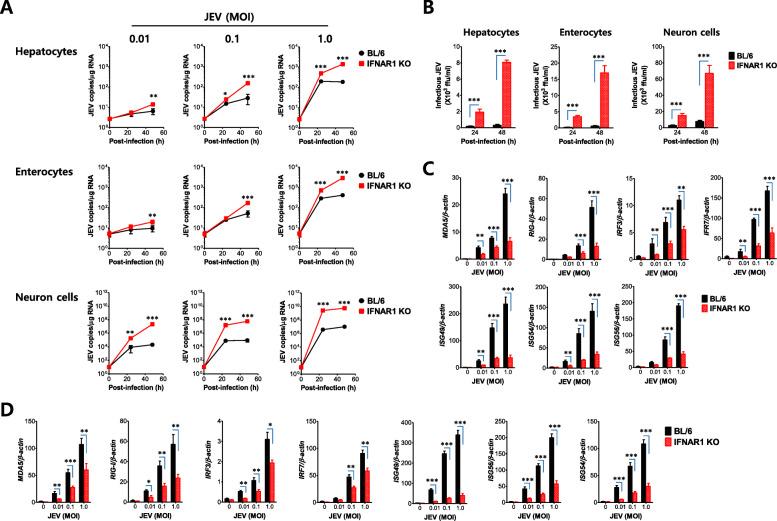
The paradoxical and interesting finding was that IFN-I signaling was essentially required for CNS neuroinflammation following JEV inoculation in distal footpad tissue. IFN-I signal-competent mice died after a prolonged neurological illness, but IFN-I signal-incompetent mice all succumbed without neurological signs. Rather, IFN-I signal-incompetent mice developed hemorrhage-like disease as evidenced by thrombocytopenia, functional injury of the liver and kidney, increased vascular leakage, and excessive cytokine production. This hemorrhage-like disease was closely associated with quick viral dissemination and impaired IFN-I innate responses before invasion of JEV into the CNS. Using bone marrow (BM) chimeric models, we found that intrinsic IFN-I signaling in tissue-resident cells in peripheral organs played a major role in inducing the hemorrhage-like disease because IFN-I signal-incompetent recipients of BM cells from IFN-I signal-competent mice showed enhanced viral dissemination, uncontrolled cytokine production, and increased vascular leakage. IFN-I signal-deficient hepatocytes and enterocytes were permissive to JEV replication with impaired induction of antiviral IFN-stimulated genes, and neuron cells derived from both IFN-I signal-competent and -incompetent mice were vulnerable to JEV replication. Finally, circulating CD11bLy-6C monocytes infiltrated into the distal tissues inoculated by JEV participated in quick viral dissemination to peripheral organs of IFN-I signal-incompetent mice at an early stage.
CONCLUSION
An IFN-I signal-dependent model is proposed to demonstrate how CD11bLy-6C monocytes are involved in restricting the tissue tropism of JEV to the CNS.
背景
I 型干扰素(IFN-I,IFN-α/β)的关键作用众所周知,可控制神经滋养性黄病毒(如日本脑炎病毒 [JEV] 和西尼罗河病毒)引起的中枢神经系统(CNS)神经炎症。然而,体内 JEV 感染中,IFN-I 信号依赖性细胞因子对 CNS 限制嗜性的调控仍有待深入分析。
方法
在 JEV 接种于 CNS 以外的组织(如足底)后,检测 IFN-I 信号功能正常和功能缺陷小鼠中的病毒播散、组织嗜性和细胞因子产生。利用骨髓(BM)嵌合模型来确定病毒播散和组织嗜性中的造血细胞和组织固有细胞。
结果
出乎意料的有趣发现是,IFN-I 信号对于 JEV 接种于远端足底组织后 CNS 神经炎症是必需的。IFN-I 信号功能正常的小鼠在长时间的神经疾病后死亡,但 IFN-I 信号功能缺陷的小鼠在没有神经症状的情况下全部死亡。相反,IFN-I 信号功能缺陷的小鼠出现类似出血的疾病,表现为血小板减少、肝肾功能损伤、血管通透性增加和细胞因子过度产生。这种类似出血的疾病与 JEV 侵入 CNS 前的快速病毒播散和 IFN-I 固有反应受损密切相关。利用骨髓(BM)嵌合模型,我们发现外周器官组织固有细胞中的固有 IFN-I 信号在诱导类似出血的疾病中起主要作用,因为 IFN-I 信号功能缺陷的受体接受 IFN-I 信号功能正常的供体 BM 细胞后表现出增强的病毒播散、不受控制的细胞因子产生和增加的血管通透性。IFN-I 信号缺陷的肝细胞和肠细胞允许 JEV 复制,并伴有抗病毒 IFN 刺激基因诱导受损,来自 IFN-I 信号功能正常和缺陷的小鼠的神经元细胞均易受 JEV 复制的影响。最后,循环 CD11bLy-6C 单核细胞浸润到 JEV 接种的远端组织中,在早期参与 IFN-I 信号缺陷小鼠外周器官的快速病毒播散。
结论
提出了一个 IFN-I 信号依赖性模型,以证明 CD11bLy-6C 单核细胞如何参与限制 JEV 对 CNS 的组织嗜性。






 Zotero 插件