
一线免疫治疗可延长脑转移无进展生存期,改善总生存期,并降低晚期黑色素瘤患者脑转移的发生率。
First line immunotherapy extends brain metastasis free survival, improves overall survival, and reduces the incidence of brain metastasis in patients with advanced melanoma.
机构信息
Huntsman Cancer Institute, University of Utah Health Sciences Center, Salt Lake City, Utah, USA.
Department of Population Health Sciences, University of Utah, Salt Lake City, Utah, USA.
出版信息
Cancer Rep (Hoboken). 2021 Dec;4(6):e1419. doi: 10.1002/cnr2.1419. Epub 2021 Jun 17.
BACKGROUND
Recent advances in targeted therapy and immunotherapy have improved the prognosis of melanoma patients but brain metastasis remains a major challenge. Currently, it is unclear how existing therapies can be best used to prevent or treat brain metastasis in melanoma patients.
AIMS
We aimed to assess brain metastasis free survival (BMFS), overall survival (OS), incidence of brain metastases, and sequencing strategies of immunotherapy and targeted therapy in patients with BRAF-mutated advanced melanoma.
METHODS AND RESULTS
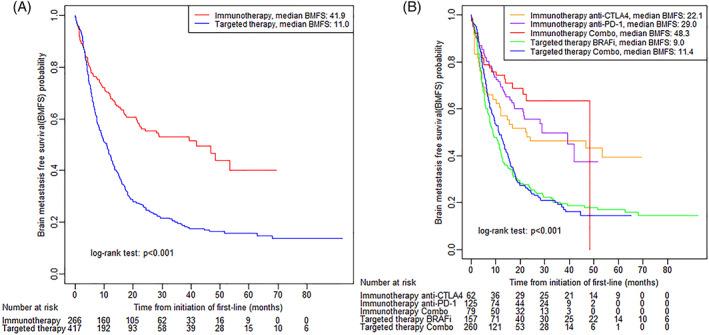
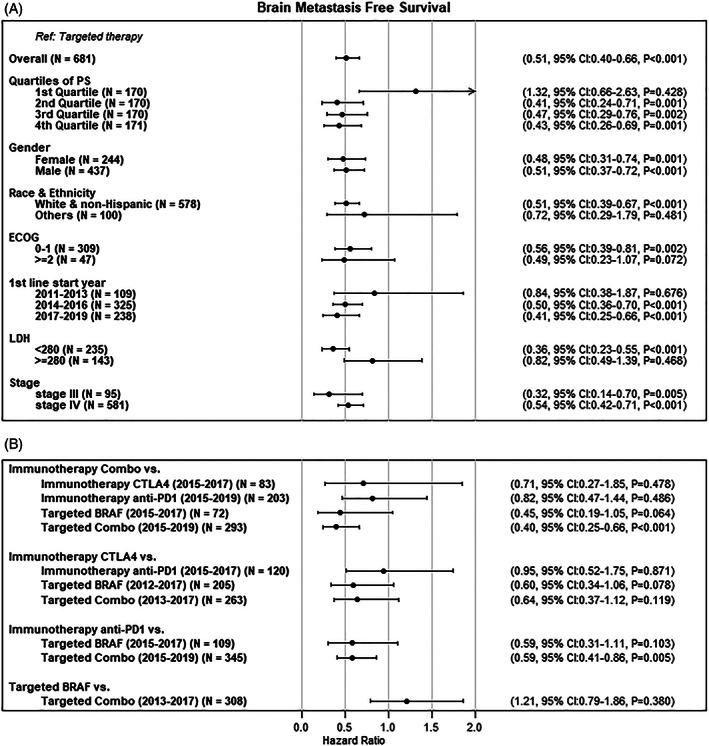
We retrospectively analyzed 683 patients with BRAF-mutated advanced melanoma treated with first line (1L) immunotherapy (N = 266) or targeted therapy (N = 417). The primary outcome was BMFS. Secondary outcomes included OS of all patients and incidence of brain metastases in patients without documented brain metastases prior to 1L therapy. The median BMFS was 13.7 months [95% confidence interval (CI): 12.4-16.0] among all patients. The median BMFS for patients receiving 1L immunotherapy was 41.9 months [95% CI: 22.8-not reached (NR)] and targeted therapy was 11.0 months (95% CI: 8.8-12.5). Median OS results were qualitatively similar to BMFS results. The cumulative incidence of brain metastases for patients receiving 1L targeted therapy was higher than for patients receiving 1L immunotherapy (P < .001). Patients receiving 1L anti-CTLA4 plus anti-PD1 combination immunotherapy only or followed by second line (2L) targeted therapy had better BMFS (HR 0.40, 95% CI: 0.24-0.67, P = .001), improved OS (HR 0.49, 95% CI: 0.30-0.81, P = .005), and reduced incidence of brain metastases (HR 0.47, 95% CI: 0.24-0.67, P = .047) than patients receiving 1L combination BRAF and MEK targeted therapy followed by 2L immunotherapy.
CONCLUSION
Patients with advanced BRAF mutant melanoma treated with 1L immunotherapy have significantly longer BMFS and OS, and reduced incidence of brain metastases, compared with those treated with 1L targeted therapy. Further studies evaluating the ability of immunotherapy and targeted therapy to improve OS and prevent brain metastases are warranted.
背景
靶向治疗和免疫治疗的最新进展改善了黑色素瘤患者的预后,但脑转移仍然是一个主要挑战。目前,尚不清楚如何最好地利用现有的治疗方法来预防或治疗黑色素瘤患者的脑转移。
目的
我们旨在评估 BRAF 突变型晚期黑色素瘤患者的无脑转移生存(BMFS)、总生存(OS)、脑转移发生率,以及免疫治疗和靶向治疗的测序策略。
方法和结果
我们回顾性分析了 683 例接受一线(1L)免疫治疗(N=266)或靶向治疗(N=417)的 BRAF 突变型晚期黑色素瘤患者。主要结局是 BMFS。次要结局包括所有患者的 OS 和 1L 治疗前无脑转移记录的患者的脑转移发生率。所有患者的中位 BMFS 为 13.7 个月[95%置信区间(CI):12.4-16.0]。接受 1L 免疫治疗的患者的中位 BMFS 为 41.9 个月[95%CI:22.8-NR],接受靶向治疗的患者为 11.0 个月[95%CI:8.8-12.5]。OS 结果与 BMFS 结果定性相似。接受 1L 靶向治疗的患者的脑转移累积发生率高于接受 1L 免疫治疗的患者(P<.001)。仅接受 1L 抗 CTLA4 联合抗 PD1 免疫治疗联合治疗或随后接受二线(2L)靶向治疗的患者具有更好的 BMFS(HR 0.40,95%CI:0.24-0.67,P=0.001)、OS(HR 0.49,95%CI:0.30-0.81,P=0.005)和降低的脑转移发生率(HR 0.47,95%CI:0.24-0.67,P=0.047)与接受 1L 联合 BRAF 和 MEK 靶向治疗联合 2L 免疫治疗的患者相比。
结论
与接受 1L 靶向治疗的患者相比,接受 1L 免疫治疗的晚期 BRAF 突变黑色素瘤患者的 BMFS 和 OS 显著更长,脑转移发生率更低。需要进一步研究评估免疫治疗和靶向治疗改善 OS 和预防脑转移的能力。


 Zotero 插件