
简单易用的方法在罕见事件荟萃分析中的应用:一项模拟研究。
Applications of simple and accessible methods for meta-analysis involving rare events: A simulation study.
机构信息
National Institute for Health Research (NIHR) School for Primary Care Research, Manchester Academic Health Science Centre, University of Manchester, Manchester, UK.
Division of Informatics, Imaging & Data Sciences, Faculty of Biology, Medicine & Health, University of Manchester, Manchester, UK.
出版信息
Stat Methods Med Res. 2021 Jul;30(7):1589-1608. doi: 10.1177/09622802211022385. Epub 2021 Jun 17.
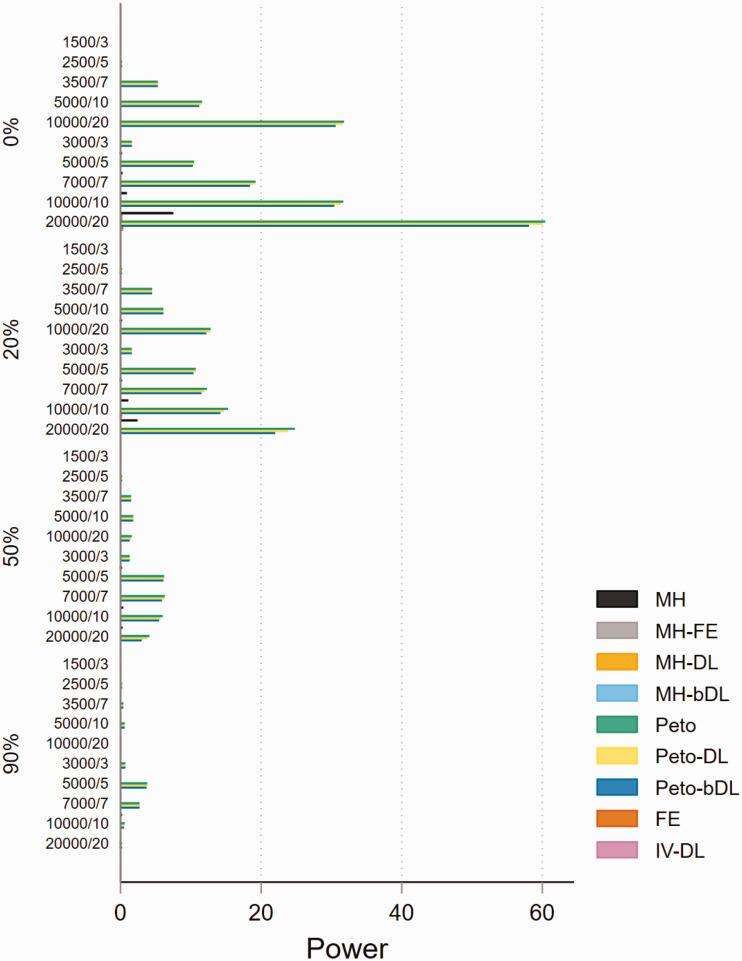
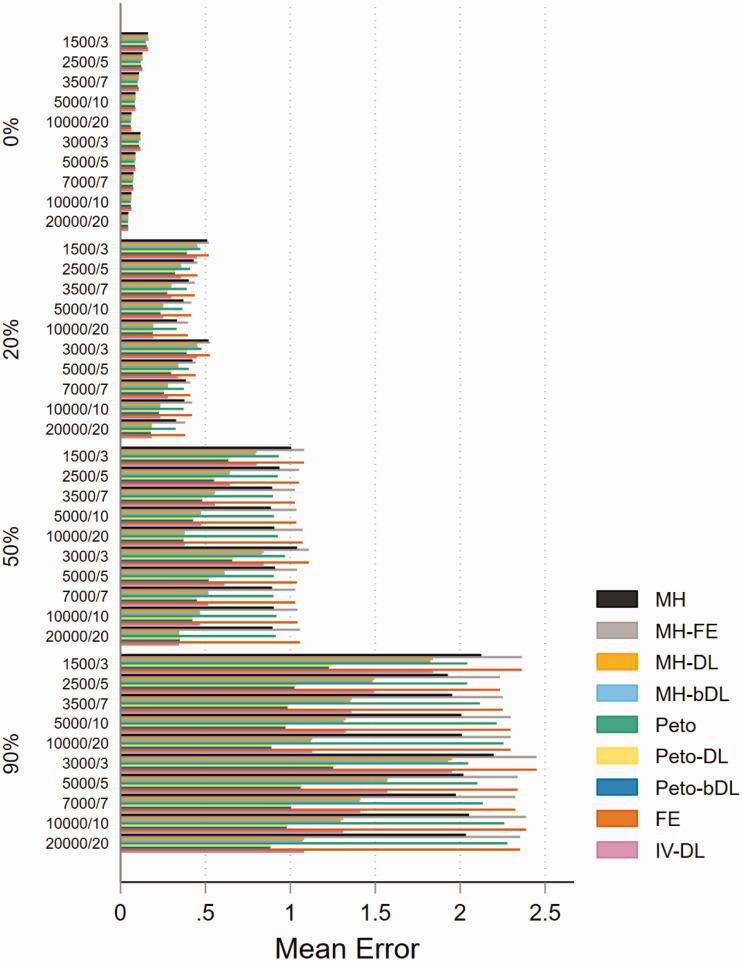
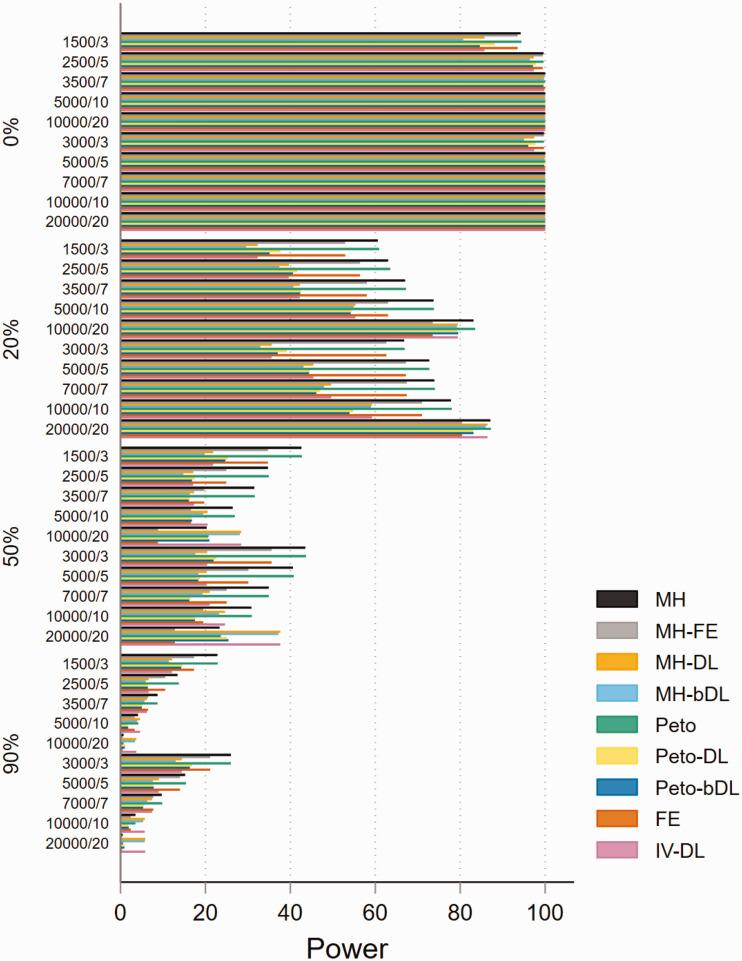
Meta-analysis of clinical trials targeting rare events face particular challenges when the data lack adequate number of events and are susceptible to high levels of heterogeneity. The standard meta-analysis methods (DerSimonian Laird (DL) and Mantel-Haenszel (MH)) often lead to serious distortions because of such data sparsity. Applications of the methods suited to specific incidence and heterogeneity characteristics are lacking, thus we compared nine available methods in a simulation study. We generated 360 meta-analysis scenarios where each considered different incidences, sample sizes, between-study variance (heterogeneity) and treatment allocation. We include globally recommended methods such as inverse-variance fixed/random-effect (IV-FE/RE), classical-MH, MH-FE, MH-DL, Peto, Peto-DL and the two extensions for MH bootstrapped-DL (bDL) and Peto-bDL. Performance was assessed on mean bias, mean error, coverage and power. In the absence of heterogeneity, the coverage and power when combined revealed small differences in meta-analysis involving rare and very rare events. The Peto-bDL method performed best, but only in smaller sample sizes involving rare events. For medium-to-larger sample sizes, MH-bDL was preferred. For meta-analysis involving very rare events, Peto-bDL was the best performing method which was sustained across all sample sizes. However, in meta-analysis with 20% or more heterogeneity, the coverage and power were insufficient. Performance based on mean bias and mean error was almost identical across methods. To conclude, in meta-analysis of rare binary outcomes, our results suggest that Peto-bDL is better in both rare and very rare event settings in meta-analysis with limited sample sizes. However, when heterogeneity is large, the coverage and power to detect rare events are insufficient. Whilst this study shows that some of the less studied methods appear to have good properties under sparse data scenarios, further work is needed to assess them against the more complex distributional-based methods to understand their overall performances.
针对罕见事件的临床试验的荟萃分析在数据缺乏足够数量的事件并且容易受到高水平异质性的影响时面临特殊挑战。由于这种数据稀疏性,标准的荟萃分析方法(DerSimonian Laird(DL)和Mantel-Haenszel(MH))通常会导致严重的扭曲。缺乏适用于特定发生率和异质性特征的方法的应用,因此我们在模拟研究中比较了九种可用的方法。我们生成了 360 个荟萃分析场景,每个场景都考虑了不同的发生率、样本量、研究间方差(异质性)和治疗分配。我们包括了全球推荐的方法,如Inverse-Variance Fixed/Random-Effect(IV-FE/RE)、Classical-MH、MH-FE、MH-DL、Peto、Peto-DL 和 MH-Bootstrapped-DL(bDL)和 Peto-bDL 的两个扩展。我们评估了平均偏差、平均误差、覆盖范围和功效。在没有异质性的情况下,当结合起来时,涉及罕见和极罕见事件的荟萃分析的覆盖率和功效显示出微小的差异。Peto-bDL 方法表现最好,但仅在涉及罕见事件的较小样本量中表现最好。对于中等至较大的样本量,MH-bDL 更受欢迎。对于涉及非常罕见事件的荟萃分析,Peto-bDL 是表现最好的方法,在所有样本量下都保持不变。然而,在异质性为 20%或更高的荟萃分析中,覆盖率和功效不足。基于平均偏差和平均误差的性能在方法之间几乎相同。总之,在罕见二项结局的荟萃分析中,我们的结果表明,在样本量有限的荟萃分析中,Peto-bDL 在罕见和极罕见事件的情况下表现更好。然而,当异质性较大时,检测罕见事件的覆盖率和功效不足。虽然这项研究表明,一些研究较少的方法在稀疏数据情况下似乎具有良好的特性,但需要进一步的工作来评估它们与更复杂的基于分布的方法相比的整体性能。


 Zotero 插件