
管状网络上的扩散搜索和轨迹:传播子方法。
Diffusive search and trajectories on tubular networks: a propagator approach.
机构信息
Department of Physics, University of California, San Diego, La Jolla, CA, 92093, USA.
Department of Physics, Ryerson University, Toronto, Canada.
出版信息
Eur Phys J E Soft Matter. 2021 Jun 18;44(6):80. doi: 10.1140/epje/s10189-021-00083-0.
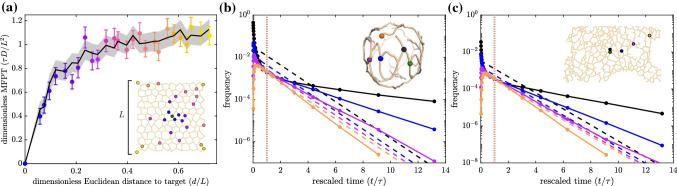
Several organelles in eukaryotic cells, including mitochondria and the endoplasmic reticulum, form interconnected tubule networks extending throughout the cell. These tubular networks host many biochemical pathways that rely on proteins diffusively searching through the network to encounter binding partners or localized target regions. Predicting the behavior of such pathways requires a quantitative understanding of how confinement to a reticulated structure modulates reaction kinetics. In this work, we develop both exact analytical methods to compute mean first passage times and efficient kinetic Monte Carlo algorithms to simulate trajectories of particles diffusing in a tubular network. Our approach leverages exact propagator functions for the distribution of transition times between network nodes and allows large simulation time steps determined by the network structure. The methodology is applied to both synthetic planar networks and organelle network structures, demonstrating key general features such as the heterogeneity of search times in different network regions and the functional advantage of broadly distributing target sites throughout the network. The proposed algorithms pave the way for future exploration of the interrelationship between tubular network structure and biomolecular reaction kinetics.
真核细胞中的几种细胞器,包括线粒体和内质网,形成相互连接的管状网络,延伸到整个细胞。这些管状网络承载着许多生化途径,这些途径依赖于蛋白质在网络中扩散搜索以遇到结合伴侣或局部目标区域。预测这些途径的行为需要定量理解限制在网状结构中如何调节反应动力学。在这项工作中,我们开发了精确的分析方法来计算平均首次通过时间,并开发了有效的动力学蒙特卡罗算法来模拟在管状网络中扩散的粒子的轨迹。我们的方法利用了网络节点之间的转移时间分布的精确传播子函数,并允许根据网络结构确定大的模拟时间步长。该方法适用于合成的平面网络和细胞器网络结构,展示了关键的一般特征,例如不同网络区域中搜索时间的异质性以及将目标站点广泛分布在网络中的功能优势。所提出的算法为未来探索管状网络结构与生物分子反应动力学之间的相互关系铺平了道路。




 Zotero 插件