
针对可燃香烟和电子烟双重使用者的定向戒烟:一项随机对照试验。
Targeted smoking cessation for dual users of combustible and electronic cigarettes: a randomised controlled trial.
作者信息
Martinez Ursula, Simmons Vani N, Sutton Steven K, Drobes David J, Meltzer Lauren R, Brandon Karen O, Byrne Margaret M, Harrell Paul T, Eissenberg Thomas, Bullen Christopher R, Brandon Thomas H
机构信息
Department of Health Outcomes and Behavior, H Lee Moffitt Cancer Center, Tampa, FL, USA; Department of Oncologic Sciences, University of South Florida, Tampa, FL, USA.
Department of Health Outcomes and Behavior, H Lee Moffitt Cancer Center, Tampa, FL, USA; Department of Oncologic Sciences, University of South Florida, Tampa, FL, USA; Department of Psychology, University of South Florida, Tampa, FL, USA.
出版信息
Lancet Public Health. 2021 Jul;6(7):e500-e509. doi: 10.1016/S2468-2667(20)30307-8.
BACKGROUND
Although many smokers use electronic cigarettes (e-cigarettes) to quit smoking, most continue to smoke while vaping. This dual use might delay cessation and increase toxicant exposure. We aimed to test the efficacy of a self-help intervention designed to help dual users to quit smoking.
METHODS
In this three-arm randomised controlled trial we recruited individuals in the USA using Facebook and multimedia advertisements. Included participants were 18 years or older, smoked at least weekly in the preceding year, and vaped at least weekly in the preceding month. We used computer generated randomisation with balanced-permuted blocks (block size 10, with 2-4-4 ratio) to allocate participants to assessment only (ASSESS group), generic smoking cessation self-help booklets (GENERIC group), or booklets targeting dual users (eTARGET group). Individuals in the generic or targeted intervention groups received monthly cessation materials for 18 months, with assessments every 3 months for 24 months. The main outcome was self-reported 7-day point-prevalence smoking abstinence at each assessment point. All randomly allocated participants were included in primary analyses using generalised estimating equations for each of 20 datasets created by multiple imputation. Analysis of the χs produced an F test. The trial is registered with ClinicalTrials.gov, NCT02416011, and is now closed.
FINDINGS
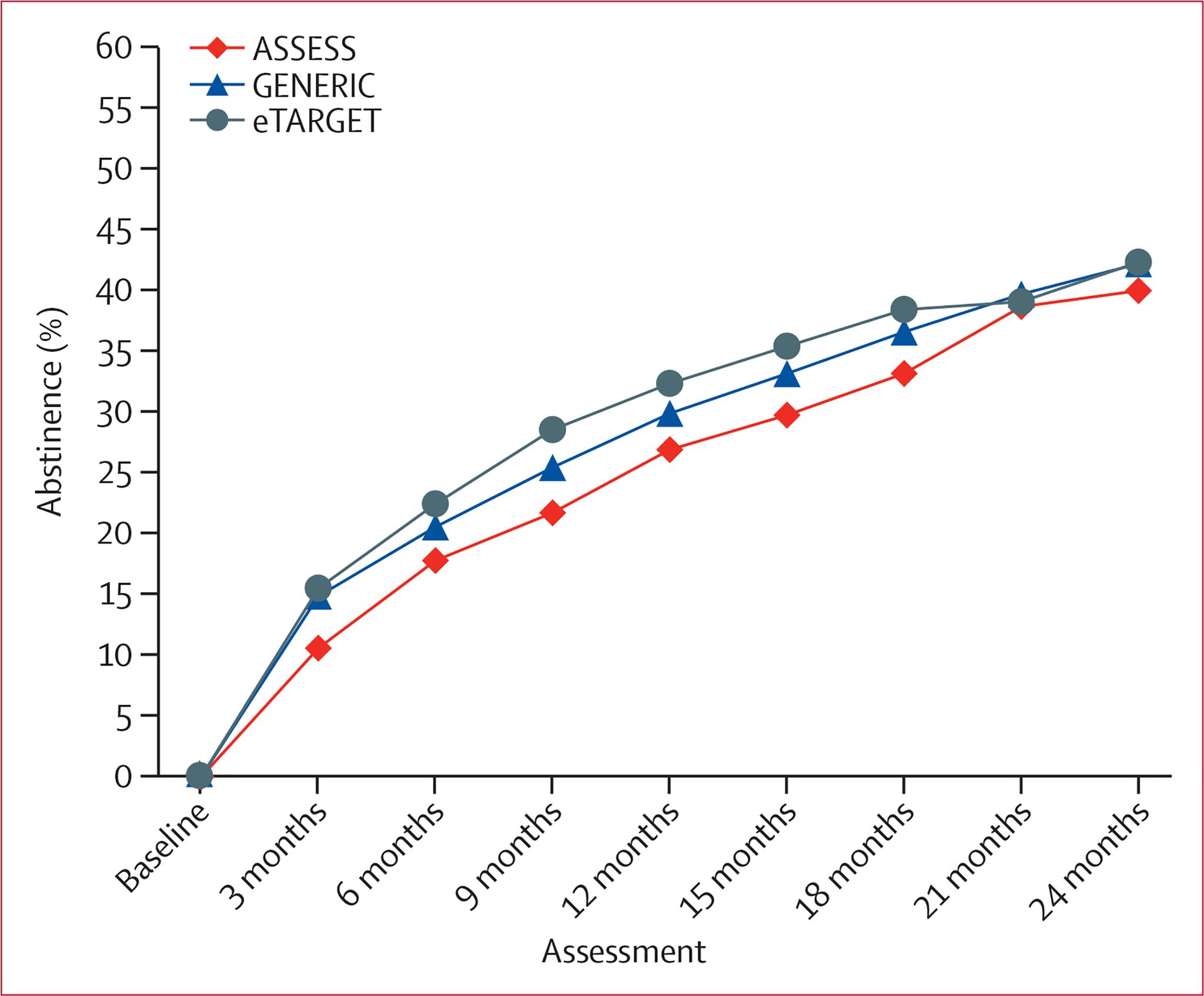
Between July 12, 2016, and June 30, 2017, we randomly assigned 2896 dual users (575 to assessment, 1154 to generic intervention, and 1167 to targeted self-help). 7-day point-prevalence smoking abstinence increased from 14% at 3 months to 42% at 24 months (F=67·1, p<0·0001) in the overall sample. Targeted self-help resulted in higher smoking abstinence than did assessment alone throughout the treatment period (F=10·20, p=0·0014 [α=0·017]). The generic intervention group had abstinence rates between those of the assessment and targeted groups, but did not significantly differ from either when adjusted for multiple comparisons (GENERIC vs eTARGET F=1·79, p=0·18 [α=0·05]; GENERIC vs ASSESS F=4·29, p=0·039 [α=0·025]). Differences between study groups attenuated after the interventions ended.
INTERPRETATION
A targeted self-help intervention with high potential for dissemination could be efficacious in promoting smoking cessation among dual users of combustible cigarettes and e-cigarettes.
FUNDING
National Institute on Drug Abuse, National Cancer Institute.
背景
尽管许多吸烟者使用电子烟来戒烟,但大多数人在吸电子烟时仍继续吸烟。这种双重使用可能会延迟戒烟并增加有毒物质暴露。我们旨在测试一种旨在帮助双重使用者戒烟的自助干预措施的效果。
方法
在这项三臂随机对照试验中,我们通过脸书和多媒体广告在美国招募参与者。纳入的参与者年龄在18岁及以上,在前一年至少每周吸烟一次,在前一个月至少每周吸一次电子烟。我们使用计算机生成的随机化方法,采用平衡置换区组(区组大小为10,比例为2-4-4)将参与者分配到仅评估组(评估组)、通用戒烟自助手册组(通用组)或针对双重使用者的手册组(电子目标组)。通用或针对性干预组的个体在18个月内每月收到戒烟材料,并在24个月内每3个月进行一次评估。主要结局是在每个评估点自我报告的7天点患病率戒烟情况。所有随机分配的参与者都被纳入使用多重插补创建的20个数据集中的每个数据集的广义估计方程进行的主要分析。χs分析产生了一个F检验。该试验已在ClinicalTrials.gov注册,编号为NCT02416011,现已结束。
结果
在2016年7月12日至2017年6月30日期间,我们随机分配了2896名双重使用者(575名至评估组,1154名至通用干预组,1167名至针对性自助组)。在整个样本中,7天点患病率戒烟率从3个月时的14%增加到24个月时的42%(F = 67·1,p < 0·0001)。在整个治疗期间,针对性自助导致的戒烟率高于仅评估组(F = 10·20,p = 0·0014 [α = 0·017])。通用干预组的戒烟率介于评估组和目标组之间,但在进行多重比较调整后,与任何一组均无显著差异(通用组与电子目标组F = 1·79,p = 0·18 [α = 0·05];通用组与评估组F = 4·29,p = 0·039 [α = 0·025])。干预结束后,研究组之间的差异有所减弱。
解读
一种具有高传播潜力的针对性自助干预措施可能对促进可燃香烟和电子烟双重使用者戒烟有效。
资金来源
国家药物滥用研究所、国家癌症研究所。


 Zotero 插件