
ReCOV:新冠疫情期间及之后的康复与恢复——一项针对患者、家属及医护人员的纵向观察性研究方案
ReCOV: recovery and rehabilitation during and after COVID-19 - a study protocol of a longitudinal observational study on patients, next of kin and health care staff.
作者信息
Rydwik E, Anmyr L, Regardt M, McAllister A, Zarenoe R, Åkerman E, Orrevall Y, Bragesjö M, Dahl O, Kemani M K, Nordstrand L, Ekman U, Holmström L, Nygren-Bonnier M
机构信息
Department of Neurobiology, Care Sciences and Society, Division of Physiotherapy, Karolinska Institutet, Huddinge, Sweden.
Women's Health and Allied Health Professionals Theme, Medical Unit Occupational Therapy and Physiotherapy, Karolinska University Hospital, Solna, Sweden.
出版信息
BMC Sports Sci Med Rehabil. 2021 Jun 30;13(1):70. doi: 10.1186/s13102-021-00299-9.
BACKGROUND
The knowledge of the long-term consequences of covid-19 is limited. In patients, symptoms such as fatigue, decreased physical, psychological, and cognitive function, and nutritional problems have been reported. How the disease has affected next of kin, as well as staff involved in the care of patients with covid-19, is also largely unknown. The overall aim of this study is therefore three-fold: (1) to describe and evaluate predictors of patient recovery, the type of rehabilitation received and patients' experiences of specialized rehabilitation following COVID-19 infection; (2) to study how next of kin experienced the hospital care of their relative and their experiences of the psychosocial support they received as well as their psychological wellbeing; (3) to describe experiences of caring for patients with COVID-19 and evaluate psychological wellbeing, coping mechanisms and predictors for development of psychological distress over time in health care staff.
METHODS
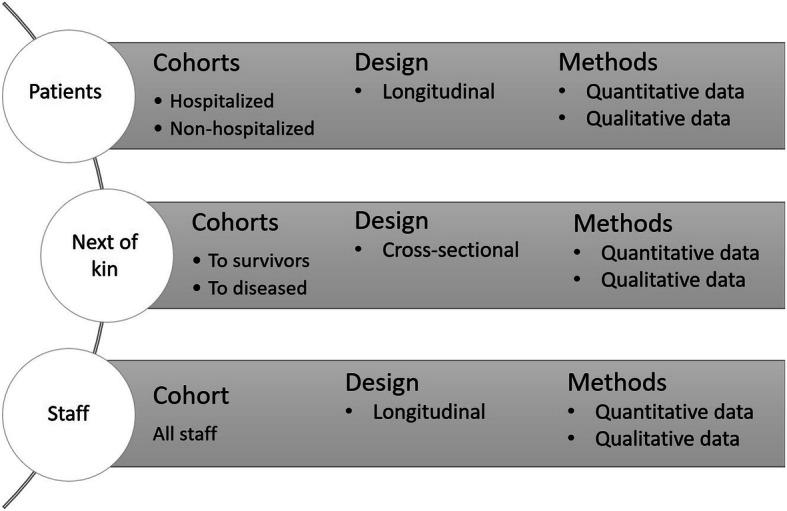
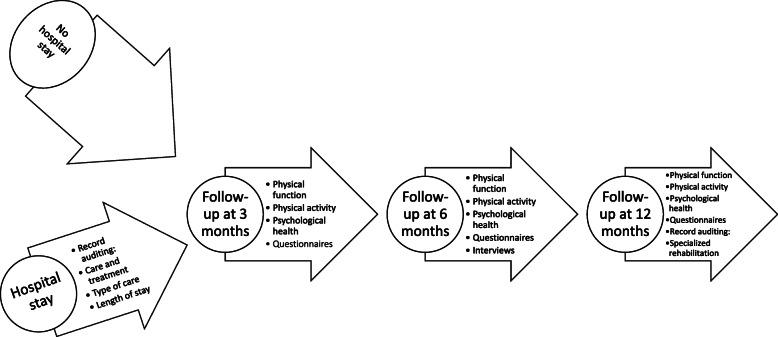
This observational longitudinal study consists of three cohorts; patients, next of kin, and health care staff. The assessments for the patients consist of physical tests (lung function, muscle strength, physical capacity) and questionnaires (communication and swallowing, nutritional status, hearing, activities of daily living, physical activity, fatigue, cognition) longitudinally at 3, 6 and 12 months. Patient records auditing (care, rehabilitation) will be done retrospectively at 12 months. Patients (3, 6 and 12 months), next of kin (6 months) and health care staff (baseline, 3, 6, 9 and 12 months) will receive questionnaires regarding, health-related quality of life, depression, anxiety, sleeping disorders, and post-traumatic stress. Staff will also answer questionnaires about burnout and coping strategies. Interviews will be conducted in all three cohorts.
DISCUSSION
This study will be able to answer different research questions from a quantitative and qualitative perspective, by describing and evaluating long-term consequences and their associations with recovery, as well as exploring patients', next of kins' and staffs' views and experiences of the disease and its consequences. This will form a base for a deeper and better understanding of the consequences of the disease from different perspectives as well as helping the society to better prepare for a future pandemic.
背景
关于新冠病毒病长期后果的了解有限。在患者中,已报告出现疲劳、身体、心理和认知功能下降以及营养问题等症状。该疾病如何影响新冠患者的亲属以及参与护理新冠患者的工作人员,在很大程度上也尚不清楚。因此,本研究的总体目标有三个方面:(1)描述和评估患者康复的预测因素、所接受的康复类型以及新冠病毒感染后患者对专科康复的体验;(2)研究亲属如何体验其亲属的住院护理以及他们所获得的心理社会支持的体验及其心理健康状况;(3)描述护理新冠患者的体验,并评估医护人员的心理健康状况、应对机制以及随时间发展心理困扰的预测因素。
方法
这项观察性纵向研究由三个队列组成;患者、亲属和医护人员。对患者的评估包括在3个月、6个月和12个月时纵向进行的身体测试(肺功能、肌肉力量、身体能力)和问卷调查(沟通与吞咽、营养状况、听力、日常生活活动、身体活动、疲劳、认知)。患者记录审核(护理、康复)将在12个月时进行回顾性分析。患者(3个月、6个月和12个月)、亲属(6个月)和医护人员(基线、3个月、6个月、9个月和12个月)将收到关于健康相关生活质量、抑郁、焦虑、睡眠障碍和创伤后应激的问卷。工作人员还将回答关于职业倦怠和应对策略的问卷。所有三个队列都将进行访谈。
讨论
本研究将能够从定量和定性的角度回答不同的研究问题,通过描述和评估长期后果及其与康复的关联,以及探索患者、亲属和工作人员对该疾病及其后果的看法和体验。这将为从不同角度更深入、更好地理解该疾病的后果奠定基础,并帮助社会更好地为未来的大流行做好准备。

 Zotero 插件