
deepBlink:用于检测和定位衍射极限点的与阈值无关的方法。
deepBlink: threshold-independent detection and localization of diffraction-limited spots.
机构信息
Friedrich Miescher Institute for Biomedical Research, 4058 Basel, Switzerland.
University of Basel, 4003 Basel, Switzerland.
出版信息
Nucleic Acids Res. 2021 Jul 21;49(13):7292-7297. doi: 10.1093/nar/gkab546.
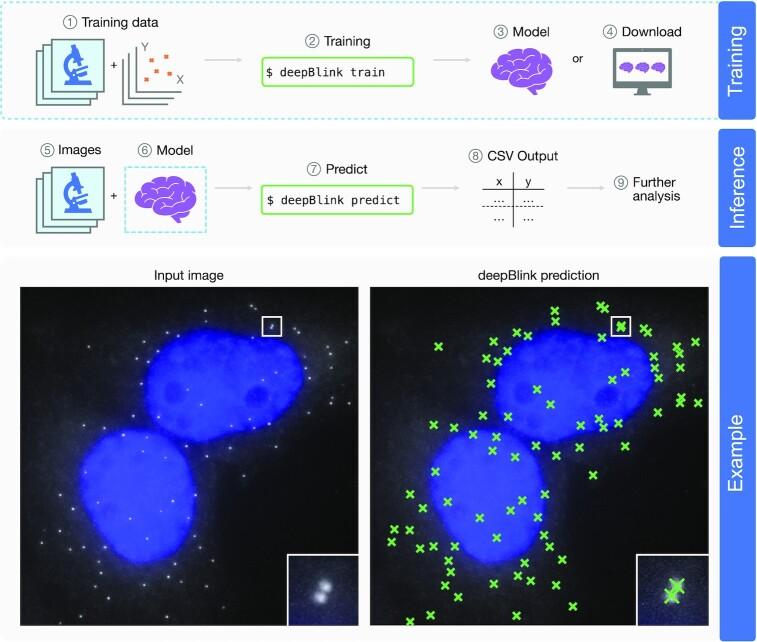
Detection of diffraction-limited spots in single-molecule microscopy images is traditionally performed with mathematical operators designed for idealized spots. This process requires manual tuning of parameters that is time-consuming and not always reliable. We have developed deepBlink, a neural network-based method to detect and localize spots automatically. We demonstrate that deepBlink outperforms other state-of-the-art methods across six publicly available datasets containing synthetic and experimental data.
传统上,在单分子显微镜图像中检测衍射极限斑点是使用专为理想斑点设计的数学算子来完成的。这个过程需要手动调整参数,既耗时又不可靠。我们开发了 deepBlink,这是一种基于神经网络的方法,可以自动检测和定位斑点。我们证明 deepBlink 在六个公开可用的数据集(包含合成数据和实验数据)上的性能优于其他最先进的方法。
 Zotero 插件