
生活方式干预对2型糖尿病病理生理及缓解的影响:史蒂文斯霍夫试点研究
The Effect of a Lifestyle Intervention on Type 2 Diabetes Pathophysiology and Remission: The Stevenshof Pilot Study.
作者信息
de Hoogh Iris M, Oosterman Johanneke E, Otten Wilma, Krijger Anne-Margreeth, Berbée-Zadelaar Susanne, Pasman Wilrike J, van Ommen Ben, Pijl Hanno, Wopereis Suzan
机构信息
Research Group Microbiology & Systems Biology, TNO, Netherlands Organization for Applied Scientific Research, 3700 AJ Zeist, The Netherlands.
Research Group Child Health, TNO, Netherlands Organization for Applied Scientific Research, 2301 DA Leiden, The Netherlands.
出版信息
Nutrients. 2021 Jun 25;13(7):2193. doi: 10.3390/nu13072193.
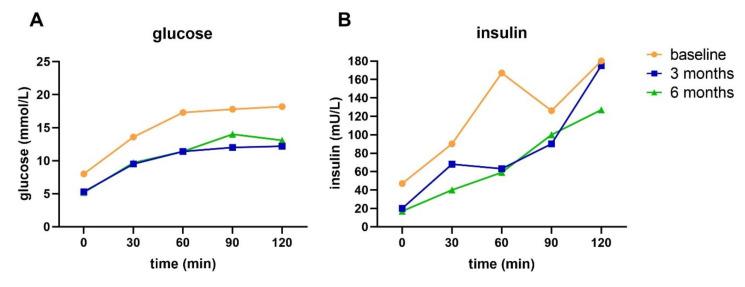
Although lifestyle interventions can lead to diabetes remission, it is unclear to what extent type 2 diabetes (T2D) remission alters or improves the underlying pathophysiology of the disease. Here, we assess the effects of a lifestyle intervention on T2D reversal or remission and the effects on the underlying pathology. In a Dutch primary care setting, 15 adults with an average T2D duration of 13.4 years who were (pharmacologically) treated for T2D received a diabetes subtyping ("diabetyping") lifestyle intervention (DLI) for six months, aiming for T2D remission. T2D subtype was determined based on an OGTT. Insulin and sulphonylurea (SU) derivative treatment could be terminated for all participants. Body weight, waist/hip ratio, triglyceride levels, HbA1c, fasting, and 2h glucose were significantly improved after three and six months of intervention. Remission and reversal were achieved in two and three participants, respectively. Indices of insulin resistance and beta cell capacity improved, but never reached healthy values, resulting in unchanged T2D subtypes. Our study implies that achieving diabetes remission in individuals with a longer T2D duration is possible, but underlying pathology is only minimally affected, possibly due to an impaired beta cell function. Thus, even when T2D remission is achieved, patients need to continue adhering to lifestyle therapy.
尽管生活方式干预可导致糖尿病缓解,但尚不清楚2型糖尿病(T2D)缓解在多大程度上改变或改善了该疾病的潜在病理生理学。在此,我们评估生活方式干预对T2D逆转或缓解的影响以及对潜在病理的影响。在荷兰的初级保健环境中,15名平均T2D病程为13.4年且正在接受(药物)治疗的T2D成人接受了为期六个月的糖尿病分型(“糖尿病分型”)生活方式干预(DLI),目标是实现T2D缓解。T2D亚型根据口服葡萄糖耐量试验(OGTT)确定。所有参与者均可终止胰岛素和磺脲类(SU)衍生物治疗。干预三个月和六个月后,体重、腰臀比、甘油三酯水平、糖化血红蛋白(HbA1c)、空腹血糖和2小时血糖均有显著改善。分别有两名和三名参与者实现了缓解和逆转。胰岛素抵抗和β细胞功能指标有所改善,但从未达到健康值,导致T2D亚型未发生变化。我们的研究表明,病程较长的T2D患者实现糖尿病缓解是可能的,但潜在病理仅受到轻微影响,这可能是由于β细胞功能受损所致。因此,即使实现了T2D缓解,患者仍需继续坚持生活方式治疗。



 Zotero 插件