
RIG-I 样受体介导的严重急性呼吸综合征冠状病毒 2 病毒基因组 RNA 的识别及病毒逃避宿主固有免疫反应。
RIG-I-Like Receptor-Mediated Recognition of Viral Genomic RNA of Severe Acute Respiratory Syndrome Coronavirus-2 and Viral Escape From the Host Innate Immune Responses.
机构信息
Department of Immunology, Graduate School of Medical Sciences, Faculty of Life Sciences, Kumamoto University, Kumamoto, Japan.
出版信息
Front Immunol. 2021 Jun 25;12:700926. doi: 10.3389/fimmu.2021.700926. eCollection 2021.
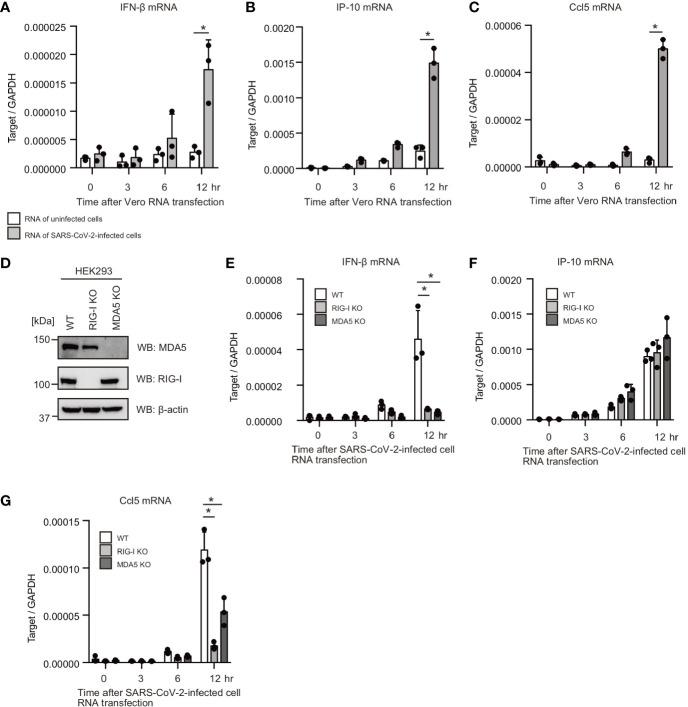
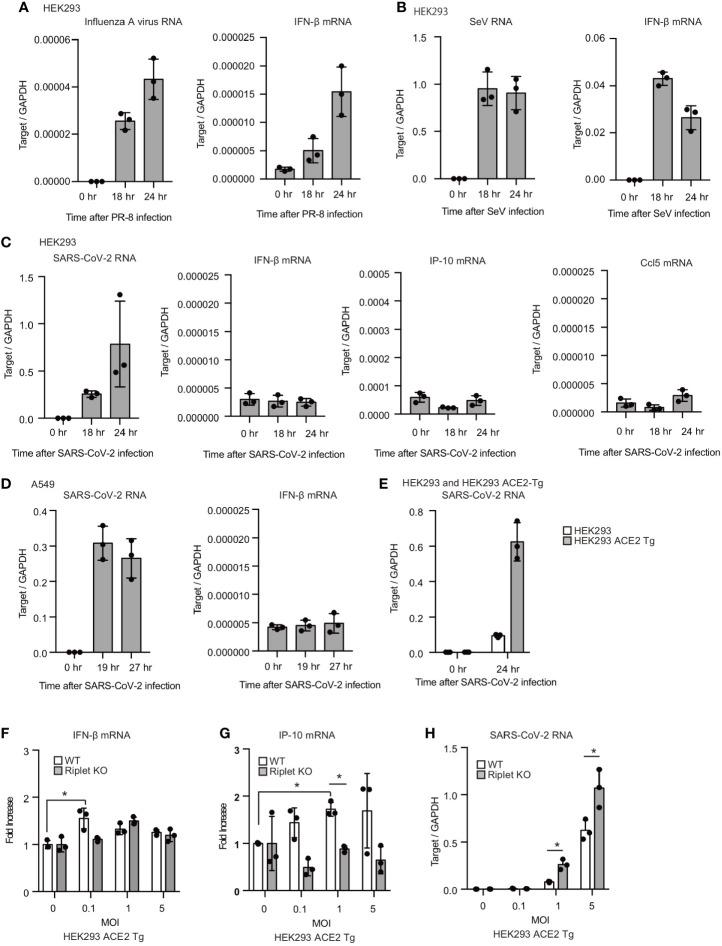
RIG-I-like receptors (RLR), RIG-I and MDA5, are cytoplasmic viral RNA sensors that recognize viral double-stranded RNAs and trigger signals to induce antiviral responses, including type I interferon production. Severe acute respiratory syndrome coronavirus-2 (SARS-CoV-2) caused the coronavirus disease 2019 pandemic. However, the RLR role in innate immune response to SARS-CoV-2 has not been fully elucidated. Here, we studied the roles of RLR in cytokine expression responding to SARS-CoV-2 and found that not only MDA5 but also RIG-I are involved in innate immune responses in some types of human cells. Transfection of total RNAs extracted from SARS-CoV-2-infected cells into epithelial cells induced IFN-β, IP-10, and Ccl5 mRNA expression. The cytokine expression was reduced by knockout of either RIG-I or MDA5, suggesting that both proteins are required for appropriate innate immune response to SARS-CoV-2. Two viral genomic RNA regions strongly induced type I IFN expression, and a 200-base fragment of viral RNA preferentially induced type I IFN in a RIG-I-dependent manner. In contrast, SARS-CoV-2 infectious particles hardly induced cytokine expression, suggesting viral escape from the host response. Viral 9b protein inhibited RIG-I and MAVS interaction, and viral 7a protein destabilized the TBK1 protein, leading to attenuated IRF-3 phosphorylation required for type I IFN expression. Our data elucidated the mechanism underlying RLR-mediated response to SARS-CoV-2 infection and viral escape from the host innate immune response.
RIG-I 样受体(RLR)、RIG-I 和 MDA5 是细胞质中的病毒 RNA 传感器,可识别病毒双链 RNA,并引发信号诱导抗病毒反应,包括产生 I 型干扰素。严重急性呼吸综合征冠状病毒 2(SARS-CoV-2)引发了 2019 年冠状病毒病大流行。然而,RLR 在先天免疫应对 SARS-CoV-2 中的作用尚未完全阐明。在这里,我们研究了 RLR 在应对 SARS-CoV-2 时细胞因子表达中的作用,发现不仅 MDA5,而且 RIG-I 也参与了某些类型人类细胞的先天免疫反应。将 SARS-CoV-2 感染细胞中提取的总 RNA 转染到上皮细胞中,诱导 IFN-β、IP-10 和 Ccl5 mRNA 的表达。敲除 RIG-I 或 MDA5 均可降低细胞因子的表达,这表明这两种蛋白均参与 SARS-CoV-2 的适当先天免疫反应。两个病毒基因组 RNA 区域强烈诱导 I 型 IFN 表达,而病毒 RNA 的 200 个碱基片段优先以 RIG-I 依赖的方式诱导 I 型 IFN。相比之下,SARS-CoV-2 感染性颗粒几乎不能诱导细胞因子表达,表明病毒逃避了宿主反应。病毒 9b 蛋白抑制 RIG-I 和 MAVS 的相互作用,病毒 7a 蛋白使 TBK1 蛋白不稳定,导致 I 型 IFN 表达所需的 IRF-3 磷酸化减弱。我们的数据阐明了 RLR 介导的 SARS-CoV-2 感染反应和病毒逃避宿主先天免疫反应的机制。




 Zotero 插件