
Ⅰ型和Ⅲ型胶原的周转率可预测特发性肺纤维化的进展。
Turnover of type I and III collagen predicts progression of idiopathic pulmonary fibrosis.
机构信息
Biomarkers and Research, Nordic Bioscience, Herlev, Denmark.
Department of Respiratory Medicine, Herlev and Gentofte University Hospital, Copenhagen, Denmark.
出版信息
Respir Res. 2021 Jul 15;22(1):205. doi: 10.1186/s12931-021-01801-0.
BACKGROUND
Idiopathic pulmonary fibrosis (IPF) is characterized by the accumulation of fibrillar collagens in the alveolar space resulting in reduced pulmonary function and a high mortality rate. Biomarkers measuring the turnover of type I and III collagen could provide valuable information for prognosis and treatment decisions in IPF.
METHODS
Serological biomarkers reflecting the formation of type III collagen (PRO-C3) and degradation of type I (C1M) and III collagen (C3M) were evaluated in a real-world cohort of 178 newly diagnosed IPF patients. Blood samples and clinical data were collected at baseline, six, and 12 months. Baseline and longitudinal biomarker levels were related to disease progression of IPF (defined as ≥ 5% decline in forced vital capacity (FVC) and/or ≥ 10% decline in diffusing capacity for carbon monoxide (DLco) and/or all-cause mortality at 12 months). Furthermore, we analysed differences in percentage change of biomarker levels from baseline between patients receiving antifibrotic treatment or not.
RESULTS
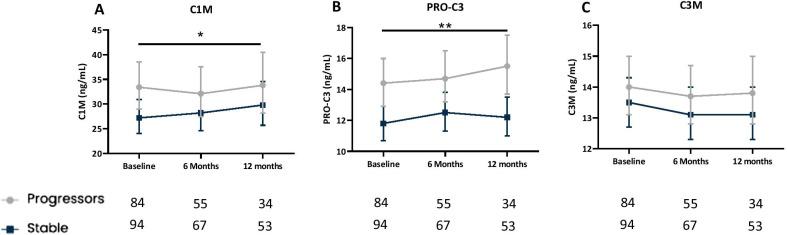
Increased baseline levels of type I and III collagen turnover biomarkers were associated with a greater risk of disease progression within 12 months compared to patients with a low baseline type I and III collagen turnover. Patients with progressive disease had higher serum levels of C1M (P = 0.038) and PRO-C3 (P = 0.0022) compared to those with stable disease over one year. There were no differences in biomarker levels between patients receiving pirfenidone, nintedanib, or no antifibrotics.
CONCLUSION
Baseline levels of type I and III collagen turnover were associated with disease progression within 12 months in a real-world cohort of IPF patients. Longitudinal biomarker levels of type I and III collagen turnover were related to progressive disease. Moreover, antifibrotic therapy did not affect type I and III collagen turnover biomarkers in these patients. PRO-C3 and C1M may be potential biomarkers for a progressive disease behavior in IPF.
背景
特发性肺纤维化(IPF)的特征是肺泡空间中纤维胶原的积累,导致肺功能下降和高死亡率。测量 I 型和 III 型胶原周转率的生物标志物可为 IPF 的预后和治疗决策提供有价值的信息。
方法
在一个由 178 例新诊断的 IPF 患者组成的真实队列中,评估了反映 III 型胶原形成(PRO-C3)和 I 型(C1M)和 III 型胶原(C3M)降解的血清生物标志物。在基线、6 个月和 12 个月采集血液样本和临床数据。基线和纵向生物标志物水平与 IPF 的疾病进展相关(定义为 12 个月时用力肺活量(FVC)下降≥5%和/或一氧化碳弥散量(DLco)下降≥10%和/或全因死亡率)。此外,我们分析了接受或不接受抗纤维化治疗的患者之间从基线开始的生物标志物水平变化百分比的差异。
结果
与基线 I 型和 III 型胶原周转率低的患者相比,基线时 I 型和 III 型胶原周转率标志物水平升高与 12 个月内疾病进展的风险更大相关。与一年后稳定疾病的患者相比,进行性疾病患者的血清 C1M(P=0.038)和 PRO-C3(P=0.0022)水平更高。接受吡非尼酮、尼达尼布或无抗纤维化治疗的患者之间的生物标志物水平没有差异。
结论
在 IPF 患者的真实队列中,基线 I 型和 III 型胶原周转率与 12 个月内的疾病进展相关。I 型和 III 型胶原周转率的纵向生物标志物水平与进行性疾病相关。此外,抗纤维化治疗并未影响这些患者的 I 型和 III 型胶原周转率生物标志物。PRO-C3 和 C1M 可能是 IPF 进行性疾病行为的潜在生物标志物。


 Zotero 插件