
Siglec-6 是急性髓系白血病嵌合抗原受体 T 细胞治疗的新靶点。
Siglec-6 is a novel target for CAR T-cell therapy in acute myeloid leukemia.
机构信息
Medizinische Klinik und Poliklinik II, Universitätsklinikum Würzburg, Würzburg, Germany.
Servicio de Hematología, Hospital Universitario de Salamanca-Instituto de Investigación Biomédica de Salamanca, Centro de Investigación Biomédica en Red de Cáncer (CB16/12/00233), Centro de Investigación del Cáncer-Instituto de Biología Molecular y Celular del Cáncer, Universidad de Salamanca-Consejo Superior de Investigaciones Científicas, Salamanca, Spain.
出版信息
Blood. 2021 Nov 11;138(19):1830-1842. doi: 10.1182/blood.2020009192.
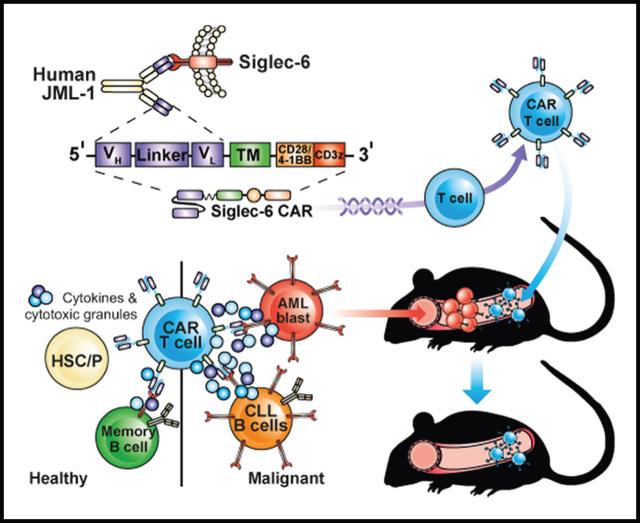
Acute myeloid leukemia (AML) is an attractive entity for the development of chimeric antigen receptor (CAR) T-cell immunotherapy because AML blasts are susceptible to T-cell-mediated elimination. Here, we introduce sialic acid-binding immunoglobulin-like lectin 6 (Siglec-6) as a novel target for CAR T cells in AML. We designed a Siglec-6-specific CAR with a targeting domain derived from the human monoclonal antibody JML-1. We found that Siglec-6 is commonly expressed on AML cell lines and primary AML blasts, including the subpopulation of AML stem cells. Treatment with Siglec-6 CAR T cells confers specific antileukemia reactivity that correlates with Siglec-6 expression in preclinical models, including induction of complete remission in a xenograft AML model in immunodeficient mice (NSG/U937). In addition, we confirmed Siglec-6 expression on transformed B cells in chronic lymphocytic leukemia (CLL), and specific anti-CLL reactivity of Siglec-6 CAR T cells in vitro. Of particular interest, we found that Siglec-6 is not detectable on normal hematopoietic stem and progenitor cells (HSPCs) and that treatment with Siglec-6 CAR T cells does not affect their viability and lineage differentiation in colony-formation assays. These data suggest that Siglec-6 CAR T-cell therapy may be used to effectively treat AML without the need for subsequent allogeneic hematopoietic stem cell transplantation. In mature normal hematopoietic cells, we detected Siglec-6 in a proportion of memory (and naïve) B cells and basophilic granulocytes, suggesting the potential for limited on-target/off-tumor reactivity. The lack of expression of Siglec-6 on normal HSPCs is a key to differentiating it from other Siglec family members (eg, Siglec-3 [CD33]) and other CAR target antigens (eg, CD123) that are under investigation in AML, and it warrants the clinical investigation of Siglec-6 CAR T-cell therapy.
急性髓细胞白血病(AML)是嵌合抗原受体(CAR)T 细胞免疫疗法的一个有吸引力的实体,因为 AML blasts 易受 T 细胞介导的消除。在这里,我们将唾液酸结合免疫球蛋白样凝集素 6(Siglec-6)介绍为 AML 中 CAR T 细胞的新型靶标。我们设计了一种 Siglec-6 特异性 CAR,其靶向结构域源自人源单克隆抗体 JML-1。我们发现 Siglec-6 通常在 AML 细胞系和原发性 AML blasts 上表达,包括 AML 干细胞的亚群。Siglec-6 CAR T 细胞的治疗赋予了特异性抗白血病反应,与临床前模型中的 Siglec-6 表达相关,包括在免疫缺陷小鼠(NSG/U937)异种 AML 模型中诱导完全缓解。此外,我们在慢性淋巴细胞白血病(CLL)中证实了转化 B 细胞上的 Siglec-6 表达,以及 Siglec-6 CAR T 细胞在体外对 CLL 的特异性反应。特别有趣的是,我们发现 Siglec-6 不可检测到正常造血干细胞和祖细胞(HSPCs)上,并且 Siglec-6 CAR T 细胞的治疗不会影响它们在集落形成测定中的活力和谱系分化。这些数据表明,Siglec-6 CAR T 细胞疗法可有效治疗 AML,而无需随后进行同种异体造血干细胞移植。在成熟的正常造血细胞中,我们在一部分记忆(和幼稚)B 细胞和嗜碱性粒细胞中检测到 Siglec-6,这表明存在有限的靶标/脱靶反应的可能性。Siglec-6 在正常 HSPCs 上的表达缺失是将其与其他 Siglec 家族成员(例如 Siglec-3[CD33])和其他正在 AML 中研究的 CAR 靶标抗原(例如 CD123)区分开来的关键,这值得 Siglec-6 CAR T 细胞疗法的临床研究。
 Zotero 插件