
精氨酸信号传导与癌症代谢
Arginine Signaling and Cancer Metabolism.
作者信息
Chen Chia-Lin, Hsu Sheng-Chieh, Ann David K, Yen Yun, Kung Hsing-Jien
机构信息
Institute of Molecular and Genomic Medicine, National Health Research Institutes, Zhunan 350, Miaoli County, Taiwan.
Institute of Biotechnology, National Tsing-Hua University, Hsinchu 30035, Taiwan.
出版信息
Cancers (Basel). 2021 Jul 15;13(14):3541. doi: 10.3390/cancers13143541.
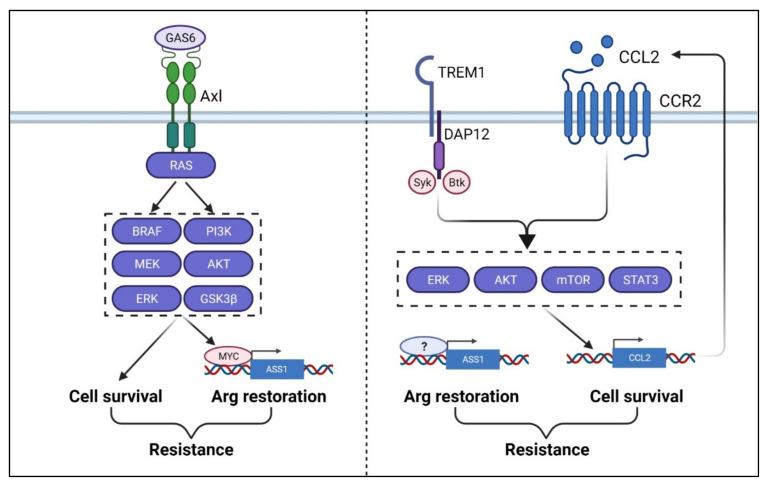
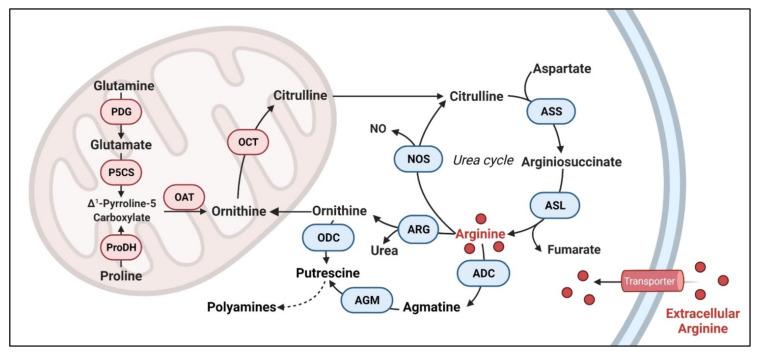
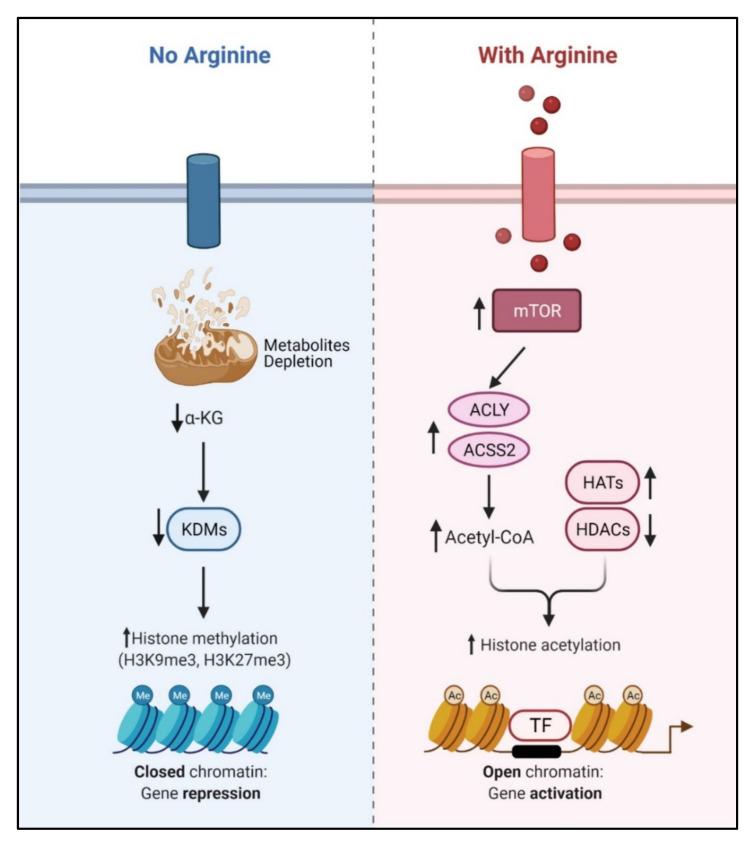
Arginine is an amino acid critically involved in multiple cellular processes including the syntheses of nitric oxide and polyamines, and is a direct activator of mTOR, a nutrient-sensing kinase strongly implicated in carcinogenesis. Yet, it is also considered as a non- or semi-essential amino acid, due to normal cells' intrinsic ability to synthesize arginine from citrulline and aspartate via ASS1 (argininosuccinate synthase 1) and ASL (argininosuccinate lyase). As such, arginine can be used as a dietary supplement and its depletion as a therapeutic strategy. Strikingly, in over 70% of tumors, ASS1 transcription is suppressed, rendering the cells addicted to external arginine, forming the basis of arginine-deprivation therapy. In this review, we will discuss arginine as a signaling metabolite, arginine's role in cancer metabolism, arginine as an epigenetic regulator, arginine as an immunomodulator, and arginine as a therapeutic target. We will also provide a comprehensive summary of ADI (arginine deiminase)-based arginine-deprivation preclinical studies and an update of clinical trials for ADI and arginase. The different cell killing mechanisms associated with various cancer types will also be described.
精氨酸是一种氨基酸,在包括一氧化氮和多胺合成在内的多个细胞过程中起着关键作用,并且是mTOR的直接激活剂,mTOR是一种与致癌作用密切相关的营养感应激酶。然而,由于正常细胞具有通过ASS1(精氨琥珀酸合成酶1)和ASL(精氨琥珀酸裂解酶)从瓜氨酸和天冬氨酸合成精氨酸的内在能力,它也被视为非必需或半必需氨基酸。因此,精氨酸可用作膳食补充剂,其消耗可作为一种治疗策略。引人注目的是,在超过70%的肿瘤中,ASS1转录受到抑制,使细胞对外部精氨酸产生依赖,这构成了精氨酸剥夺疗法的基础。在这篇综述中,我们将讨论精氨酸作为一种信号代谢物、精氨酸在癌症代谢中的作用、精氨酸作为一种表观遗传调节剂、精氨酸作为一种免疫调节剂以及精氨酸作为一种治疗靶点。我们还将全面总结基于精氨酸脱亚氨酶(ADI)的精氨酸剥夺临床前研究,并更新ADI和精氨酸酶的临床试验情况。还将描述与各种癌症类型相关的不同细胞杀伤机制。



 Zotero 插件