
德国医护人员对新冠疫苗的接受度与犹豫情况
COVID-19 Vaccination Acceptance and Hesitancy among Healthcare Workers in Germany.
作者信息
Holzmann-Littig Christopher, Braunisch Matthias Christoph, Kranke Peter, Popp Maria, Seeber Christian, Fichtner Falk, Littig Bianca, Carbajo-Lozoya Javier, Allwang Christine, Frank Tamara, Meerpohl Joerg Johannes, Haller Bernhard, Schmaderer Christoph
机构信息
Department of Nephrology, School of Medicine, Technical University of Munich, Klinikum Rechts der Isar, 81675 Munich, Germany.
TUM Medical Education Center, School of Medicine, Technical University of Munich, 81675 Munich, Germany.
出版信息
Vaccines (Basel). 2021 Jul 12;9(7):777. doi: 10.3390/vaccines9070777.
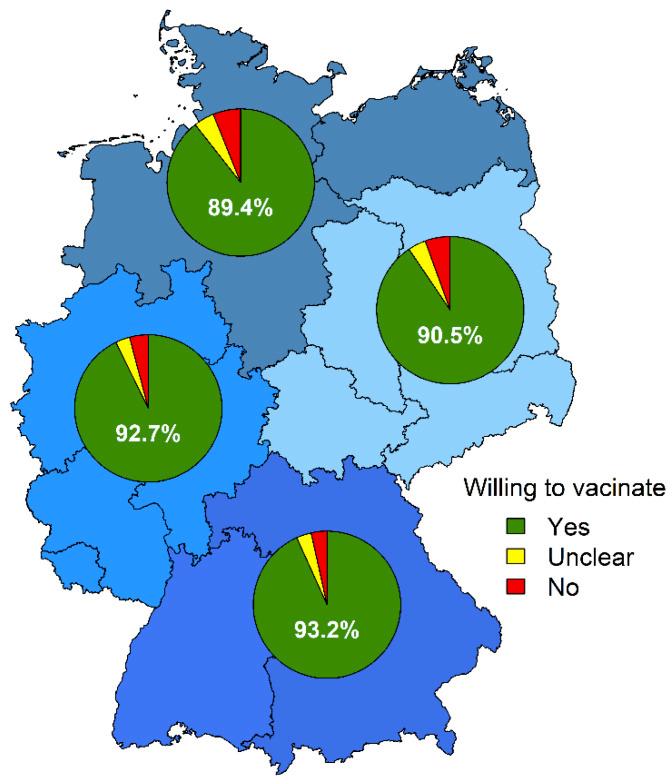
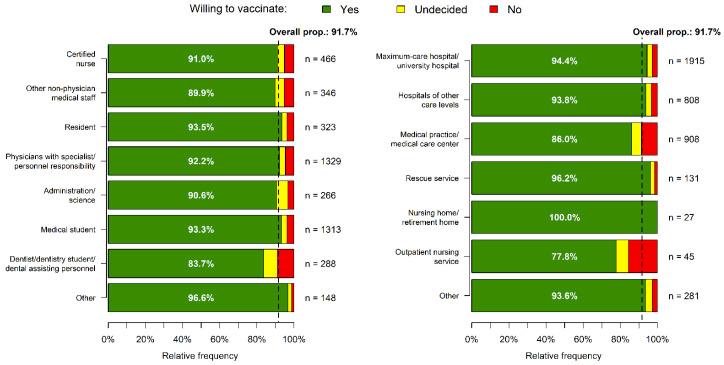
Vaccination hesitancy is a threat to herd immunity. Healthcare workers (HCWs) play a key role in promoting Coronavirus disease 2019 (COVID-19) vaccination in the general population. We therefore aimed to provide data on COVID-19 vaccination acceptance/hesitancy among German HCWs. For this exploratory, cross-sectional study, an online survey was conducted in February 2021. The survey included 54 items on demographics; previous vaccination behavior; trust in vaccines, physicians, the pharmaceutical industry and health politics; fear of adverse effects; assumptions regarding the consequences of COVID-19; knowledge about vaccines; and information seeking behavior. Odds ratios with 95% confidence intervals were calculated and chi-square tests were performed. Four thousand five hundred surveys were analyzed. The overall vaccination acceptance was 91.7%. The age group ≤20 years showed the lowest vaccination acceptance. Factors associated with vaccination hesitancy were lack of trust in authorities and pharmaceutical companies. Attitudes among acquaintances were associated with vaccination hesitancy too. Participants with vaccination hesitancy more often obtained information about COVID-19 vaccines via messenger services or online video platforms and underperformed in the knowledge test. We found high acceptance amongst German HCWs. Several factors associated with vaccination hesitancy were identified which could be targeted in HCW vaccination campaigns.
疫苗接种犹豫对群体免疫构成威胁。医护人员在促进普通人群接种2019冠状病毒病(COVID-19)疫苗方面发挥着关键作用。因此,我们旨在提供有关德国医护人员对COVID-19疫苗接种接受度/犹豫情况的数据。对于这项探索性横断面研究,于2021年2月进行了一项在线调查。该调查包括54项关于人口统计学、既往疫苗接种行为、对疫苗、医生、制药行业和卫生政策的信任、对不良反应的恐惧、对COVID-19后果的假设、对疫苗的了解以及信息寻求行为的问题。计算了具有95%置信区间的比值比并进行了卡方检验。对4500份调查问卷进行了分析。总体疫苗接种接受率为91.7%。年龄≤20岁的年龄组疫苗接种接受率最低。与疫苗接种犹豫相关的因素是对当局和制药公司缺乏信任。熟人的态度也与疫苗接种犹豫有关。有疫苗接种犹豫的参与者更多地通过即时通讯服务或在线视频平台获取有关COVID-19疫苗的信息,并且在知识测试中表现较差。我们发现德国医护人员的接受度较高。确定了几个与疫苗接种犹豫相关的因素,这些因素可作为医护人员疫苗接种活动的目标。




 Zotero 插件