
嵌合抗原受体T细胞(CAR T)在临床试验中与治疗相关的不良事件:一项系统评价和荟萃分析
Treatment-Related Adverse Events of Chimeric Antigen Receptor T-Cell (CAR T) in Clinical Trials: A Systematic Review and Meta-Analysis.
作者信息
Lei Wen, Xie Mixue, Jiang Qi, Xu Nengwen, Li Ping, Liang Aibin, Young Ken H, Qian Wenbin
机构信息
Department of Hematology, The Second Affiliated Hospital, College of Medicine, Zhejiang University, Hangzhou 310009, China.
Department of Haematology, The First Affiliated Hospital, College of Medicine, Zhejiang University, Hangzhou 310003, China.
出版信息
Cancers (Basel). 2021 Aug 3;13(15):3912. doi: 10.3390/cancers13153912.
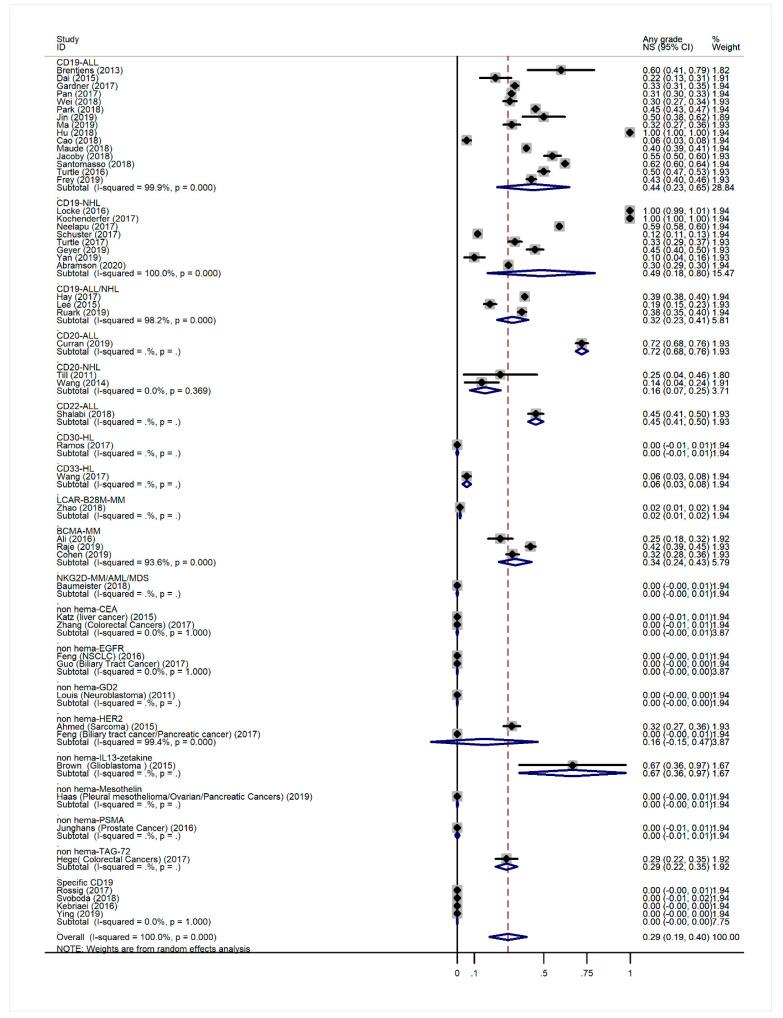
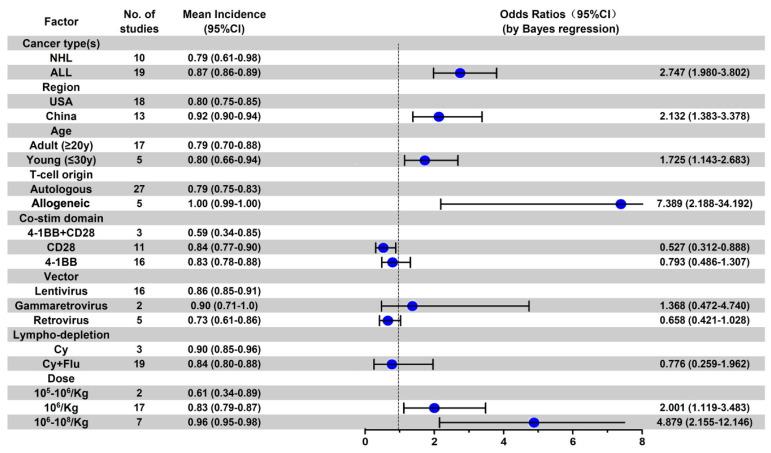
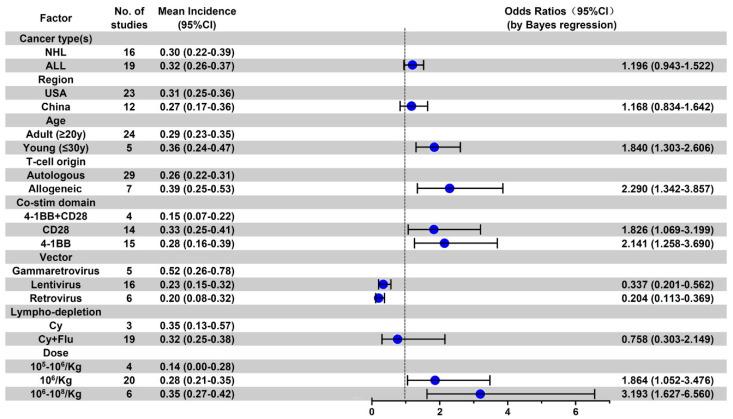
Chimeric antigen receptors T (CAR-T) cell therapy of cancer is a rapidly evolving field. It has been shown to be remarkably effective in cases of hematological malignancies, and its approval by the FDA has significantly increased the enthusiasm for wide clinical usage and development of novel CAR-T therapies. However, it has also challenged physicians and investigators to recognize and deal with treatment-associated toxicities. A total of 2592 patients were included from 84 eligible studies that were systematically searched and reviewed from the databases of PubMed, de, the American Society of Hematology and the Cochrane Library. The meta-analysis and subgroup analysis by a Bayesian logistic regression model were used to evaluate the incidences of therapy-related toxicities such as cytokine release syndrome (CRS) and neurological symptoms (NS), and the differences between different targets and cancer types were analyzed. The pooled all-grade CRS rate and grade ≥ 3 CRS rate was 77% and 29%, respectively, with a significantly higher incidence in the hematologic malignancies (all-grade: 81%; grade ≥ 3: 29%) than in solid tumors (all-grade: 37%; grade ≥ 3: 19%). The pooled estimate NS rate from the individual studies were 40% for all-grade and 28% for grade ≥ 3. It was also higher in the hematologic subgroup than in the solid tumors group. The subgroup analysis by cancer type showed that higher incidences of grade ≥ 3 CRS were observed in anti-CD19 CAR-T therapy for ALL and NHL, anti-BCMA CAR-T for MM, and anti-CEA CAR-T for solid tumors, which were between 24-36%, while higher incidences of grade ≥ 3 NS were mainly observed in CD19-ALL/NHL (23-37%) and BCMA-MM (12%). Importantly, subgroup analysis on anti-CD19 CAR-T studies showed that young patients (vs. adult patients), allologous T cell origin (vs. autologous origin), gamma retrovirus vector, and higher doses of CAR-T cells were associated with high-grade CRS. On the other hand, the patients with NHL (vs ALL), administered with higher dose of CAR-T, and adult patients (vs. young patients) had an increased incidence of grade ≥ 3 NS events. This study offers a comprehensive summary of treatment-related toxicity and will guide future clinical trials and therapeutic designs investigating CAR T cell therapy.
嵌合抗原受体T(CAR-T)细胞癌症治疗是一个快速发展的领域。已证明其在血液系统恶性肿瘤病例中非常有效,并且美国食品药品监督管理局(FDA)对其的批准显著提高了人们对广泛临床应用和新型CAR-T疗法开发的热情。然而,它也给医生和研究人员带来了挑战,要求他们识别和处理与治疗相关的毒性。从PubMed、de、美国血液学会和考克兰图书馆的数据库中系统检索并审查了84项符合条件的研究,共纳入2592例患者。采用贝叶斯逻辑回归模型进行荟萃分析和亚组分析,以评估细胞因子释放综合征(CRS)和神经症状(NS)等治疗相关毒性的发生率,并分析不同靶点和癌症类型之间的差异。汇总的所有级别CRS发生率和≥3级CRS发生率分别为77%和29%,血液系统恶性肿瘤中的发生率(所有级别:81%;≥3级:29%)显著高于实体瘤(所有级别:37%;≥3级:19%)。各研究汇总估计的所有级别NS发生率为40%,≥3级为28%。血液学亚组中的发生率也高于实体瘤组。按癌症类型进行的亚组分析表明',在针对急性淋巴细胞白血病(ALL)和非霍奇金淋巴瘤(NHL)的抗CD19 CAR-T治疗、针对多发性骨髓瘤(MM)的抗B细胞成熟抗原(BCMA)CAR-T治疗以及针对实体瘤的抗癌胚抗原(CEA)CAR-T治疗中,观察到≥3级CRS的发生率较高,在24%-36%之间,而≥3级NS的较高发生率主要在CD19-ALL/NHL(23%-37%)和BCMA-MM(12%)中观察到。重要的是,对抗CD19 CAR-T研究的亚组分析表明,年轻患者(与成年患者相比)、异基因T细胞来源(与自体来源相比)、γ逆转录病毒载体以及更高剂量的CAR-T细胞与高级别CRS相关。另一方面,接受更高剂量CAR-T治疗的NHL患者(与ALL患者相比)以及成年患者(与年轻患者相比)≥3级NS事件的发生率增加。本研究全面总结了治疗相关毒性,并将指导未来研究CAR-T细胞治疗的临床试验和治疗设计。





 Zotero 插件