
糖尿病与心血管疾病:与热量限制相关的营养干预。
Diabetes Mellitus and Cardiovascular Diseases: Nutraceutical Interventions Related to Caloric Restriction.
机构信息
Department of Biomedical Sciences for Health, Università degli Studi di Milano, 20131 Milan, Italy.
Department of Endocrinology, Nutrition and Metabolic Diseases, IRCCS MultiMedica, Sesto San Giovanni, 20099 Milan, Italy.
出版信息
Int J Mol Sci. 2021 Jul 21;22(15):7772. doi: 10.3390/ijms22157772.
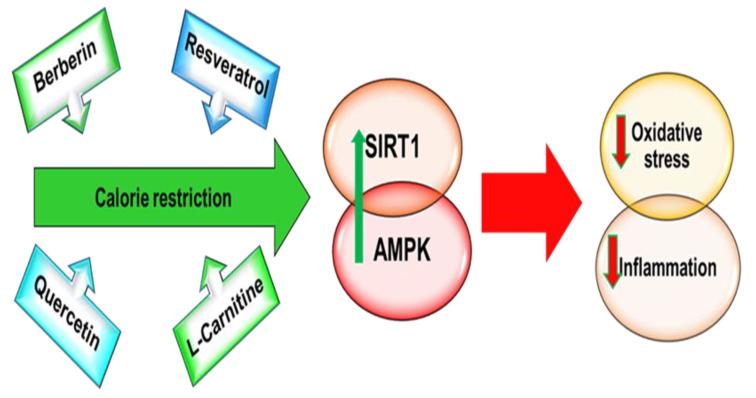
Type 2 diabetes (T2DM) and cardiovascular disease (CVD) are closely associated and represent a key public health problem worldwide. An excess of adipose tissue, NAFLD, and gut dysbiosis establish a vicious circle that leads to chronic inflammation and oxidative stress. Caloric restriction (CR) is the most promising nutritional approach capable of improving cardiometabolic health. However, adherence to CR represents a barrier to patients and is the primary cause of therapeutic failure. To overcome this problem, many different nutraceutical strategies have been designed. Based on several data that have shown that CR action is mediated by AMPK/SIRT1 activation, several nutraceutical compounds capable of activating AMPK/SIRT1 signaling have been identified. In this review, we summarize recent data on the possible role of berberine, resveratrol, quercetin, and L-carnitine as CR-related nutrients. Additionally, we discuss the limitations related to the use of these nutrients in the management of T2DM and CVD.
2 型糖尿病(T2DM)和心血管疾病(CVD)密切相关,是全球范围内的一个主要公共卫生问题。脂肪组织过多、非酒精性脂肪性肝病和肠道菌群失调构成了一个恶性循环,导致慢性炎症和氧化应激。热量限制(CR)是最有前途的营养干预措施,能够改善心脏代谢健康。然而,CR 的实施对患者来说是一个障碍,也是治疗失败的主要原因。为了克服这个问题,已经设计了许多不同的营养策略。有几项研究表明,CR 的作用是通过 AMPK/SIRT1 的激活介导的,因此已经确定了几种能够激活 AMPK/SIRT1 信号通路的营养化合物。在这篇综述中,我们总结了最近关于小檗碱、白藜芦醇、槲皮素和左旋肉碱作为与 CR 相关的营养物质的可能作用的研究数据。此外,我们还讨论了在 T2DM 和 CVD 管理中使用这些营养物质的局限性。


 Zotero 插件