
病毒质:轮状病毒复制工厂的组装和功能。
Viroplasms: Assembly and Functions of Rotavirus Replication Factories.
机构信息
MRC Laboratory of Molecular Biology, Cambridge Biomedical Campus, Cambridge CB2 0QH, UK.
Department of Biochemistry, University of Cambridge, Cambridge CB2 1QW, UK.
出版信息
Viruses. 2021 Jul 12;13(7):1349. doi: 10.3390/v13071349.
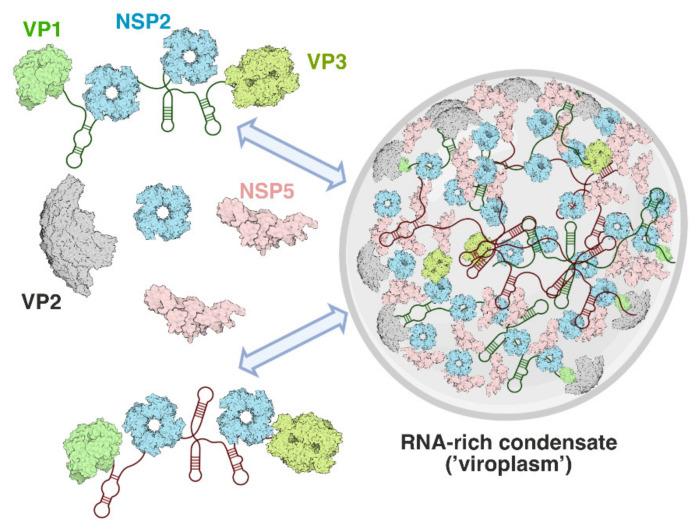
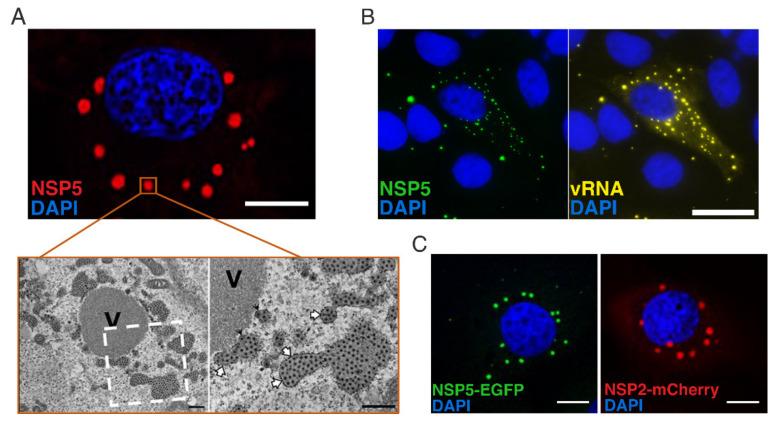
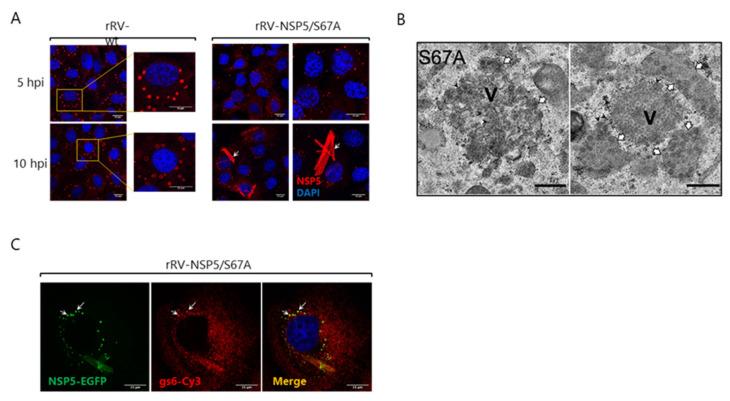
Viroplasms are cytoplasmic, membraneless structures assembled in rotavirus (RV)-infected cells, which are intricately involved in viral replication. Two virus-encoded, non-structural proteins, NSP2 and NSP5, are the main drivers of viroplasm formation. The structures (as far as is known) and functions of these proteins are described. Recent studies using plasmid-only-based reverse genetics have significantly contributed to elucidation of the crucial roles of these proteins in RV replication. Thus, it has been recognized that viroplasms resemble liquid-like protein-RNA condensates that may be formed via liquid-liquid phase separation (LLPS) of NSP2 and NSP5 at the early stages of infection. Interactions between the RNA chaperone NSP2 and the multivalent, intrinsically disordered protein NSP5 result in their condensation (protein droplet formation), which plays a central role in viroplasm assembly. These droplets may provide a unique molecular environment for the establishment of inter-molecular contacts between the RV (+)ssRNA transcripts, followed by their assortment and equimolar packaging. Future efforts to improve our understanding of RV replication and genome assortment in viroplasms should focus on their complex molecular composition, which changes dynamically throughout the RV replication cycle, to support distinct stages of virion assembly.
病毒包涵体是在轮状病毒(RV)感染的细胞中组装的细胞质无膜结构,它们在病毒复制中起着复杂的作用。两种病毒编码的非结构蛋白 NSP2 和 NSP5 是形成病毒包涵体的主要驱动因素。本文描述了这些蛋白的结构(据了解)和功能。最近使用仅质粒的反向遗传学研究极大地促进了阐明这些蛋白在 RV 复制中的关键作用。因此,人们已经认识到病毒包涵体类似于液体状的蛋白-RNA 凝聚物,可能是通过 NSP2 和 NSP5 在感染的早期阶段通过液-液相分离(LLPS)形成的。RNA 分子伴侣 NSP2 与多价、固有无序蛋白 NSP5 之间的相互作用导致它们的凝聚(蛋白液滴形成),这在病毒包涵体组装中起着核心作用。这些液滴可能为 RV (+)ssRNA 转录物之间建立分子间接触提供独特的分子环境,随后进行分类和等摩尔包装。未来的研究应集中在病毒包涵体的 RV 复制和基因组分类的复杂分子组成上,这在 RV 复制周期中动态变化,以支持病毒粒子组装的不同阶段。

 Zotero 插件