
将聚对苯二甲酸乙二酯电催化升级循环为商品化学品和氢燃料。
Electrocatalytic upcycling of polyethylene terephthalate to commodity chemicals and H fuel.
作者信息
Zhou Hua, Ren Yue, Li Zhenhua, Xu Ming, Wang Ye, Ge Ruixiang, Kong Xianggui, Zheng Lirong, Duan Haohong
机构信息
Department of Chemistry, Tsinghua University, Beijing, China.
State Key Laboratory of Chemical Resource Engineering, College of Chemistry, Beijing University of Chemical Technology, Beijing, China.
出版信息
Nat Commun. 2021 Aug 17;12(1):4679. doi: 10.1038/s41467-021-25048-x.
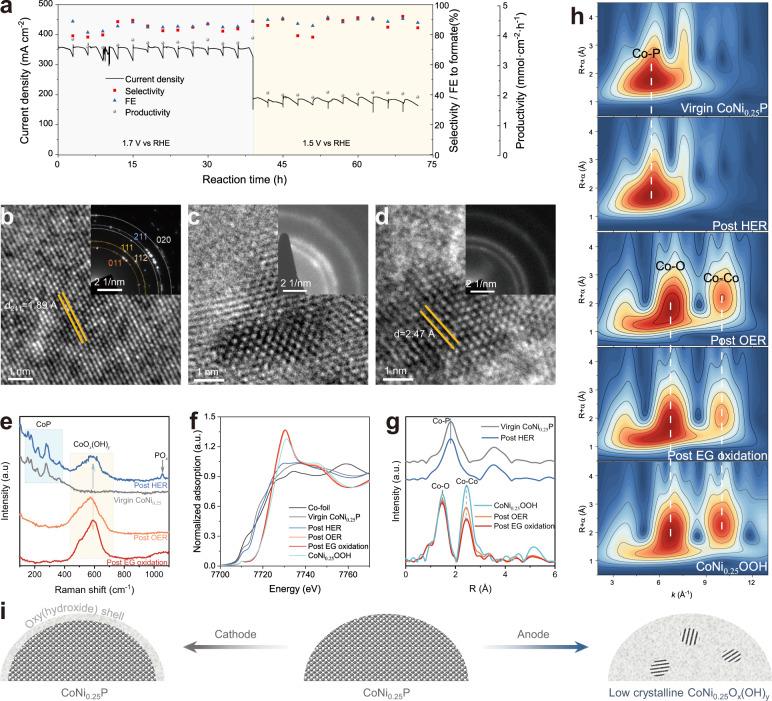
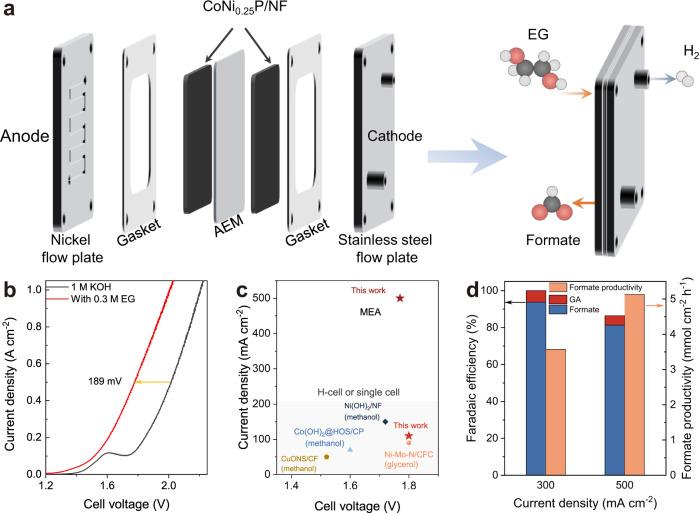
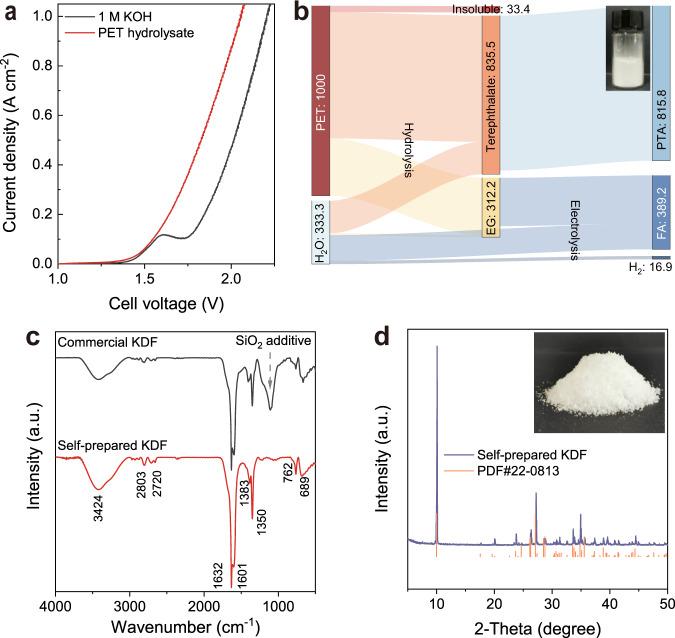
Plastic wastes represent a largely untapped resource for manufacturing chemicals and fuels, particularly considering their environmental and biological threats. Here we report electrocatalytic upcycling of polyethylene terephthalate (PET) plastic to valuable commodity chemicals (potassium diformate and terephthalic acid) and H fuel. Preliminary techno-economic analysis suggests the profitability of this process when the ethylene glycol (EG) component of PET is selectively electrooxidized to formate (>80% selectivity) at high current density (>100 mA cm). A nickel-modified cobalt phosphide (CoNiP) electrocatalyst is developed to achieve a current density of 500 mA cm at 1.8 V in a membrane-electrode assembly reactor with >80% of Faradaic efficiency and selectivity to formate. Detailed characterizations reveal the in-situ evolution of CoNiP catalyst into a low-crystalline metal oxy(hydroxide) as an active state during EG oxidation, which might be responsible for its advantageous performances. This work demonstrates a sustainable way to implement waste PET upcycling to value-added products.
塑料废弃物是制造化学品和燃料的一种基本未被开发利用的资源,尤其是考虑到它们对环境和生物的威胁。在此,我们报告了将聚对苯二甲酸乙二酯(PET)塑料电催化升级循环为有价值的商品化学品(甲酸氢钾和对苯二甲酸)和氢气燃料。初步的技术经济分析表明,当PET中的乙二醇(EG)成分在高电流密度(>100 mA cm²)下被选择性电氧化为甲酸(选择性>80%)时,该工艺具有盈利性。开发了一种镍改性磷化钴(CoNiP)电催化剂,在膜电极组件反应器中于1.8 V时实现了500 mA cm²的电流密度,对甲酸的法拉第效率和选择性>80%。详细表征揭示了在EG氧化过程中,CoNiP催化剂原位演变成一种低结晶度的金属氧(氢氧)化物作为活性状态,这可能是其优异性能的原因。这项工作展示了一种将废弃PET升级循环为增值产品的可持续方法。


 Zotero 插件