
两种猕猴物种的 SARS-CoV-2 感染后阶段与肺部和肺外组织中持续病毒复制和病理学的迹象有关。
The Post-Acute Phase of SARS-CoV-2 Infection in Two Macaque Species Is Associated with Signs of Ongoing Virus Replication and Pathology in Pulmonary and Extrapulmonary Tissues.
机构信息
Biomedical Primate Research Centre (BPRC), Department of Virology, 2288 GJ Rijswijk, The Netherlands.
Department of Parasitology, BPRC, 2288 GJ Rijswijk, The Netherlands.
出版信息
Viruses. 2021 Aug 23;13(8):1673. doi: 10.3390/v13081673.
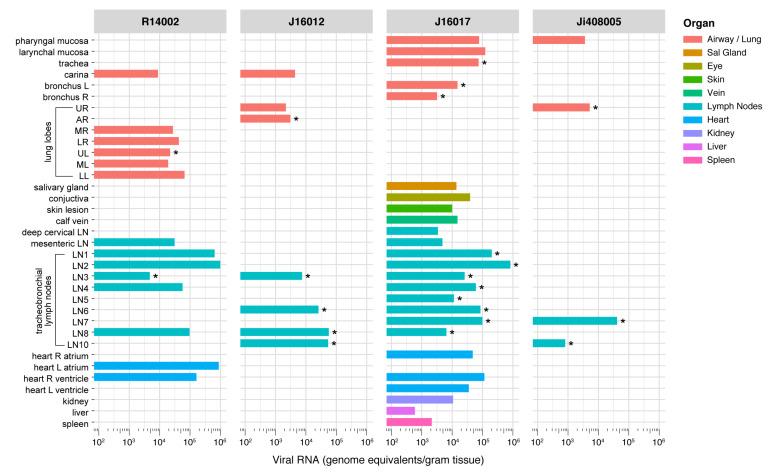
The post-acute phase of SARS-CoV-2 infection was investigated in rhesus () and cynomolgus macaques (). During the acute phase of infection, SARS-CoV-2 was shed via the nose and throat, and viral RNA was occasionally detected in feces. This phase coincided with a transient change in systemic immune activation. Even after the alleged resolution of the infection, computed tomography (CT) and positron emission tomography (PET)-CT revealed pulmonary lesions and activated tracheobronchial lymph nodes in all animals. Post-mortem histological examination of the lung tissue revealed mostly marginal or resolving minimal lesions that were indicative of SARS-CoV-2 infection. Evidence for SARS-CoV-2-induced histopathology was also found in extrapulmonary tissue samples, such as conjunctiva, cervical, and mesenteric lymph nodes. However, 5-6 weeks after SARS-CoV-2 exposure, upon necropsy, viral RNA was still detectable in a wide range of tissue samples in 50% of the macaques and included amongst others the heart, the respiratory tract and surrounding lymph nodes, salivary gland, and conjunctiva. Subgenomic messenger RNA was detected in the lungs and tracheobronchial lymph nodes, indicative of ongoing virus replication during the post-acute phase. These results could be relevant for understanding the long-term consequences of COVID-19 in humans.
SARS-CoV-2 感染的急性后期在恒河猴()和食蟹猴()中进行了研究。在感染的急性期,SARS-CoV-2 通过鼻子和喉咙排出,粪便中偶尔会检测到病毒 RNA。这一阶段与全身性免疫激活的短暂变化同时发生。即使在所谓的感染得到解决后,计算机断层扫描(CT)和正电子发射断层扫描(PET-CT)仍显示所有动物的肺部病变和激活的气管支气管淋巴结。对肺组织的死后组织学检查显示,大多数边缘或正在解决的最小病变表明存在 SARS-CoV-2 感染。在结膜、颈部和肠系膜淋巴结等肺外组织样本中也发现了 SARS-CoV-2 引起的组织病理学证据。然而,在 SARS-CoV-2 暴露后 5-6 周,尸检时,仍有 50%的猕猴在广泛的组织样本中检测到病毒 RNA,其中包括心脏、呼吸道和周围淋巴结、唾液腺和结膜。在肺部和气管支气管淋巴结中检测到亚基因组信使 RNA,表明在急性后期仍有病毒复制。这些结果可能与理解 COVID-19 在人类中的长期后果有关。


 Zotero 插件