
群体检测 SARS-CoV-2 在实际场景和检测策略下可将效率提高 10 倍。
Group Testing for SARS-CoV-2 Allows for Up to 10-Fold Efficiency Increase Across Realistic Scenarios and Testing Strategies.
机构信息
Department of Mathematics, Technical University of Munich, Garching, Germany.
Department of Electrical and Computer Engineering, Technical University of Munich, Munich, Germany.
出版信息
Front Public Health. 2021 Aug 18;9:583377. doi: 10.3389/fpubh.2021.583377. eCollection 2021.
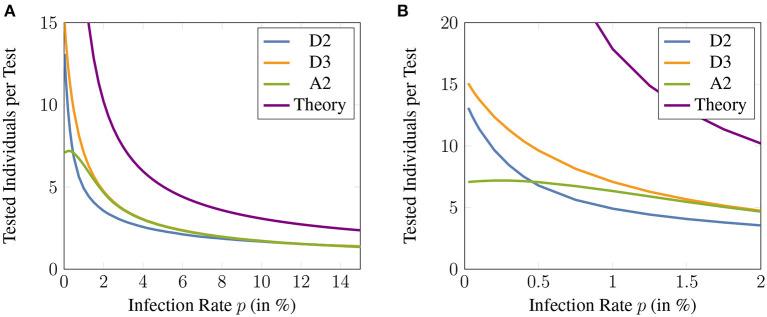
Due to the ongoing COVID-19 pandemic, demand for diagnostic testing has increased drastically, resulting in shortages of necessary materials to conduct the tests and overwhelming the capacity of testing laboratories. The supply scarcity and capacity limits affect test administration: priority must be given to hospitalized patients and symptomatic individuals, which can prevent the identification of asymptomatic and presymptomatic individuals and hence effective tracking and tracing policies. We describe optimized group testing strategies applicable to SARS-CoV-2 tests in scenarios tailored to the current COVID-19 pandemic and assess significant gains compared to individual testing. We account for biochemically realistic scenarios in the context of dilution effects on SARS-CoV-2 samples and consider evidence on specificity and sensitivity of PCR-based tests for the novel coronavirus. Because of the current uncertainty and the temporal and spatial changes in the prevalence regime, we provide analysis for several realistic scenarios and propose fast and reliable strategies for massive testing procedures. We find significant efficiency gaps between different group testing strategies in realistic scenarios for SARS-CoV-2 testing, highlighting the need for an informed decision of the pooling protocol depending on estimated prevalence, target specificity, and high- vs. low-risk population. For example, using one of the presented methods, all 1.47 million inhabitants of Munich, Germany, could be tested using only around 141 thousand tests if the infection rate is below 0.4% is assumed. Using 1 million tests, the 6.69 million inhabitants from the city of Rio de Janeiro, Brazil, could be tested as long as the infection rate does not exceed 1%. Moreover, we provide an interactive web application, available at www.grouptexting.com, for visualizing the different strategies and designing pooling schemes according to specific prevalence scenarios and test configurations. Altogether, this work may help provide a basis for an efficient upscaling of current testing procedures, which takes the population heterogeneity into account and is fine-grained towards the desired study populations, e.g., mild/asymptomatic individuals vs. symptomatic ones but also mixtures thereof. German Science Foundation (DFG), German Federal Ministry of Education and Research (BMBF), Chan Zuckerberg Initiative DAF, and Austrian Science Fund (FWF).
由于持续的 COVID-19 大流行,对诊断检测的需求急剧增加,导致进行检测所需的必要材料短缺,并使检测实验室的能力不堪重负。供应短缺和能力限制影响了测试管理:必须优先考虑住院患者和有症状的个体,这可能会阻止无症状和出现症状前个体的识别,从而无法制定有效的跟踪和追踪政策。我们描述了适用于 SARS-CoV-2 测试的优化分组测试策略,这些策略适用于当前 COVID-19 大流行的情况,并评估了与个体测试相比的显著收益。我们考虑了 SARS-CoV-2 样本稀释效应对生物化学的影响,并考虑了基于 PCR 的新型冠状病毒检测的特异性和敏感性的证据。由于当前的不确定性以及流行率制度的时空变化,我们为几个现实情况提供了分析,并为大规模测试程序提出了快速可靠的策略。我们发现,在 SARS-CoV-2 测试的现实情况下,不同的分组测试策略之间存在显著的效率差距,这突出表明需要根据估计的流行率、目标特异性以及高风险与低风险人群,对汇集协议做出明智的决策。例如,如果假设感染率低于 0.4%,则可以使用德国慕尼黑的 141 千次测试左右即可对其 147 万居民进行测试;如果使用 100 万次测试,则巴西里约热内卢的 669 万居民可以在感染率不超过 1%的情况下进行测试。此外,我们还提供了一个交互式网络应用程序,可在 www.grouptexting.com 上使用,用于根据特定的流行率场景和测试配置可视化不同的策略并设计汇集方案。总的来说,这项工作可能有助于为当前测试程序的有效扩展提供基础,该程序考虑了人口异质性,并针对所需的研究人群(例如,轻症/无症状个体与有症状个体,但也包括它们的混合物)进行了精细调整。德国科学基金会(DFG)、德国联邦教育和研究部(BMBF)、Chan Zuckerberg Initiative DAF 和奥地利科学基金会(FWF)。

 Zotero 插件