
间充质基质细胞在再生医学中的治疗潜力:当前认知与未来展望
The Therapeutic Potential of Mesenchymal Stromal Cells for Regenerative Medicine: Current Knowledge and Future Understandings.
作者信息
Merimi Makram, El-Majzoub Rania, Lagneaux Laurence, Moussa Agha Douâa, Bouhtit Fatima, Meuleman Nathalie, Fahmi Hassan, Lewalle Philippe, Fayyad-Kazan Mohammad, Najar Mehdi
机构信息
Laboratory of Experimental Hematology, Institut Jules Bordet, Université Libre de Bruxelles (ULB), Bruxelles, Belgium.
LBBES Laboratory, Genetics and Immune-Cell Therapy Unit, Faculty of Sciences, University Mohammed Premier, Oujda, Morocco.
出版信息
Front Cell Dev Biol. 2021 Aug 18;9:661532. doi: 10.3389/fcell.2021.661532. eCollection 2021.
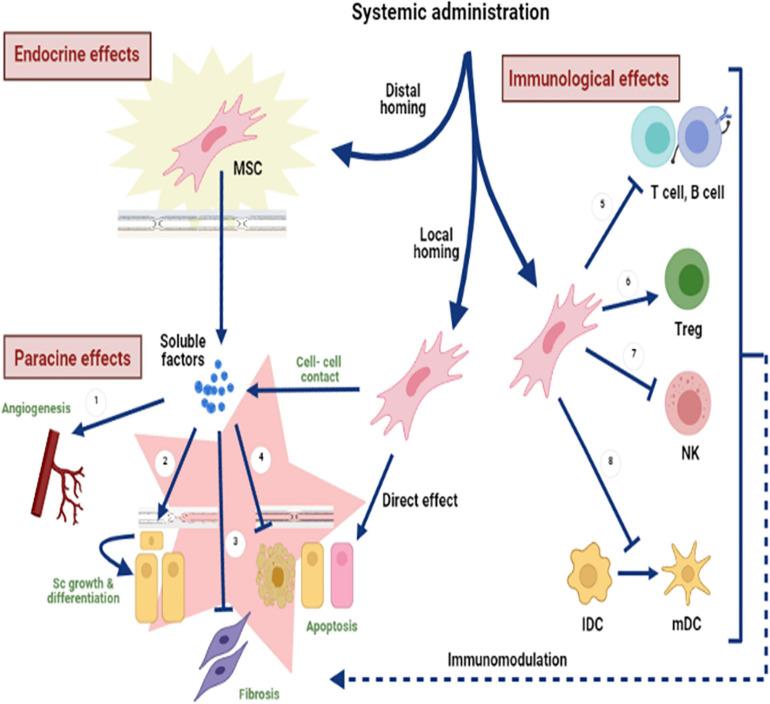
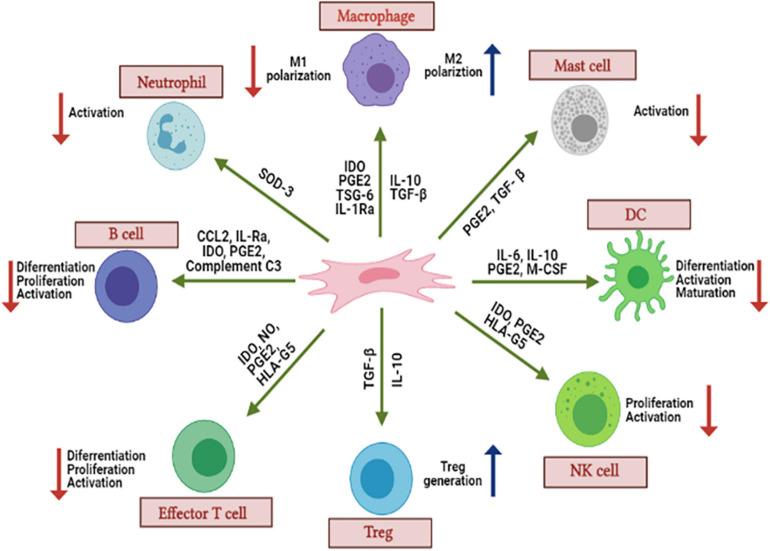
In recent decades, research on the therapeutic potential of progenitor cells has advanced considerably. Among progenitor cells, mesenchymal stromal cells (MSCs) have attracted significant interest and have proven to be a promising tool for regenerative medicine. MSCs are isolated from various anatomical sites, including bone marrow, adipose tissue, and umbilical cord. Advances in separation, culture, and expansion techniques for MSCs have enabled their large-scale therapeutic application. This progress accompanied by the rapid improvement of transplantation practices has enhanced the utilization of MSCs in regenerative medicine. During tissue healing, MSCs may exhibit several therapeutic functions to support the repair and regeneration of injured tissue. The process underlying these effects likely involves the migration and homing of MSCs, as well as their immunotropic functions. The direct differentiation of MSCs as a cell replacement therapeutic mechanism is discussed. The fate and behavior of MSCs are further regulated by their microenvironment, which may consequently influence their repair potential. A paracrine pathway based on the release of different messengers, including regulatory factors, chemokines, cytokines, growth factors, and nucleic acids that can be secreted or packaged into extracellular vesicles, is also implicated in the therapeutic properties of MSCs. In this review, we will discuss relevant outcomes regarding the properties and roles of MSCs during tissue repair and regeneration. We will critically examine the influence of the local microenvironment, especially immunological and inflammatory signals, as well as the mechanisms underlying these therapeutic effects. Importantly, we will describe the interactions of local progenitor and immune cells with MSCs and their modulation during tissue injury. We will also highlight the crucial role of paracrine pathways, including the role of extracellular vesicles, in this healing process. Moreover, we will discuss the therapeutic potential of MSCs and MSC-derived extracellular vesicles in the treatment of COVID-19 (coronavirus disease 2019) patients. Overall, this review will provide a better understanding of MSC-based therapies as a novel immunoregenerative strategy.
近几十年来,祖细胞治疗潜力的研究取得了长足进展。在祖细胞中,间充质基质细胞(MSCs)引起了广泛关注,并已被证明是再生医学中一种很有前景的工具。MSCs可从包括骨髓、脂肪组织和脐带在内的各种解剖部位分离得到。MSCs分离、培养和扩增技术的进步使其能够大规模应用于治疗。这一进展伴随着移植技术的迅速改进,提高了MSCs在再生医学中的应用。在组织愈合过程中,MSCs可能发挥多种治疗功能,以支持受损组织的修复和再生。这些作用的潜在机制可能涉及MSCs的迁移和归巢,以及它们的免疫调节功能。文中还讨论了MSCs作为细胞替代治疗机制的直接分化。MSCs的命运和行为受到其微环境的进一步调节,这可能会影响它们的修复潜力。基于不同信使释放的旁分泌途径,包括可分泌或包装到细胞外囊泡中的调节因子、趋化因子、细胞因子、生长因子和核酸,也与MSCs的治疗特性有关。在这篇综述中,我们将讨论MSCs在组织修复和再生过程中的特性和作用的相关研究结果。我们将严格审查局部微环境的影响,特别是免疫和炎症信号,以及这些治疗作用的潜在机制。重要的是,我们将描述局部祖细胞和免疫细胞与MSCs的相互作用及其在组织损伤过程中的调节。我们还将强调旁分泌途径,包括细胞外囊泡的作用,在这个愈合过程中的关键作用。此外,我们将讨论MSCs和MSCs衍生的细胞外囊泡在治疗2019冠状病毒病(COVID-19)患者方面的治疗潜力。总的来说,这篇综述将有助于更好地理解基于MSCs的治疗作为一种新型免疫再生策略。

 Zotero 插件