
褪黑素抑制破骨细胞生成和溶骨性骨转移:对骨质疏松症的影响。
Melatonin Inhibits Osteoclastogenesis and Osteolytic Bone Metastasis: Implications for Osteoporosis.
机构信息
Graduate Institute of Basic Medical Science, China Medical University, Taichung 40402, Taiwan.
Translational Medicine Center, Shin Kong Wu Ho-Su Memorial Hospital, Taipei City 111, Taiwan.
出版信息
Int J Mol Sci. 2021 Aug 30;22(17):9435. doi: 10.3390/ijms22179435.
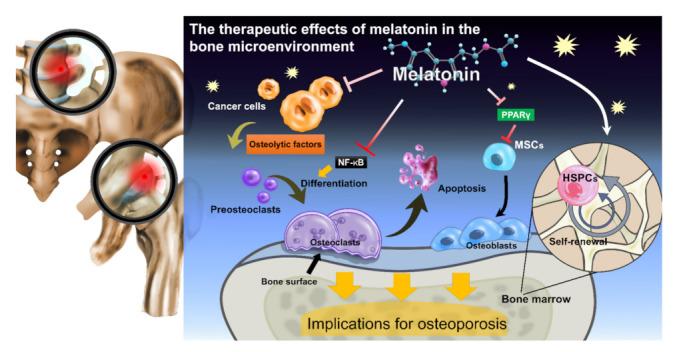
Osteoblasts and osteoclasts are major cellular components in the bone microenvironment and they play a key role in the bone turnover cycle. Many risk factors interfere with this cycle and contribute to bone-wasting diseases that progressively destroy bone and markedly reduce quality of life. Melatonin (-acetyl-5-methoxy-tryptamine) has demonstrated intriguing therapeutic potential in the bone microenvironment, with reported effects that include the regulation of bone metabolism, acceleration of osteoblastogenesis, inhibition of osteoclastogenesis and the induction of apoptosis in mature osteoclasts, as well as the suppression of osteolytic bone metastasis. This review aims to shed light on molecular and clinical evidence that points to possibilities of melatonin for the treatment of both osteoporosis and osteolytic bone metastasis. It appears that the therapeutic qualities of melatonin supplementation may enable existing antiresorptive osteoporotic drugs to treat osteolytic metastasis.
成骨细胞和破骨细胞是骨微环境中的主要细胞成分,它们在骨转换周期中起着关键作用。许多风险因素干扰这一周期,导致骨质流失疾病的发生,这些疾病逐渐破坏骨骼,显著降低生活质量。褪黑素(N-乙酰-5-甲氧基色胺)在骨微环境中显示出了有趣的治疗潜力,据报道,其作用包括调节骨代谢、加速成骨细胞生成、抑制破骨细胞生成和诱导成熟破骨细胞凋亡,以及抑制溶骨性骨转移。本综述旨在阐明分子和临床证据,指出褪黑素治疗骨质疏松症和溶骨性骨转移的可能性。似乎褪黑素补充的治疗特性可以使现有的抗吸收骨质疏松症药物能够治疗溶骨性转移。
 Zotero 插件