
外周和肿瘤内新生抗原特异性 TCR 的功能分析,在一名黑色素瘤患者中鉴定。
Functional analysis of peripheral and intratumoral neoantigen-specific TCRs identified in a patient with melanoma.
机构信息
Klinik und Poliklinik für Innere Medizin III, Klinikum rechts der Isar der Technischen Universität München, München, Germany.
Laboratory of Protein Biochemistry, Institute for Chemistry and Biochemistry, Freie Universität Berlin, Berlin, Germany.
出版信息
J Immunother Cancer. 2021 Sep;9(9). doi: 10.1136/jitc-2021-002754.
BACKGROUND
Neoantigens derived from somatic mutations correlate with therapeutic responses mediated by treatment with immune checkpoint inhibitors. Neoantigens are therefore highly attractive targets for the development of therapeutic approaches in personalized medicine, although many aspects of their quality and associated immune responses are not yet well understood. In a case study of metastatic malignant melanoma, we aimed to perform an in-depth characterization of neoantigens and respective T-cell responses in the context of immune checkpoint modulation.
METHODS
Three neoantigens, which we identified either by immunopeptidomics or in silico prediction, were investigated using binding affinity analyses and structural simulations. We isolated seven T-cell receptors (TCRs) from the patient's immune repertoire recognizing these antigens. TCRs were compared in vitro by multiparametric analyses including functional avidity, multicytokine secretion, and cross-reactivity screenings. A xenograft mouse model served to study in vivo functionality of selected TCRs. We investigated the patient's TCR repertoire in blood and different tumor-related tissues over 3 years using TCR beta deep sequencing.
RESULTS
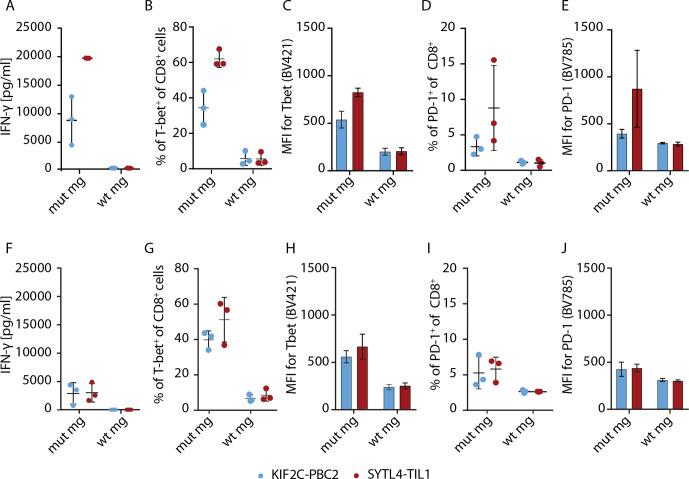
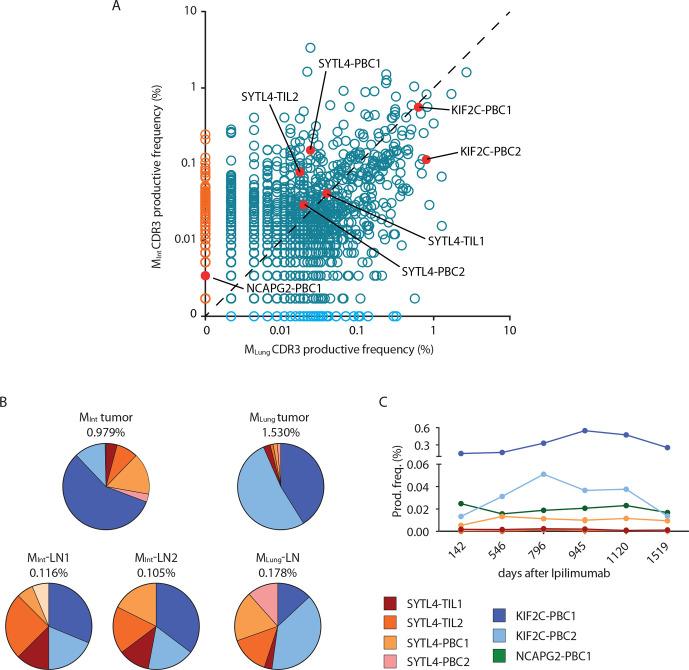
Selected mutated peptide ligands with proven immunogenicity showed similar binding affinities to the human leukocyte antigen complex and comparable disparity to their wild-type counterparts in molecular dynamic simulations. Nevertheless, isolated TCRs recognizing these antigens demonstrated distinct patterns in functionality and frequency. TCRs with lower functional avidity showed at least equal antitumor immune responses in vivo. Moreover, they occurred at high frequencies and particularly demonstrated long-term persistence within tumor tissues, lymph nodes and various blood samples associated with a reduced activation pattern on primary in vitro stimulation.
CONCLUSIONS
We performed a so far unique fine characterization of neoantigen-specific T-cell responses revealing defined reactivity patterns of neoantigen-specific TCRs. Our data highlight qualitative differences of these TCRs associated with function and longevity of respective T cells. Such features need to be considered for further optimization of neoantigen targeting including adoptive T-cell therapies using TCR-transgenic T cells.
背景
源自体细胞突变的新抗原与免疫检查点抑制剂介导的治疗反应相关。因此,新抗原是个性化医学中治疗方法开发的极具吸引力的靶标,尽管它们的质量和相关免疫反应的许多方面尚未得到很好的理解。在转移性恶性黑色素瘤的病例研究中,我们旨在深入研究免疫检查点调节背景下的新抗原及其相应的 T 细胞反应。
方法
我们通过免疫肽组学或计算机预测鉴定了三个新抗原,并通过结合亲和力分析和结构模拟进行了研究。我们从患者的免疫组库中分离出识别这些抗原的七个 T 细胞受体 (TCR)。通过包括功能亲和力、多细胞因子分泌和交叉反应筛选在内的多参数分析,在体外比较 TCR。使用异种移植小鼠模型研究选定 TCR 的体内功能。我们使用 TCRβ 深度测序在 3 年内研究了患者血液和不同肿瘤相关组织中的 TCR repertoire。
结果
具有已证明免疫原性的选定突变肽配体与人类白细胞抗原复合物具有相似的结合亲和力,并且在分子动力学模拟中与野生型相比具有相似的差异。然而,识别这些抗原的分离 TCR 在功能和频率上表现出不同的模式。具有较低功能亲和力的 TCR 在体内显示出至少同等的抗肿瘤免疫反应。此外,它们在肿瘤组织、淋巴结和各种与原发性体外刺激时降低的激活模式相关的血液样本中以高频率出现,并且特别表现出长期持久性。
结论
我们对新抗原特异性 T 细胞反应进行了迄今为止独特的精细表征,揭示了新抗原特异性 TCR 的明确反应模式。我们的数据强调了这些 TCR 的定性差异与相应 T 细胞的功能和寿命相关。在使用 TCR 转基因 T 细胞进行过继性 T 细胞治疗等新抗原靶向的进一步优化中,需要考虑这些特征。


 Zotero 插件