
肿瘤浸润淋巴细胞的新抗原特异性刺激可实现有效的 TCR 分离和扩增,同时保持干细胞样记忆表型。
Neoantigen-specific stimulation of tumor-infiltrating lymphocytes enables effective TCR isolation and expansion while preserving stem-like memory phenotypes.
机构信息
Surgery Branch, Center for Cancer Research, National Cancer Institute, Bethesda, Maryland, USA
Surgery Branch, Center for Cancer Research, National Cancer Institute, Bethesda, Maryland, USA.
出版信息
J Immunother Cancer. 2024 May 30;12(5):e008645. doi: 10.1136/jitc-2023-008645.
BACKGROUND
Tumor-infiltrating lymphocytes (TILs) targeting neoantigens can effectively treat a selected set of metastatic solid cancers. However, harnessing TILs for cancer treatments remains challenging because neoantigen-reactive T cells are often rare and exhausted, and ex vivo expansion can further reduce their frequencies. This complicates the identification of neoantigen-reactive T-cell receptors (TCRs) and the development of TIL products with high reactivity for patient treatment.
METHODS
We tested whether TILs could be in vitro stimulated against neoantigens to achieve selective expansion of neoantigen-reactive TILs. Given their prevalence, mutant p53 or RAS were studied as models of human neoantigens. An in vitro stimulation method, termed "NeoExpand", was developed to provide neoantigen-specific stimulation to TILs. 25 consecutive patient TILs from tumors harboring p53 or RAS mutations were subjected to NeoExpand.
RESULTS
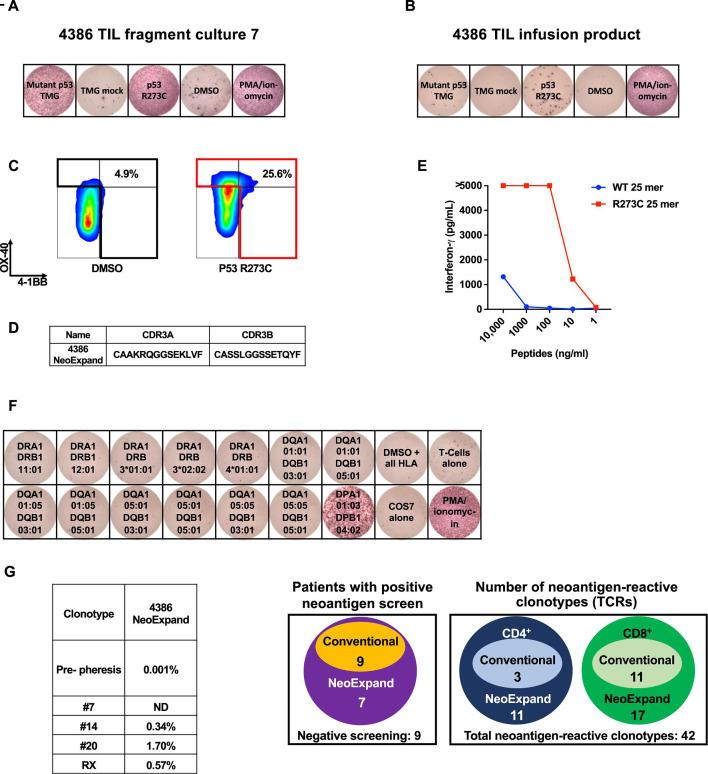
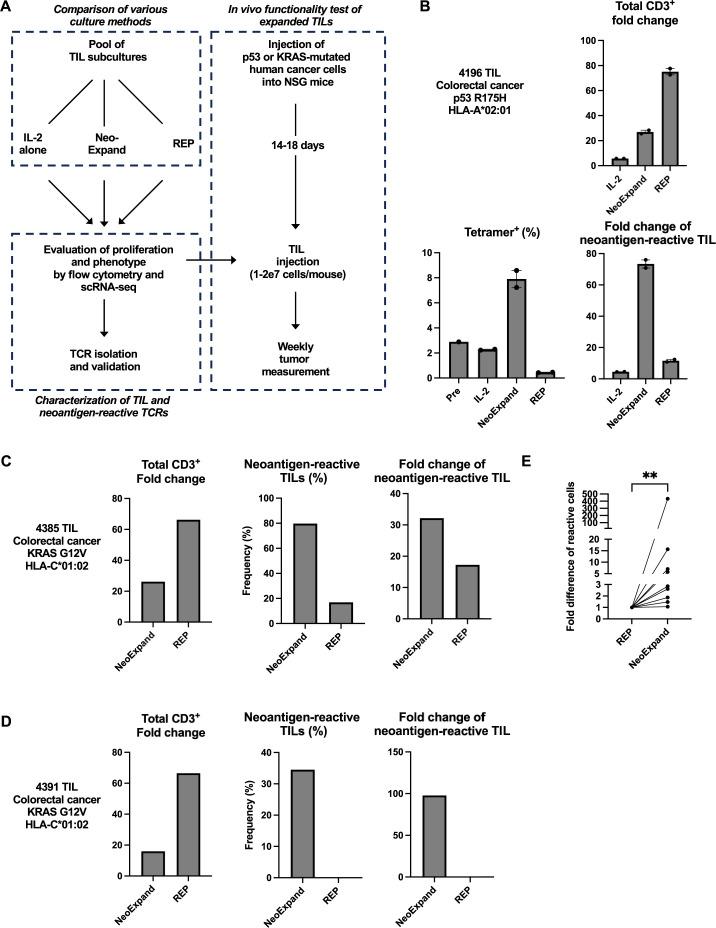
We show that neoantigenic stimulation achieved selective expansion of neoantigen-reactive TILs and broadened the neoantigen-reactive CD4 and CD8 TIL clonal repertoire. This allowed the effective isolation of novel neoantigen-reactive TCRs. Out of the 25 consecutive TIL samples, neoantigenic stimulation enabled the identification of 16 unique reactivities and 42 TCRs, while conventional TIL expansion identified 9 reactivities and 14 TCRs. Single-cell transcriptome analysis revealed that neoantigenic stimulation increased neoantigen-reactive TILs with stem-like memory phenotypes expressing IL-7R, CD62L, and KLF2. Furthermore, neoantigenic stimulation improved the in vivo antitumor efficacy of TILs relative to the conventional OKT3-induced rapid TIL expansion in p53-mutated or KRAS-mutated xenograft mouse models.
CONCLUSIONS
Taken together, neoantigenic stimulation of TILs selectively expands neoantigen-reactive TILs by frequencies and by their clonal repertoire. NeoExpand led to improved phenotypes and functions of neoantigen-reactive TILs. Our data warrant its clinical evaluation.
TRIAL REGISTRATION NUMBER
NCT00068003, NCT01174121, and NCT03412877.
背景
针对新抗原的肿瘤浸润淋巴细胞(TIL)可以有效治疗一组选定的转移性实体瘤。然而,利用 TIL 进行癌症治疗仍然具有挑战性,因为新抗原反应性 T 细胞通常很少且衰竭,体外扩增会进一步降低其频率。这使得新抗原反应性 T 细胞受体(TCR)的鉴定以及具有高反应性的 TIL 产品的开发变得复杂,从而无法用于患者治疗。
方法
我们测试了 TIL 是否可以针对新抗原进行体外刺激,以实现新抗原反应性 TIL 的选择性扩增。鉴于其普遍性,突变型 p53 或 RAS 被研究为人类新抗原的模型。开发了一种称为“NeoExpand”的体外刺激方法,为 TIL 提供新抗原特异性刺激。对来自携带 p53 或 RAS 突变的肿瘤的 25 例连续患者 TIL 进行了 NeoExpand 处理。
结果
我们表明,新抗原刺激实现了新抗原反应性 TIL 的选择性扩增,并拓宽了新抗原反应性 CD4 和 CD8 TIL 克隆谱。这使得能够有效分离新的新抗原反应性 TCR。在 25 例连续的 TIL 样本中,新抗原刺激使 16 种独特的反应性和 42 个 TCR 得以鉴定,而常规 TIL 扩增仅鉴定出 9 种反应性和 14 个 TCR。单细胞转录组分析显示,新抗原刺激增加了具有 IL-7R、CD62L 和 KLF2 表达的干细胞样记忆表型的新抗原反应性 TIL。此外,与 p53 突变或 KRAS 突变异种移植小鼠模型中常规 OKT3 诱导的快速 TIL 扩增相比,新抗原刺激提高了 TIL 的体内抗肿瘤疗效。
结论
总之,TIL 的新抗原刺激通过频率和克隆谱选择性地扩增新抗原反应性 TIL。NeoExpand 导致新抗原反应性 TIL 的表型和功能得到改善。我们的数据证明了其临床评估的价值。
临床试验注册号
NCT00068003、NCT01174121 和 NCT03412877。



 Zotero 插件