
运用保护动机理论和阴谋信念预测 COVID-19 疫苗接种意愿。
Predicting COVID-19 vaccination intention using protection motivation theory and conspiracy beliefs.
机构信息
Teesside University, School of Social Sciences, Humanities and Law, Borough Road, Middlesbrough TS1 3BA, United Kingdom.
University of Sunderland, Faculty of Health Sciences and Wellbeing, Chester Road, Sunderland SR1 3SD, United Kingdom.
出版信息
Vaccine. 2021 Oct 8;39(42):6269-6275. doi: 10.1016/j.vaccine.2021.09.010. Epub 2021 Sep 7.
BACKGROUND
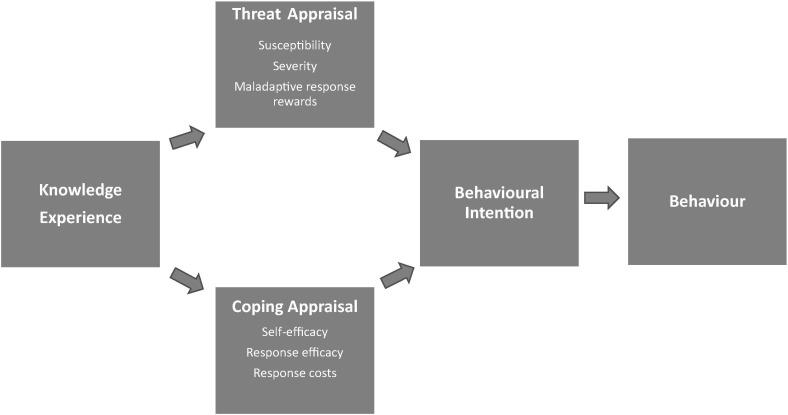
While COVID-19 vaccine uptake has been encouraging overall, some individuals are either hesitant towards, or refuse, the vaccine. Protection Motivation Theory (PMT) has been applied to influenza vaccine acceptance, but there is a lack of research applying PMT to COVID-19 vaccine acceptance. Additionally, prior research has suggested that coronavirus conspiracy beliefs and demographic factors may play a role in attitudes towards the vaccine. This study aimed to predict COVID-19 vaccination intention using PMT, coronavirus conspiracy beliefs, and demographic factors. Furthermore, vaccinated and unvaccinated individuals were compared in relation to their coronavirus conspiracy beliefs.
METHODS
An online survey was administered to 382 (278 vaccinated, and 104 unvaccinated) individuals in the United Kingdom (77 males, 301 females, one non-binary/third gender, and three unstated). Respondents' mean age was 43.78 (SD = 12.58).
RESULTS
A hierarchical multiple linear regression was performed in three stages. Initially, four PMT constructs - severity, susceptibility, maladaptive response costs, and self-efficacy - emerged as significant predictors of COVID-19 vaccination intention. The final model accounted for 75% of the variance and retained two significant predictors from PMT - maladaptive response rewards and self-efficacy - alongside coronavirus conspiracy beliefs and age. An independent t-test established that unvaccinated individuals held greater coronavirus conspiracy beliefs than vaccinated ones.
CONCLUSIONS
Interventions and campaigns addressing COVID-19 vaccine acceptance should employ strategies increasing individuals' perceived severity of COVID-19, perceived susceptibility, and perceived ability to get vaccinated, while decreasing perceived rewards of not getting vaccinated. Additionally, coronavirus conspiracy beliefs should be addressed, as these appear to play a role for some vaccine-hesitant individuals.
背景
虽然 COVID-19 疫苗接种总体上令人鼓舞,但仍有一些人对疫苗犹豫不决或拒绝接种。保护动机理论(PMT)已应用于流感疫苗接种接受度,但缺乏将 PMT 应用于 COVID-19 疫苗接种接受度的研究。此外,先前的研究表明,冠状病毒阴谋论信仰和人口统计学因素可能在对疫苗的态度中发挥作用。本研究旨在使用 PMT、冠状病毒阴谋论信仰和人口统计学因素预测 COVID-19 疫苗接种意愿。此外,还比较了已接种和未接种疫苗的个体与他们的冠状病毒阴谋论信仰。
方法
对英国的 382 名(278 名已接种疫苗,104 名未接种疫苗)个体进行了在线调查(77 名男性,301 名女性,1 名非二进制/第三性别,3 名未说明)。受访者的平均年龄为 43.78 岁(SD=12.58)。
结果
在三个阶段进行了层次多重线性回归。最初,PMT 的四个结构 - 严重性、易感性、适应不良反应成本和自我效能 - 成为 COVID-19 疫苗接种意愿的显著预测因素。最终模型解释了 75%的方差,保留了 PMT 中的两个重要预测因素 - 适应不良反应奖励和自我效能 - 以及冠状病毒阴谋论信仰和年龄。独立样本 t 检验表明,未接种疫苗的个体比接种疫苗的个体具有更高的冠状病毒阴谋论信仰。
结论
针对 COVID-19 疫苗接种接受度的干预和宣传活动应采用策略,增加个体对 COVID-19 的严重程度、易感性和接种疫苗的能力的认识,同时降低不接种疫苗的奖励感知。此外,应解决冠状病毒阴谋论信仰问题,因为这些信仰似乎对一些疫苗犹豫的个体起作用。
 Zotero 插件