
核纤层蛋白A/C机械传感器驱动肿瘤细胞在具有组织特异性弹性的基质上的侵袭性和黏附性。
Lamin A/C Mechanosensor Drives Tumor Cell Aggressiveness and Adhesion on Substrates With Tissue-Specific Elasticity.
作者信息
Urciuoli Enrica, D'Oria Valentina, Petrini Stefania, Peruzzi Barbara
机构信息
Multifactorial Disease and Complex Phenotype Research Area, IRCCS Bambino Gesù Children's Hospital, Rome, Italy.
Confocal Microscopy Core Facility, Research Center, IRCCS Bambino Gesù Children's Hospital, Rome, Italy.
出版信息
Front Cell Dev Biol. 2021 Sep 14;9:712377. doi: 10.3389/fcell.2021.712377. eCollection 2021.
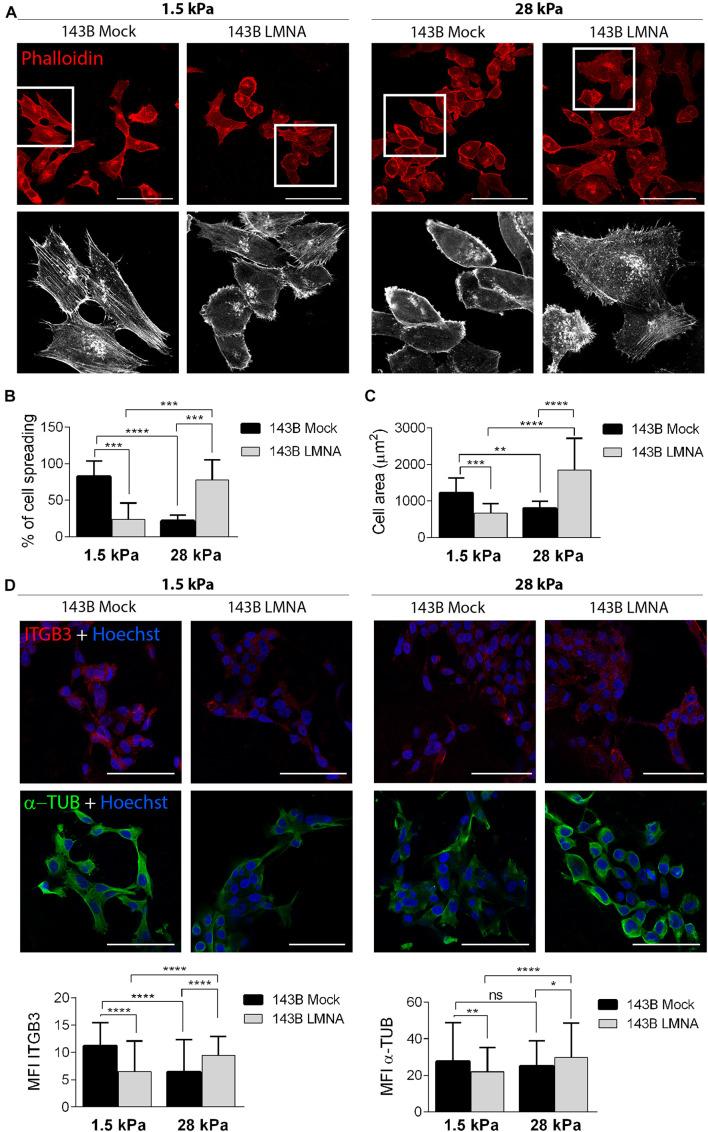
Besides its structural properties in the nucleoskeleton, Lamin A/C is a mechanosensor protein involved in perceiving the elasticity of the extracellular matrix. In this study we provide evidence about Lamin A/C-mediated regulation of osteosarcoma cell adhesion and spreading on substrates with tissue-specific elasticities. Our working hypothesis is based on the observation that low-aggressive and bone-resident SaOS-2 osteosarcoma cells express high level of Lamin A/C in comparison to highly metastatic, preferentially to the lung, osteosarcoma 143B cells, thereby suggesting a role for Lamin A/C in tumor cell tropism. Specifically, LMNA gene over-expression in 143B cells induced a reduction in tumor cell aggressiveness in comparison to parental cells, with decreased proliferation rate and reduced migration capability. Furthermore, LMNA reintegration into 143B cells changed the adhesion properties of tumor cells, from a preferential tropism toward the 1.5 kPa PDMS substrate (resembling normal lung parenchyma) to the 28 kPa (resembling pre-mineralized bone osteoid matrix). Our study suggests that Lamin A/C expression could be involved in the organ tropism of tumor cells, thereby providing a rationale for further studies focused on the definition of cancer mechanism of metastatization.
除了在核骨架中的结构特性外,核纤层蛋白A/C还是一种机械传感蛋白,参与感知细胞外基质的弹性。在本研究中,我们提供了关于核纤层蛋白A/C介导的骨肉瘤细胞在具有组织特异性弹性的底物上的黏附与铺展调控的证据。我们的工作假设基于以下观察结果:与高转移性(优先转移至肺部)的骨肉瘤143B细胞相比,低侵袭性且定位于骨组织的SaOS-2骨肉瘤细胞表达高水平的核纤层蛋白A/C,这表明核纤层蛋白A/C在肿瘤细胞嗜性中发挥作用。具体而言,与亲本细胞相比,143B细胞中LMNA基因的过表达导致肿瘤细胞侵袭性降低,增殖率下降且迁移能力减弱。此外,将LMNA重新整合到143B细胞中改变了肿瘤细胞的黏附特性,从优先趋向于1.5 kPa的聚二甲基硅氧烷底物(类似于正常肺实质)转变为趋向于28 kPa的底物(类似于矿化前的骨类骨质基质)。我们的研究表明,核纤层蛋白A/C的表达可能参与肿瘤细胞的器官嗜性,从而为进一步研究癌症转移机制的定义提供了理论依据。


 Zotero 插件