
PSMA PET 验证了欧洲泌尿外科学会生化复发风险组更高的转移疾病发生率:一项国际多中心研究。
PSMA PET Validates Higher Rates of Metastatic Disease for European Association of Urology Biochemical Recurrence Risk Groups: An International Multicenter Study.
机构信息
Department of Nuclear Medicine, University of Duisburg-Essen and German Cancer Consortium-University Hospital Essen, Essen, Germany.
Department of Nuclear Medicine, University of Duisburg-Essen and German Cancer Consortium-University Hospital Essen, Essen, Germany;
出版信息
J Nucl Med. 2022 Jan;63(1):76-80. doi: 10.2967/jnumed.121.262821. Epub 2021 Oct 7.
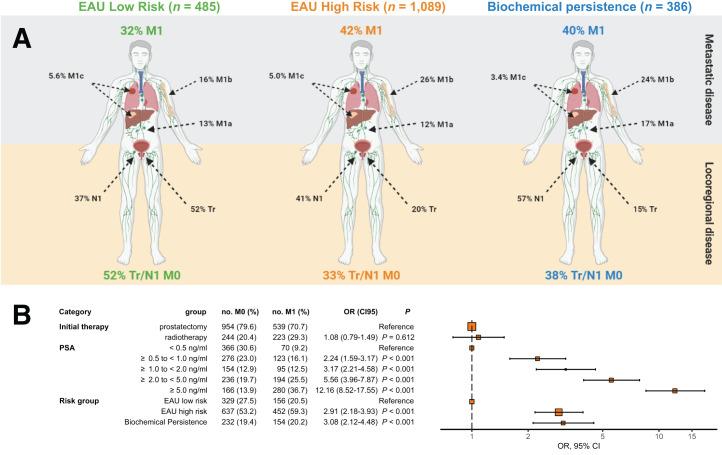
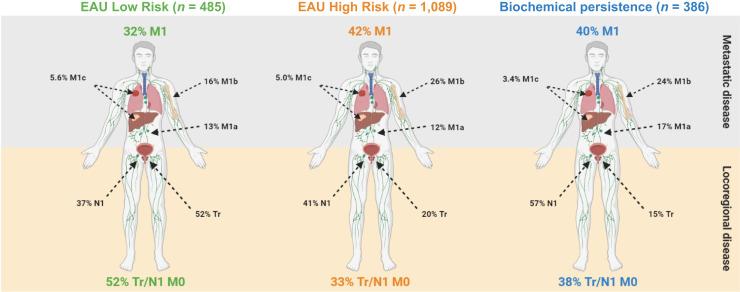
The European Association of Urology (EAU) prostate cancer guidelines panel recommends risk groups for biochemical recurrence (BCR) of prostate cancer to identify men at high risk of progression or metastatic disease. The rapidly growing availability of PSMA-directed PET imaging will impact prostate cancer staging. We determined the rates of local and metastatic disease in BCR and biochemical persistence (BCP) of prostate cancer stratified by EAU BCR risk groups and BCP. Patients with BCR or BCP were enrolled under the same prospective clinical trial protocol conducted at 3 sites ( = 1,777 [91%]: UCLA, = 662 [NCT02940262]; University of California San Francisco, = 508 [NCT03353740]; University of Michigan, = 607 [NCT03396874]); 183 patients with BCP from the Universities of Essen, Bologna, and Munich were included retrospectively. Patients with BCR had to have sufficient data to determine the EAU risk score. Multivariate, binomial logistic regression models were applied to assess independent predictors of M1 disease. In total, 1,960 patients were included. Post-radical prostatectomy EAU BCR low-risk, EAU BCR high-risk, and BCP groups yielded distant metastatic (M1) detection in 43 of 176 (24%), 342 of 931 (37%), and 154 of 386 (40%) patients. For postradiotherapy EAU BCR low-risk and EAU BCR high-risk groups, the M1 detection rate was 113 of 309 (37%) and 110 of 158 (70%), respectively. BCP, high-risk BCR, and higher levels of serum prostate-specific antigen were significantly associated with PSMA PET M1 disease in multivariate regression analysis. PSMA PET revealed no disease in 25% and locoregional-only disease in 33% of patients with post-radical prostatectomy or postradiotherapy EAU BCR high risk. Our findings support the new EAU classification; EAU BCR high-risk groups have higher rates of metastatic disease on PSMA PET than do the low-risk groups. Discordant subgroups, including metastatic disease in low-risk patients and no disease in high-risk patients, warrant inclusion of PSMA PET stage to refine risk assessment.
欧洲泌尿外科学会(EAU)前列腺癌指南小组建议将前列腺癌的生化复发(BCR)风险组分类,以识别出有进展或转移疾病高风险的男性。PSMA 导向的 PET 成像的应用日益广泛,将影响前列腺癌的分期。我们根据 EAU BCR 风险组和 BCP 对前列腺癌 BCR 和生化持续性(BCP)患者进行了局部和转移性疾病的分层,并确定了相应的发生率。UCLA( = 662,NCT02940262)、加州大学旧金山分校( = 508,NCT03353740)和密歇根大学( = 607,NCT03396874)这 3 个地点的同一前瞻性临床试验方案纳入了 BCR 或 BCP 的患者( = 1777 [91%]);此外,还回顾性纳入了来自埃森大学、博洛尼亚大学和慕尼黑大学的 183 名 BCP 患者。BCR 患者必须有足够的数据来确定 EAU 风险评分。应用多变量二项逻辑回归模型来评估 M1 疾病的独立预测因素。 总共纳入了 1960 名患者。在根治性前列腺切除术后,EAU BCR 低危、高危和 BCP 组中,远处转移(M1)分别在 176 名患者中的 43 名(24%)、931 名患者中的 342 名(37%)和 386 名患者中的 154 名(40%)中检测到。在放疗后,EAU BCR 低危和高危组的 M1 检测率分别为 309 名患者中的 113 名(37%)和 158 名患者中的 110 名(70%)。多变量回归分析显示,BCP、高危 BCR 和更高水平的血清前列腺特异性抗原与 PSMA PET M1 疾病显著相关。在根治性前列腺切除术或放疗后 EAU BCR 高危患者中,PSMA PET 显示 25%的患者无疾病,33%的患者仅存在局部疾病。我们的研究结果支持新的 EAU 分类;与低危组相比,高危组的 PSMA PET 转移性疾病发生率更高。包括低危患者的转移疾病和高危患者的无疾病在内的不同亚组,需要纳入 PSMA PET 分期来完善风险评估。

 Zotero 插件