
铁死亡关键基因在泛癌中的预后及免疫作用
Prognostic and Immunological Role of Key Genes of Ferroptosis in Pan-Cancer.
作者信息
Shi Zhi-Zhou, Tao Hao, Fan Ze-Wen, Song Sheng-Jie, Bai Jie
机构信息
Medical School, Kunming University of Science and Technology, Kunming, China.
出版信息
Front Cell Dev Biol. 2021 Oct 13;9:748925. doi: 10.3389/fcell.2021.748925. eCollection 2021.
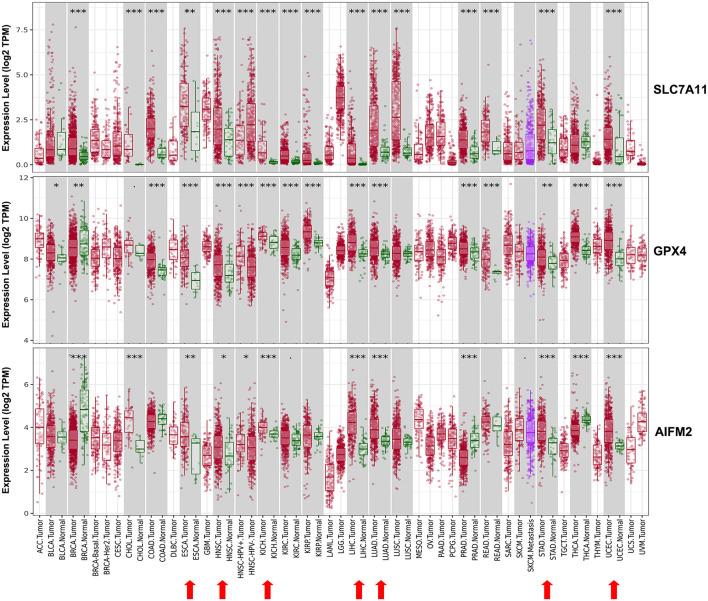
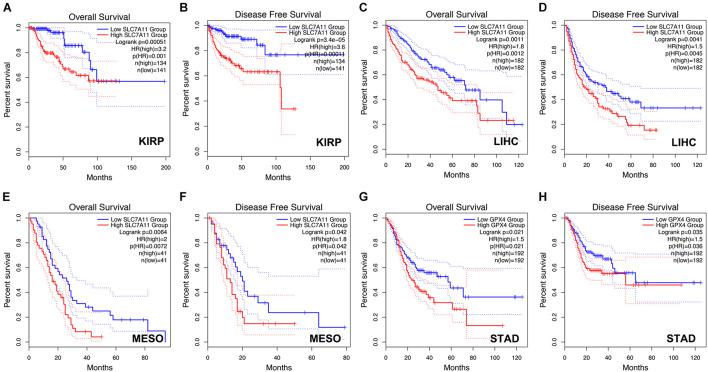
Solute carrier family 7 member 11 (SLC7A11), glutathione peroxidase 4 (GPX4), and apoptosis inducing factor mitochondria associated 2 (AIFM2) are the key regulators in ferroptosis. However, the expression patterns and prognostic roles of these genes in pan-cancer are still largely unclear. The expression patterns and prognostic roles of SLC7A11, GPX4, and AIFM2 and the relationships between the expression levels of these genes and immune infiltration levels in pan-cancer were analyzed by using TIMER, gene expression profiling interactive analysis (GEPIA), Oncomine, and Kaplan-Meier databases. Our results showed that both SLC7A11 and GPX4 were overexpressed in colorectal cancer, and SLC7A11 was overexpressed in lung cancer. High levels of SLC7A11 and AIFM2 were significantly linked with the shortened disease-free survival and overall survival (OS) in adrenocortical carcinoma (ACC), respectively. And high expression of SLC7A11, GPX4, and AIFM2 were significantly correlated with the shortened OS of acute myeloid leukemia patients. In esophageal carcinoma (ESCA), GPX4 expression was significantly associated with the infiltration of macrophage and myeloid dendritic cell, and AIFM2 expression was significantly associated with the infiltration of CD4 T cell. Importantly, GPX4 expression was positively correlated with the expression levels of monocyte markers (CD14 and CD115) and M2 macrophage markers (VSIG4 and MS4A4A) both in ESCA and in head and neck squamous cell carcinoma (HNSC). In summary, SLC7A11, GPX4, and AIFM2 are dysregulated in many types of cancers, and are candidate prognostic biomarkers for many types of cancers, and can be used to evaluate the infiltration of immune cells in tumor tissues.
溶质载体家族7成员11(SLC7A11)、谷胱甘肽过氧化物酶4(GPX4)和凋亡诱导因子线粒体相关2(AIFM2)是铁死亡的关键调节因子。然而,这些基因在泛癌中的表达模式和预后作用仍不清楚。利用TIMER、基因表达谱交互式分析(GEPIA)、Oncomine和Kaplan-Meier数据库分析了SLC7A11、GPX4和AIFM2的表达模式、预后作用以及这些基因表达水平与泛癌免疫浸润水平之间的关系。我们的结果显示,SLC7A11和GPX4在结直肠癌中均过表达,SLC7A11在肺癌中过表达。高水平的SLC7A11和AIFM2分别与肾上腺皮质癌(ACC)患者无病生存期和总生存期(OS)缩短显著相关。SLC7A11、GPX4和AIFM2的高表达与急性髓系白血病患者OS缩短显著相关。在食管癌(ESCA)中,GPX4表达与巨噬细胞和髓系树突状细胞浸润显著相关,AIFM2表达与CD4 T细胞浸润显著相关。重要的是,在ESCA和头颈部鳞状细胞癌(HNSC)中,GPX4表达均与单核细胞标志物(CD14和CD115)和M2巨噬细胞标志物(VSIG4和MS4A4A)的表达水平呈正相关。总之,SLC7A11、GPX4和AIFM2在多种癌症中表达失调,是多种癌症的候选预后生物标志物,可用于评估肿瘤组织中免疫细胞的浸润情况。



 Zotero 插件