
载脂蛋白 B 对寿命和包括 2 型糖尿病在内的主要疾病风险的影响:基于一级亲属结局的孟德尔随机化分析。
Effects of apolipoprotein B on lifespan and risks of major diseases including type 2 diabetes: a mendelian randomisation analysis using outcomes in first-degree relatives.
机构信息
Medical Research Council Integrative Epidemiology Unit.
Medical Research Council Integrative Epidemiology Unit; University of Bristol, Bristol, UK; Clinical Trial Service Unit & Epidemiological Studies Unit, Nuffield Department of Population Health; University of Oxford, Oxford, UK; Systems Epidemiology, Baker Heart and Diabetes Institute, Melbourne, VIC, Australia; Computational Medicine, Faculty of Medicine, University of Oulu and Biocenter Oulu, Oulu, Finland.
出版信息
Lancet Healthy Longev. 2021 Jun;2(6):e317-e326. doi: 10.1016/S2666-7568(21)00086-6. Epub 2021 May 21.
BACKGROUND
Apolipoprotein B (apoB) is emerging as the crucial lipoprotein trait for the role of lipoprotein lipids in the aetiology of coronary heart disease. In this study, we evaluated the effects of genetically predicted apoB on outcomes in first-degree relatives.
METHODS
Data on lipoprotein lipids and disease outcomes in first-degree relatives were obtained from the UK Biobank study. We did a univariable mendelian randomisation analysis using a weighted genetic instrument for apoB. For outcomes with which apoB was associated at a false discovery rate (FDR) of less than 5%, multivariable mendelian randomisation analyses were done, including genetic instruments for LDL cholesterol and triglycerides. Associations between apoB and self-reported outcomes in first-degree relatives were characterised for 12 diseases (including heart disease, stroke, and hypertension) and parental vital status together with age at death. Estimates were inferred causal effects per 1 SD elevated lipoprotein trait (for apoB, 1 SD=0·24 g/L). Replication of estimates for lifespan and type 2 diabetes was done using conventional two-sample mendelian randomisation with summary estimates from genome-wide association study consortia.
FINDINGS
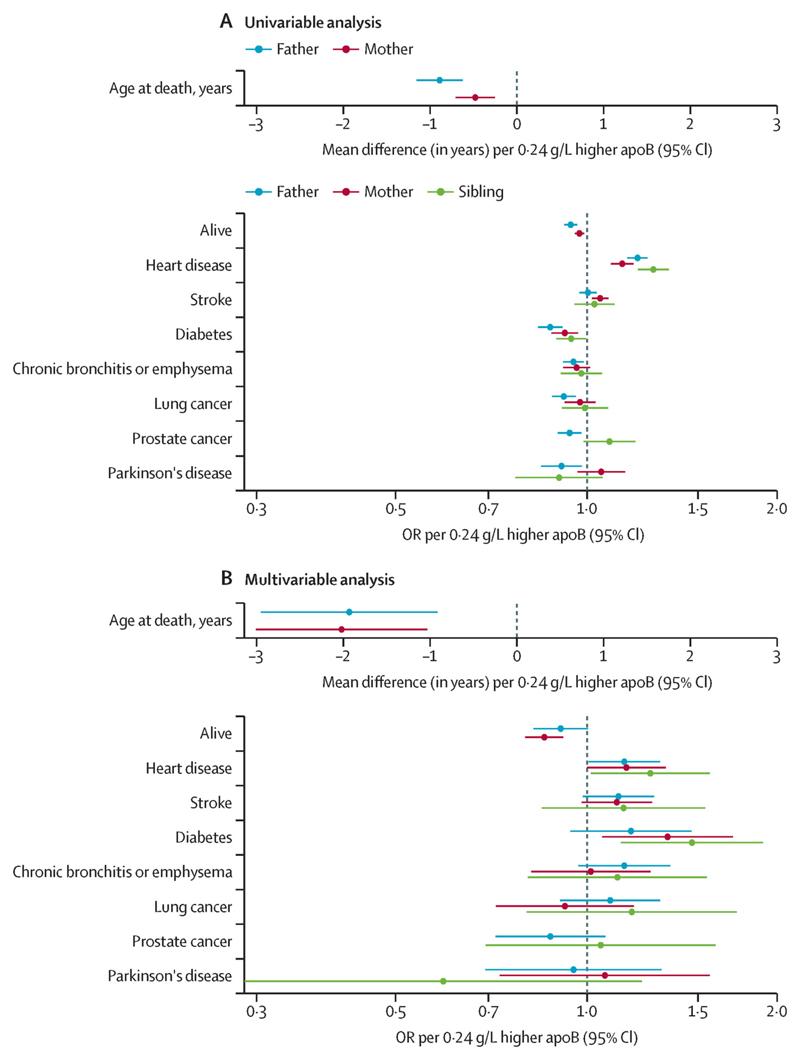
In univariable mendelian randomisation, genetically elevated apoB in participants was identified to lead to a shorter lifespan in parents (fathers: 0·89 years of life lost per 1 SD higher apoB in offspring, 95% CI 0·63-1·16, FDR-adjusted p=4·0 × 10; mothers: 0·48 years of life lost per 1 SD higher apoB in offspring, 0·25-0·71, FDR-adjusted p=1·7 × 10). The effects were strengthened to around 2 years of life lost in multivariable mendelian randomisation and were replicated in conventional two-sample mendelian randomisation (odds ratio [OR] of surviving to the 90th centile of lifespan: 0·38 per 1 SD higher apoB in offspring, 95% CI 0·22-0·65). Genetically elevated apoB caused higher risks of heart disease in all first-degree relatives and a higher risk of stroke in mothers. Findings in first-degree relatives were replicated in two-sample multivariable mendelian randomisation, which identified apoB to increase (OR 2·32 per 1 SD higher apoB, 95% CI 1·49-3·61) and LDL cholesterol to decrease (0·34 per 1 SD higher LDL cholesterol, 0·21-0·54) the risk of type 2 diabetes.
INTERPRETATION
Higher apoB shortens lifespan, increases risks of heart disease and stroke, and in multivariable analyses that account for LDL cholesterol, increases risk of diabetes.
FUNDING
British Heart Foundation, UK Medical Research Council, and UK Research and Innovation.
背景
载脂蛋白 B(apoB)作为脂蛋白脂质在冠心病发病机制中作用的关键脂蛋白特征,正逐渐受到关注。本研究旨在评估遗传预测apoB 对一级亲属结局的影响。
方法
从英国生物库研究中获取一级亲属的脂蛋白脂质和疾病结局数据。我们使用apoB 的加权遗传工具进行了单变量孟德尔随机分析。对于与 apoB 相关且假发现率(FDR)<5%的结局,我们进行了多变量孟德尔随机分析,包括 LDL 胆固醇和甘油三酯的遗传工具。我们描述了apoB 与一级亲属中 12 种疾病(包括心脏病、中风和高血压)和父母生存状态以及死亡年龄的自我报告结局之间的关系。通过单变量孟德尔随机分析推断每升高 1 SD 脂蛋白特征的因果效应(apoB 为 0.24 g/L)。使用来自全基因组关联研究联盟的汇总估计值,通过常规两样本孟德尔随机分析,对寿命和 2 型糖尿病的估计值进行了复制。
结果
在单变量孟德尔随机分析中,参与者中apoB 的遗传升高被确定为导致父母寿命缩短(父亲:每升高 1 SD 后代 apoB 导致 0.89 年的生命损失,95%CI 0.63-1.16,FDR 调整后 p=4.0×10;母亲:每升高 1 SD 后代 apoB 导致 0.48 年的生命损失,0.25-0.71,FDR 调整后 p=1.7×10)。在多变量孟德尔随机分析中,这种影响加强到大约 2 年的生命损失,并且在常规两样本孟德尔随机分析中得到了复制(存活到寿命第 90 百分位数的比值比[OR]:每升高 1 SD 后代 apoB 为 0.38,95%CI 0.22-0.65)。遗传升高的 apoB 导致所有一级亲属患心脏病的风险增加,并导致母亲患中风的风险增加。一级亲属的发现通过两样本多变量孟德尔随机分析得到了复制,该分析确定 apoB 增加(每升高 1 SD apoB 的 OR 为 2.32,95%CI 1.49-3.61),LDL 胆固醇降低(每升高 1 SD LDL 胆固醇的 OR 为 0.34,0.21-0.54)与 2 型糖尿病风险相关。
解释
较高的 apoB 会缩短寿命,增加患心脏病和中风的风险,并且在多变量分析中,apoB 会增加(apoB 每升高 1 SD,OR 为 2.32,95%CI 1.49-3.61),LDL 胆固醇会降低(LDL 胆固醇每升高 1 SD,OR 为 0.34,0.21-0.54),患 2 型糖尿病的风险增加。
资助
英国心脏基金会、英国医学研究理事会和英国研究与创新署。


 Zotero 插件