
在表皮生长因子受体(EGFR)-酪氨酸激酶抑制剂(TKI)治疗失败后,EGFR突变的晚期非小细胞肺癌患者中,化疗联合抗血管生成疗法与化疗联合免疫疗法的真实世界疗效。
Real-world outcomes of chemo-antiangiogenesis versus chemo-immunotherapy combinations in EGFR-mutant advanced non-small cell lung cancer patients after failure of EGFR-TKI therapy.
作者信息
Yu Xin, Li Jiaqi, Ye Lingyun, Zhao Jing, Xie Mengqing, Zhou Juan, Shen Yinchen, Zhou Fei, Wu Yan, Han Chaonan, Qian Jialin, Chu Tianqing, Su Chunxia
机构信息
Department of Oncology, Shanghai Pulmonary Hospital & Thoracic Cancer Institute, Tongji University School of Medicine, Shanghai, China.
Department of Pulmonary Medicine, Shanghai Chest Hospital, Shanghai Jiao Tong University, Shanghai, China.
出版信息
Transl Lung Cancer Res. 2021 Sep;10(9):3782-3792. doi: 10.21037/tlcr-21-681.
BACKGROUND
Despite the potent efficacy of epidermal growth factor receptor (EGFR)-tyrosine kinase inhibitors (TKIs) in the treatment of EGFR-mutant non-small cell lung cancer (NSCLC) patients, drug resistance inevitably ensues, and there remains a paucity of treatment options in clinical practice.
METHODS
We identified patients with EGFR-mutant advanced NSCLC presenting to Shanghai Pulmonary Hospital and Shanghai Chest Hospital between January 2015 and December 2020 treated with chemo-antiangiogenesis or chemo-immunotherapy combinations after EGFR-TKI resistance. Patient information was collected, and the objective response rate (ORR), disease control rate (DCR), and progression-free survival (PFS) were assessed.
RESULTS
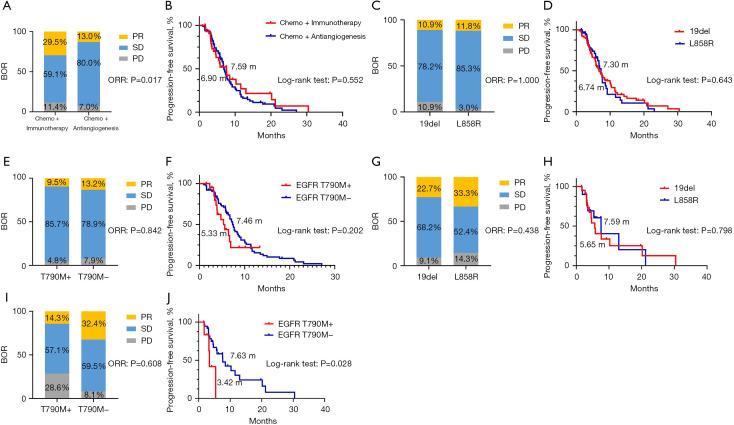
A total of 144 patients who met our inclusion criteria were enrolled. Chemo-immunotherapy combinations achieved a higher objective response rate (ORR) compared with chemo-antiangiogenesis combinations (29.5% 13.0%, P=0.018). The DCR was similar between the two groups (93.0% 88.6%, P=0.585), as was the median PFS (7.59 6.90 months, P=0.552). In the subgroup analyses, patients who developed secondary T790M mutations after EGFR-TKI treatment were less likely to benefit from chemo-immunotherapy combinations than their T790M-negative counterparts (3.42 7.63 months, P=0.028). For patients who received chemo-antiangiogenesis combinations after TKI resistance, no significant difference was observed in the median PFS between T790M-positive and T790M-negative patients (median PFS: 5.33 7.46 months, P=0.202). Additionally, multivariate analysis showed that an elevated platelet count was independently associated with a worse PFS for both groups.
CONCLUSIONS
The efficacy of chemo-immunotherapy combinations was comparable to chemo-antiangiogenesis combinations after failure of EGFR-TKI therapy. For patients harboring EGFR T790M mutations, chemo-antiangiogenesis combinations may be the preferred therapeutic option. In addition, platelet count could be a potential prognostic factor for patients after failure of EGFR-TKI therapy. Further research should be conducted on larger populations and in a prospective setting.
背景
尽管表皮生长因子受体(EGFR)-酪氨酸激酶抑制剂(TKIs)在治疗EGFR突变的非小细胞肺癌(NSCLC)患者中疗效显著,但不可避免地会出现耐药性,且临床实践中治疗选择仍然匮乏。
方法
我们纳入了2015年1月至2020年12月期间在上海肺科医院和上海胸科医院就诊的EGFR突变的晚期NSCLC患者,这些患者在EGFR-TKI耐药后接受了化疗联合抗血管生成或化疗联合免疫治疗。收集患者信息,并评估客观缓解率(ORR)、疾病控制率(DCR)和无进展生存期(PFS)。
结果
共有144例符合纳入标准的患者入组。与化疗联合抗血管生成治疗相比,化疗联合免疫治疗的客观缓解率(ORR)更高(29.5%对13.0%,P=0.018)。两组的疾病控制率(DCR)相似(93.0%对88.6%,P=0.585),中位无进展生存期(PFS)也相似(7.59对6.90个月,P=0.552)。在亚组分析中,EGFR-TKI治疗后出现继发性T790M突变的患者比T790M阴性的患者从化疗联合免疫治疗中获益的可能性更小(3.42对7.63个月,P=0.028)。对于TKI耐药后接受化疗联合抗血管生成治疗的患者,T790M阳性和T790M阴性患者的中位无进展生存期无显著差异(中位PFS:5.33对7.46个月,P=0.202)。此外,多因素分析显示,血小板计数升高与两组患者较差的无进展生存期独立相关。
结论
EGFR-TKI治疗失败后,化疗联合免疫治疗的疗效与化疗联合抗血管生成治疗相当。对于携带EGFR T790M突变的患者,化疗联合抗血管生成治疗可能是首选的治疗方案。此外,血小板计数可能是EGFR-TKI治疗失败后患者的潜在预后因素。应在更大规模人群中进行前瞻性研究。

 Zotero 插件