
未分隔电化学电池中的过渡金属催化有机反应。
Transition metal-catalyzed organic reactions in undivided electrochemical cells.
作者信息
Ma Cong, Fang Ping, Liu Dong, Jiao Ke-Jin, Gao Pei-Sen, Qiu Hui, Mei Tian-Sheng
机构信息
State Key Laboratory of Organometallic Chemistry, Center for Excellence in Molecular Synthesis, Shanghai Institute of Organic Chemistry, University of Chinese Academy of Sciences, Chinese Academy of Sciences 345 Lingling Road Shanghai 200032 China
出版信息
Chem Sci. 2021 Aug 24;12(39):12866-12873. doi: 10.1039/d1sc04011a. eCollection 2021 Oct 13.
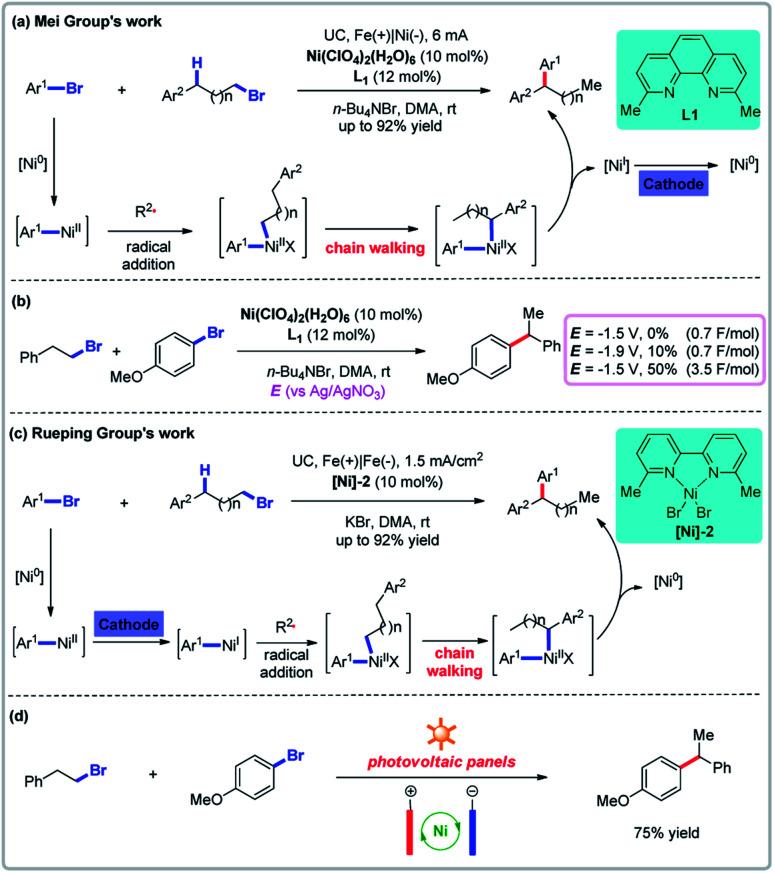
Transition metal-catalyzed organic electrochemistry is a rapidly growing research area owing in part to the ability of metal catalysts to alter the selectivity of a given transformation. This conversion mainly focuses on transition metal-catalyzed anodic oxidation and cathodic reduction and great progress has been achieved in both areas. Typically, only one of the half-cell reactions is involved in the organic reaction while a sacrificial reaction occurs at the counter electrode, which is inherently wasteful since one electrode is not being used productively. Recently, transition metal-catalyzed paired electrolysis that makes use of both anodic oxidation and cathodic reduction has attracted much attention. This perspective highlights the recent progress of each type of electrochemical reaction and relatively focuses on the transition metal-catalyzed paired electrolysis, showcasing that electrochemical reactions involving transition metal catalysis have advantages over conventional reactions in terms of controlling the reaction activity and selectivity and figuring out that transition metal-catalyzed paired electrolysis is an important direction of organic electrochemistry in the future and offers numerous opportunities for new and improved organic reaction methods.
过渡金属催化的有机电化学是一个快速发展的研究领域,部分原因在于金属催化剂能够改变特定转化反应的选择性。这种转化主要集中在过渡金属催化的阳极氧化和阴极还原,并且在这两个领域都取得了很大进展。通常,有机反应中仅涉及一个半电池反应,而在对电极上会发生牺牲反应,这本质上是浪费的,因为一个电极没有得到有效利用。最近,利用阳极氧化和阴极还原的过渡金属催化成对电解引起了广泛关注。这篇综述突出了每种类型电化学反应的最新进展,并相对侧重于过渡金属催化的成对电解,表明涉及过渡金属催化的电化学反应在控制反应活性和选择性方面优于传统反应,同时指出过渡金属催化的成对电解是未来有机电化学的一个重要方向,为新型和改进的有机反应方法提供了众多机会。




 Zotero 插件