
具核梭杆菌与口腔癌:批判性回顾。
Fusobacterium nucleatum and oral cancer: a critical review.
机构信息
Patrick G Johnson Centre for Cancer Research, Queen's University Belfast, Belfast, Northern Ireland, UK.
Centre for Public Health, School of Medicine, Dentistry and Biomedical Sciences, Queen's University Belfast, Belfast, Northern Ireland, UK.
出版信息
BMC Cancer. 2021 Nov 13;21(1):1212. doi: 10.1186/s12885-021-08903-4.
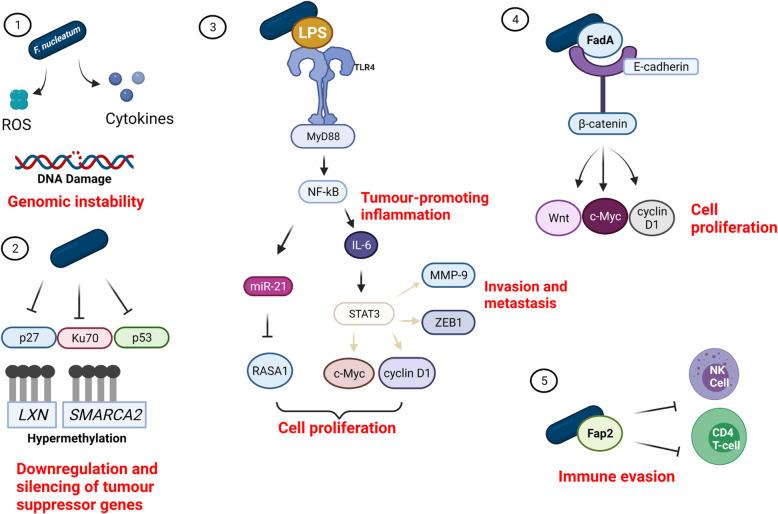
There is a growing level of interest in the potential role inflammation has on the initiation and progression of malignancy. Notable examples include Helicobacter pylori-mediated inflammation in gastric cancer and more recently Fusobacterium nucleatum-mediated inflammation in colorectal cancer. Fusobacterium nucleatum is a Gram-negative anaerobic bacterium that was first isolated from the oral cavity and identified as a periodontal pathogen. Biofilms on oral squamous cell carcinomas are enriched with anaerobic periodontal pathogens, including F. nucleatum, which has prompted hypotheses that this bacterium could contribute to oral cancer development. Recent studies have demonstrated that F. nucleatum can promote cancer by several mechanisms; activation of cell proliferation, promotion of cellular invasion, induction of chronic inflammation and immune evasion. This review provides an update on the association between F. nucleatum and oral carcinogenesis, and provides insights into the possible mechanisms underlying it.
人们对炎症在恶性肿瘤的发生和发展中所起的作用越来越感兴趣。值得注意的例子包括幽门螺杆菌引起的胃癌炎症和最近发现的具核梭杆菌引起的结直肠癌炎症。具核梭杆菌是一种革兰氏阴性厌氧菌,最初从口腔中分离出来,并被确定为牙周病原体。口腔鳞状细胞癌的生物膜富含包括具核梭杆菌在内的厌氧牙周病原体,这促使人们假设这种细菌可能有助于口腔癌的发展。最近的研究表明,具核梭杆菌可以通过几种机制促进癌症的发生;激活细胞增殖、促进细胞侵袭、诱导慢性炎症和免疫逃逸。本综述提供了具核梭杆菌与口腔癌发生之间关联的最新信息,并探讨了其潜在的作用机制。

 Zotero 插件