
门诊手术肿瘤中心的加速康复计划。
Enhanced Recovery Programs in an Ambulatory Surgical Oncology Center.
机构信息
From the Department of Anesthesiology & Critical Care Medicine, Memorial Sloan Kettering Cancer Center, New York, New York.
Department of Anesthesiology, Weill Cornell Medical College, New York, New York.
出版信息
Anesth Analg. 2021 Dec 1;133(6):1391-1401. doi: 10.1213/ANE.0000000000005356.
BACKGROUND
We describe the implementation of enhanced recovery after surgery (ERAS) programs designed to minimize postoperative nausea and vomiting (PONV) and pain and reduce opioid use in patients undergoing selected procedures at an ambulatory cancer surgery center. Key components of the ERAS included preoperative patient education regarding the postoperative course, liberal preoperative hydration, standardized PONV prophylaxis, appropriate intraoperative fluid management, and multimodal analgesia at all stages.
METHODS
We retrospectively reviewed data on patients who underwent mastectomy with or without immediate reconstruction, minimally invasive hysterectomy, thyroidectomy, or minimally invasive prostatectomy from the opening of our institution on January 2016 to December 2018. Data collected included use of total intravenous anesthesia (TIVA), rate of PONV rescue, time to first oral opioid, and total intraoperative and postoperative opioid consumption. Compliance with ERAS elements was determined for each service. Quality outcomes included time to first ambulation, postoperative length of stay (LOS), rate of reoperation, rate of transfer to acute care hospital, 30-day readmission, and urgent care visits ≤30 days.
RESULTS
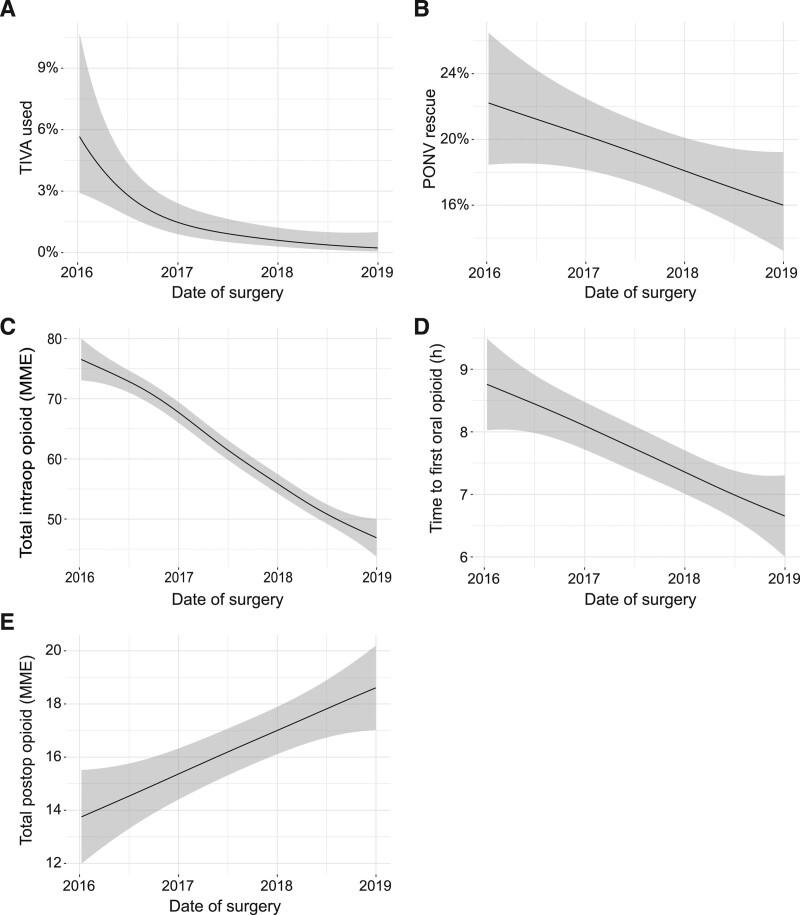
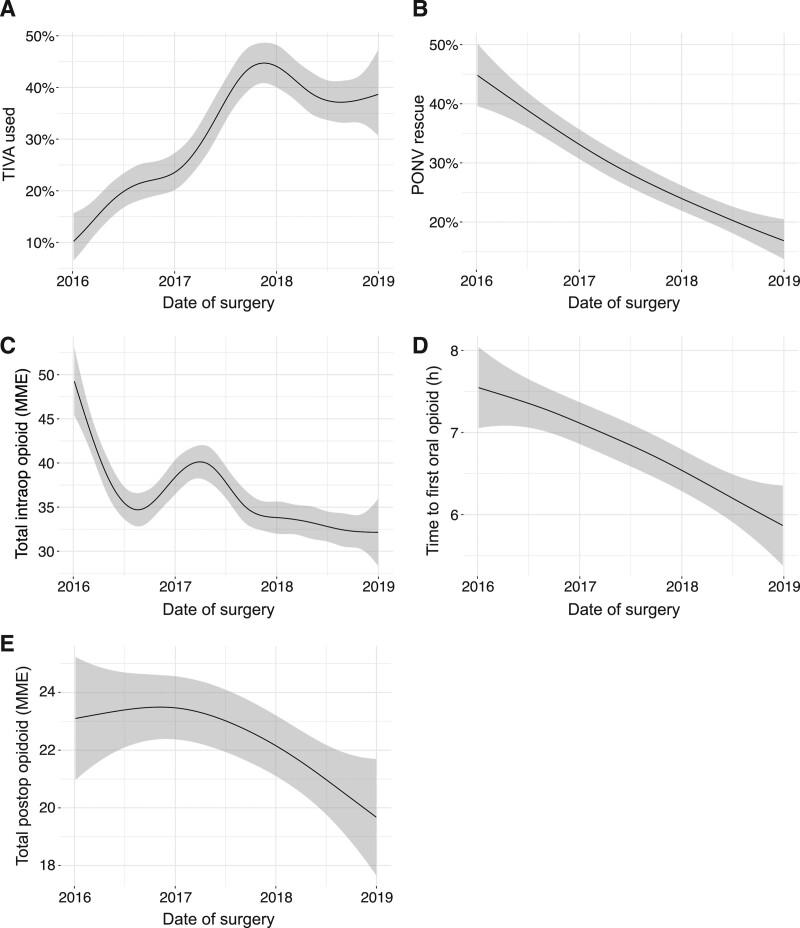
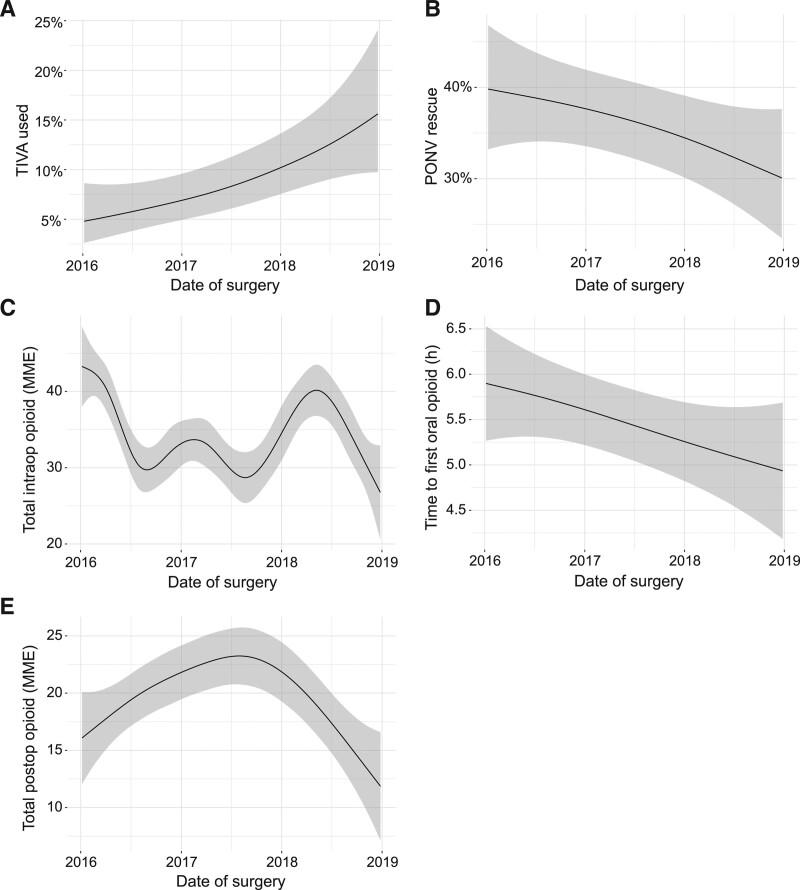
We analyzed 6781 ambulatory surgery cases (2965 mastectomies, 1099 hysterectomies, 680 thyroidectomies, and 1976 prostatectomies). PONV rescue decreased most appreciably for mastectomy (28% decrease; 95% confidence interval [CI], -36 to -22). TIVA use increased for both mastectomies (28%; 95% CI, 20-40) and hysterectomies (58%; 95% CI, 46-76). Total intraoperative opioid administration decreased over time across all procedures. Time to first oral opioid decreased for all surgeries; decreases ranged from 0.96 hours (95% CI, 2.1-1.4) for thyroidectomies to 3.3 hours (95% CI, 4.5 to -1.7) for hysterectomies. Total postoperative opioid consumption did not change by a clinically meaningful degree for any surgery. Compliance with ERAS measures was generally high but varied among surgeries.
CONCLUSIONS
This quality improvement study demonstrates the feasibility of implementing ERAS at an ambulatory surgery center. However, the study did not include either a concurrent or preintervention control so that further studies are needed to assess whether there is an association between implementation of ERAS components and improvements in outcomes. Nevertheless, we provide benchmarking data on postoperative outcomes during the first 3 years of ERAS implementation. Our findings reflect progressive improvement achieved through continuous feedback and education of staff.
背景
我们描述了在一个日间癌症手术中心实施旨在最小化术后恶心和呕吐(PONV)和疼痛发生率并减少阿片类药物使用的手术后恢复增强(ERAS)方案的情况。ERAS 的关键组成部分包括术前对术后过程的患者教育、术前充分补液、标准化 PONV 预防、术中适当的液体管理以及各阶段的多模式镇痛。
方法
我们回顾性分析了 2016 年 1 月至 2018 年 12 月期间在我们机构接受乳房切除术(伴或不伴即刻重建)、微创子宫切除术、甲状腺切除术或微创前列腺切除术的患者数据。收集的数据包括全静脉麻醉(TIVA)的使用、PONV 解救率、首次口服阿片类药物的时间以及总术中及术后阿片类药物的使用量。为每个服务确定了对 ERAS 元素的遵守情况。质量结果包括首次下床活动的时间、术后住院时间(LOS)、再次手术率、转至急性护理医院的比例、30 天再入院率和 30 天内紧急就诊率。
结果
我们分析了 6781 例日间手术病例(2965 例乳房切除术、1099 例子宫切除术、680 例甲状腺切除术和 1976 例前列腺切除术)。乳房切除术的 PONV 解救明显减少(减少 28%;95%置信区间[CI],-36 至-22)。TIVA 的使用在乳房切除术(28%;95% CI,20-40)和子宫切除术(58%;95% CI,46-76)中均增加。所有手术的总术中阿片类药物用量随时间减少。所有手术的首次口服阿片类药物时间均缩短;甲状腺切除术的降幅为 0.96 小时(95% CI,2.1-1.4),子宫切除术的降幅为 3.3 小时(95% CI,4.5 至-1.7)。任何手术的总术后阿片类药物用量均无明显变化。ERAS 措施的依从性总体较高,但因手术而异。
结论
这项质量改进研究表明,在日间手术中心实施 ERAS 是可行的。然而,该研究既没有采用同期对照,也没有采用干预前对照,因此需要进一步研究以评估实施 ERAS 各组成部分与改善结果之间是否存在关联。尽管如此,我们还是提供了 ERAS 实施的头 3 年期间术后结果的基准数据。我们的研究结果反映了通过对员工的持续反馈和教育而取得的渐进性改善。

 Zotero 插件