
预测哺乳动物传播 SARS-CoV-2 的人畜共患能力。
Predicting the zoonotic capacity of mammals to transmit SARS-CoV-2.
机构信息
Cary Institute of Ecosystem Studies, Box AB Millbrook, NY 12545, USA.
Department of Structural Biology, Stanford University School of Medicine, Stanford, CA 94305, USA.
出版信息
Proc Biol Sci. 2021 Nov 24;288(1963):20211651. doi: 10.1098/rspb.2021.1651. Epub 2021 Nov 17.
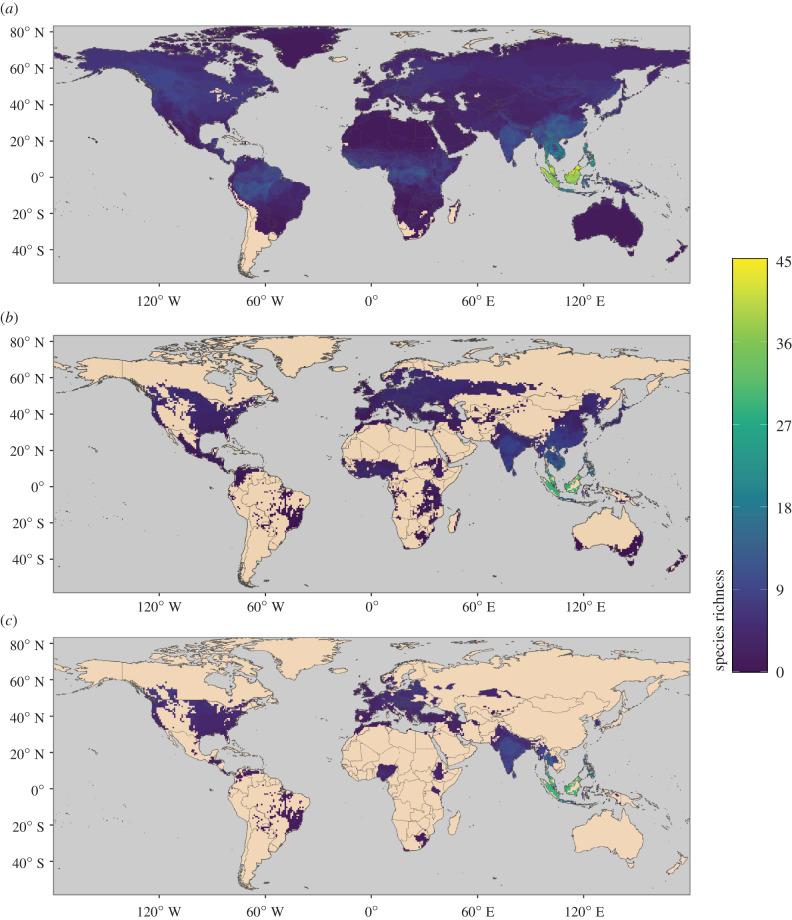
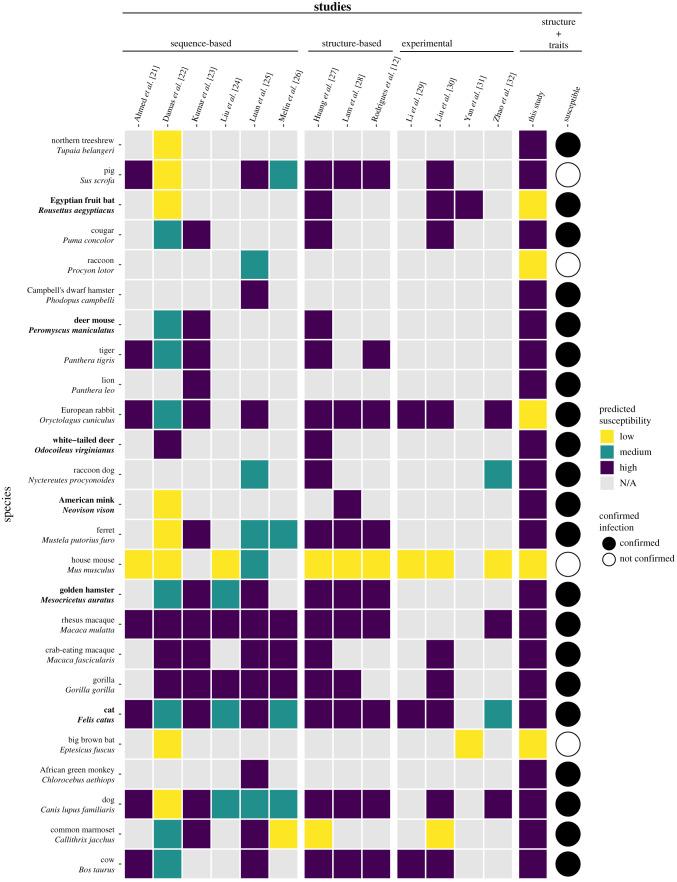
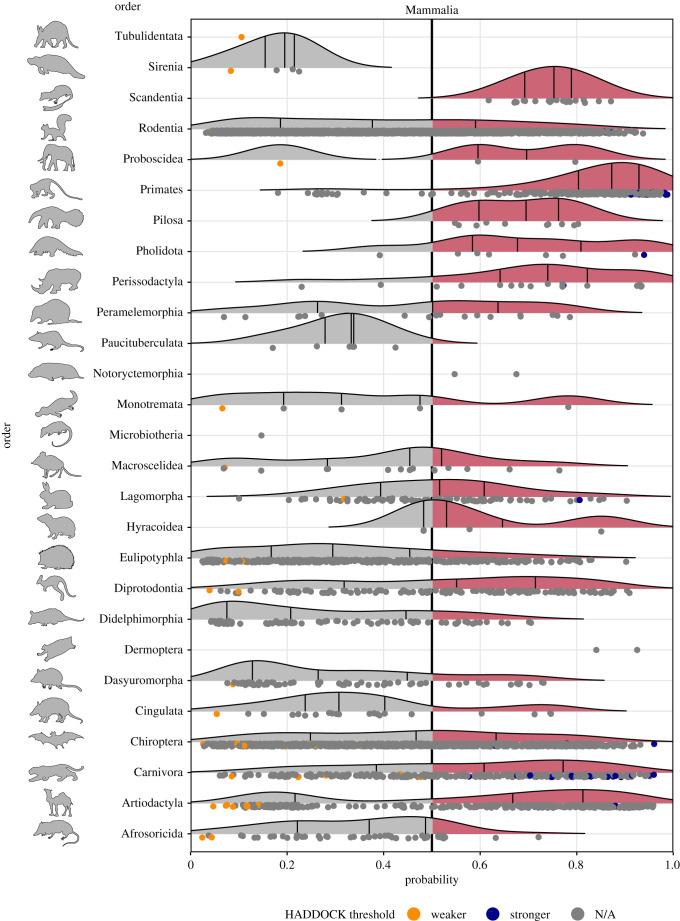
Back and forth transmission of severe acute respiratory syndrome coronavirus 2 (SARS-CoV-2) between humans and animals will establish wild reservoirs of virus that endanger long-term efforts to control COVID-19 in people and to protect vulnerable animal populations. Better targeting surveillance and laboratory experiments to validate zoonotic potential requires predicting high-risk host species. A major bottleneck to this effort is the few species with available sequences for angiotensin-converting enzyme 2 receptor, a key receptor required for viral cell entry. We overcome this bottleneck by combining species' ecological and biological traits with three-dimensional modelling of host-virus protein-protein interactions using machine learning. This approach enables predictions about the zoonotic capacity of SARS-CoV-2 for greater than 5000 mammals-an order of magnitude more species than previously possible. Our predictions are strongly corroborated by studies. The predicted zoonotic capacity and proximity to humans suggest enhanced transmission risk from several common mammals, and priority areas of geographic overlap between these species and global COVID-19 hotspots. With molecular data available for only a small fraction of potential animal hosts, linking data across biological scales offers a conceptual advance that may expand our predictive modelling capacity for zoonotic viruses with similarly unknown host ranges.
严重急性呼吸综合征冠状病毒 2(SARS-CoV-2)在人类和动物之间的来回传播将建立病毒的野生动物宿主,这将危及人们长期控制 COVID-19 和保护脆弱动物种群的努力。更好地针对监测和实验室实验来验证人畜共患病潜力需要预测高风险宿主物种。这方面的一个主要瓶颈是,用于血管紧张素转换酶 2 受体(一种病毒细胞进入所需的关键受体)的少数物种具有可用序列。我们通过将物种的生态和生物学特征与使用机器学习进行的宿主-病毒蛋白-蛋白相互作用的三维建模相结合来克服这一瓶颈。这种方法可以对 SARS-CoV-2 的超过 5000 种哺乳动物的人畜共患病能力进行预测——比以前可能的物种数量多一个数量级。我们的预测得到了研究的强烈证实。预测的人畜共患病能力和与人类的接近程度表明,从几种常见哺乳动物传播的风险增加,这些物种与全球 COVID-19 热点地区之间存在优先的地理重叠区域。由于仅有一小部分潜在动物宿主具有分子数据,因此跨生物尺度链接数据提供了一个概念上的进步,这可能会扩大我们对具有类似未知宿主范围的人畜共患病病毒的预测建模能力。

 Zotero 插件