
T细胞双特异性抗体:一种基于抗体的诱导抗肿瘤免疫的递送系统。
T Cell Bispecific Antibodies: An Antibody-Based Delivery System for Inducing Antitumor Immunity.
作者信息
Kamakura Daisuke, Asano Ryutaro, Yasunaga Masahiro
机构信息
Division of Developmental Therapeutics, Exploratory Oncology Research & Clinical Trial Center, National Cancer Center, Kashiwa 277-8577, Japan.
Department on Biotechnology and Life Science, Graduate School of Engineering, Tokyo University of Agriculture and Technology, Tokyo 184-8588, Japan.
出版信息
Pharmaceuticals (Basel). 2021 Nov 17;14(11):1172. doi: 10.3390/ph14111172.
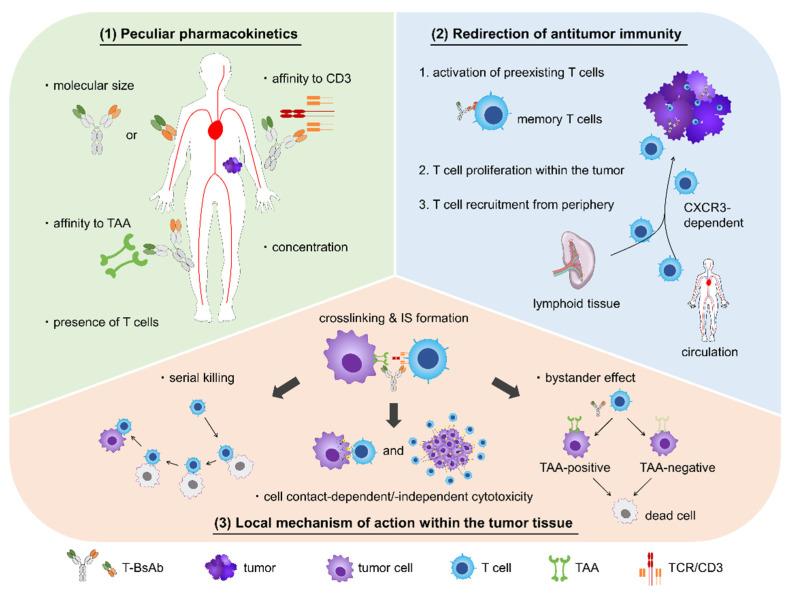
As a breakthrough immunotherapy, T cell bispecific antibodies (T-BsAbs) are a promising antibody therapy for various kinds of cancer. In general, T-BsAbs have dual-binding specificity to a tumor-associated antigen and a CD3 subunit forming a complex with the TCR. This enables T-BsAbs to crosslink tumor cells and T cells, inducing T cell activation and subsequent tumor cell death. Unlike immune checkpoint inhibitors, which release the brake of the immune system, T-BsAbs serve as an accelerator of T cells by stimulating their immune response via CD3 engagement. Therefore, they can actively redirect host immunity toward tumors, including T cell recruitment from the periphery to the tumor site and immunological synapse formation between tumor cells and T cells. Although the low immunogenicity of solid tumors increases the challenge of cancer immunotherapy, T-BsAbs capable of immune redirection can greatly benefit patients with such tumors. To investigate the detailed relationship between T-BsAbs delivery and their T cell redirection activity, it is necessary to determine how T-BsAbs deliver antitumor immunity to the tumor site and bring about tumor cell death. This review article discusses T-BsAb properties, specifically their pharmacokinetics, redirection of anticancer immunity, and local mechanism of action within tumor tissues, and discuss further challenges to expediting T-BsAb development.
作为一种突破性的免疫疗法,T细胞双特异性抗体(T-BsAbs)是一种用于治疗各类癌症的有前景的抗体疗法。一般来说,T-BsAbs对肿瘤相关抗原和与TCR形成复合物的CD3亚基具有双重结合特异性。这使得T-BsAbs能够交联肿瘤细胞和T细胞,诱导T细胞活化及随后的肿瘤细胞死亡。与释放免疫系统刹车的免疫检查点抑制剂不同,T-BsAbs通过与CD3结合刺激T细胞的免疫反应,从而充当T细胞的加速器。因此,它们可以积极地将宿主免疫重定向到肿瘤,包括将外周T细胞募集到肿瘤部位以及在肿瘤细胞和T细胞之间形成免疫突触。尽管实体瘤的低免疫原性增加了癌症免疫治疗的挑战,但能够进行免疫重定向的T-BsAbs可以使患有此类肿瘤的患者大大受益。为了研究T-BsAbs递送与其T细胞重定向活性之间的详细关系,有必要确定T-BsAbs如何将抗肿瘤免疫力递送至肿瘤部位并导致肿瘤细胞死亡。这篇综述文章讨论了T-BsAb的特性,特别是其药代动力学、抗癌免疫重定向以及在肿瘤组织内的局部作用机制,并探讨了加速T-BsAb开发面临的进一步挑战。
 Zotero 插件