
空间编码缺陷的海马神经整体钙活动在三转基因阿尔茨海默病小鼠模型。
Spatial coding defects of hippocampal neural ensemble calcium activities in the triple-transgenic Alzheimer's disease mouse model.
机构信息
Department of Anatomy and Neurobiology, School of Medicine, University of California, Irvine, CA 92697, United States of America.
Department of Anatomy and Neurobiology, School of Medicine, University of California, Irvine, CA 92697, United States of America; Department of Biomedical Engineering, University of California, Irvine, CA 92697, United States of America.
出版信息
Neurobiol Dis. 2022 Jan;162:105562. doi: 10.1016/j.nbd.2021.105562. Epub 2021 Nov 24.
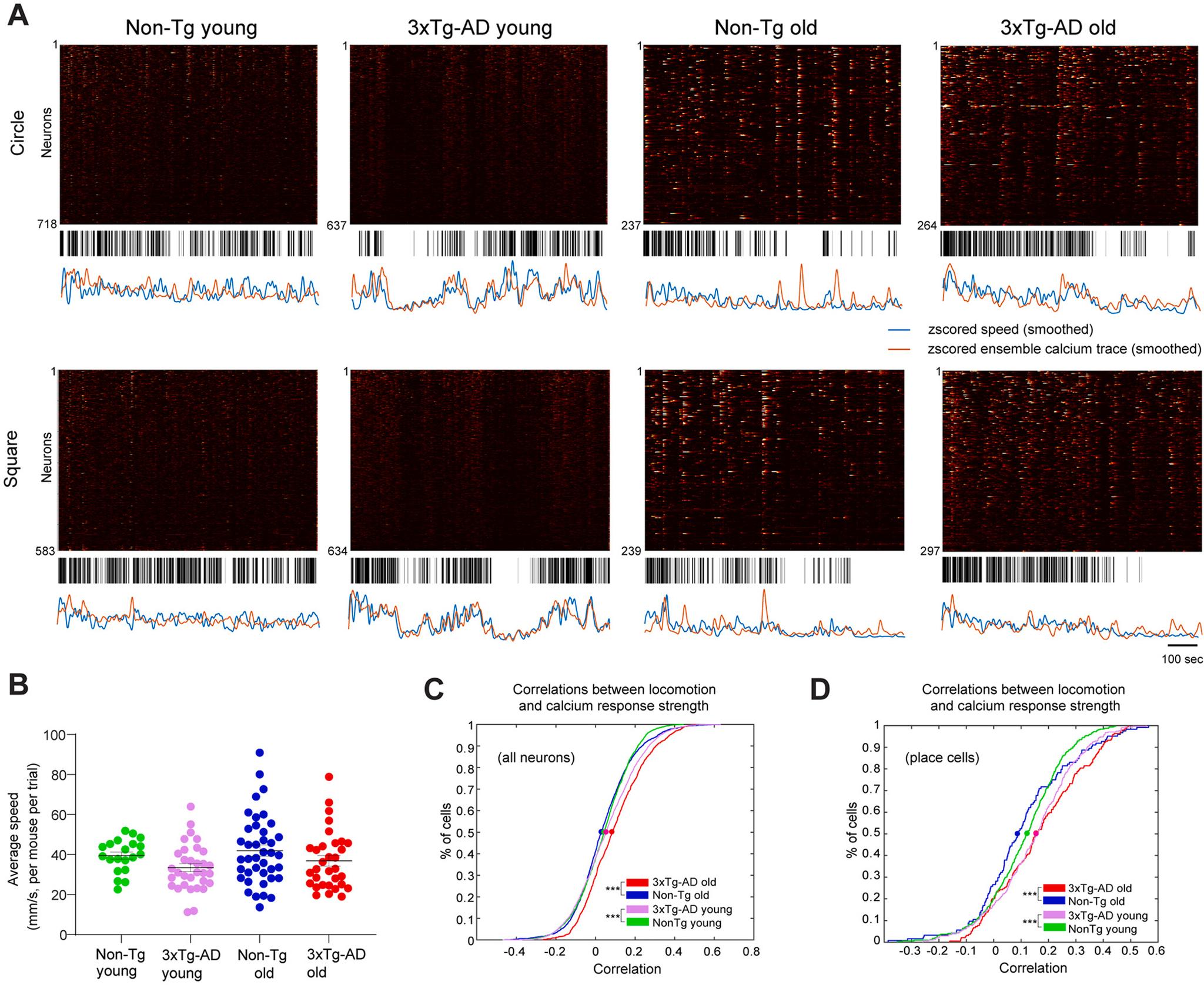
Alzheimer's disease (AD) causes progressive age-related defects in memory and cognitive function and has emerged as a major health and socio-economic concern in the US and worldwide. To develop effective therapeutic treatments for AD, we need to better understand the neural mechanisms by which AD causes memory loss and cognitive deficits. Here we examine large-scale hippocampal neural population calcium activities imaged at single cell resolution in a triple-transgenic Alzheimer's disease mouse model (3xTg-AD) that presents both amyloid plaque and neurofibrillary pathological features along with age-related behavioral defects. To measure encoding of environmental location in hippocampal neural ensembles in the 3xTg-AD mice in vivo, we performed GCaMP6-based calcium imaging using head-mounted, miniature fluorescent microscopes ("miniscopes") on freely moving animals. We compared hippocampal CA1 excitatory neural ensemble activities during open-field exploration and track-based route-running behaviors in age-matched AD and control mice at young (3-6.5 months old) and old (18-21 months old) ages. During open-field exploration, 3xTg-AD CA1 excitatory cells display significantly higher calcium activity rates compared with Non-Tg controls for both the young and old age groups, suggesting that in vivo enhanced neuronal calcium ensemble activity is a disease feature. CA1 neuronal populations of 3xTg-AD mice show lower spatial information scores compared with control mice. The spatial firing of CA1 neurons of old 3xTg-AD mice also displays higher sparsity and spatial coherence, indicating less place specificity for spatial representation. We find locomotor speed significantly modulates the amplitude of hippocampal neural calcium ensemble activities to a greater extent in 3xTg-AD mice during open field exploration. Our data offer new and comprehensive information about age-dependent neural circuit activity changes in this important AD mouse model and provide strong evidence that spatial coding defects in the neuronal population activities are associated with AD pathology and AD-related memory behavioral deficits.
阿尔茨海默病(AD)导致与年龄相关的记忆和认知功能进行性缺陷,已成为美国和全球主要的健康和社会经济关注点。为了开发有效的 AD 治疗方法,我们需要更好地了解 AD 导致记忆丧失和认知缺陷的神经机制。在这里,我们检查了在具有淀粉样斑块和神经纤维状病理特征以及与年龄相关的行为缺陷的三重转基因 AD 小鼠模型(3xTg-AD)中以单细胞分辨率成像的大规模海马神经群体钙活动。为了测量 3xTg-AD 小鼠海马神经群体在体内对环境位置的编码,我们在自由移动的动物上使用基于 GCaMP6 的钙成像进行了头部安装的微型荧光显微镜(“miniscopes”)。我们比较了年龄匹配的 AD 和对照组小鼠在年轻(3-6.5 个月大)和老年(18-21 个月大)时在开放场探索和基于轨迹的奔跑行为期间海马 CA1 兴奋性神经群体活动。在开放场探索期间,与非Tg 对照相比,3xTg-AD CA1 兴奋性细胞在年轻和老年组中均显示出显着更高的钙活动率,这表明体内增强的神经元钙群体活动是一种疾病特征。与对照组相比,3xTg-AD 小鼠的 CA1 神经元群体显示出较低的空间信息评分。老年 3xTg-AD 小鼠 CA1 神经元的空间放电也显示出更高的稀疏性和空间相干性,表明空间表示的位置特异性较低。我们发现,在开放场探索过程中,3xTg-AD 小鼠的运动速度对海马神经钙群体活动幅度的调节作用要大得多。我们的数据提供了有关该重要 AD 小鼠模型中年龄依赖性神经回路活动变化的新的和全面的信息,并提供了有力的证据,表明神经元群体活动中的空间编码缺陷与 AD 病理学和 AD 相关的记忆行为缺陷有关。


 Zotero 插件