
Src 家族激酶活性是传递嘌呤能 P2X7 受体信号在皮质扩散抑制和神经炎症中的必需的。
Src family kinases activity is required for transmitting purinergic P2X7 receptor signaling in cortical spreading depression and neuroinflammation.
机构信息
Department of Biological Sciences, Centre for Neuroscience, Xi'an Jiaotong-Liverpool University (XJTLU), 111 Ren Ai Road, Suzhou Industrial Park, Suzhou, 215123, P. R. China.
Department of Pharmacology and Therapeutics, Institute of Systems, Molecular and Integrative Biology, Liverpool, L69 7ZB, UK.
出版信息
J Headache Pain. 2021 Dec 4;22(1):146. doi: 10.1186/s10194-021-01359-8.
BACKGROUND
Purinergic P2X7 receptor plays an important role in migraine pathophysiology. Yet precise molecular mechanism underlying P2X7R signaling in migraine remains unclear. This study explores the hypothesis that P2X7 receptor transmits signaling to Src family kinases (SFKs) during cortical spreading depression (CSD) and neuroinflammation after CSD.
METHODS
CSD was recorded using electrophysiology in rats and intrinsic optical imaging in mouse brain slices. Cortical IL-1β and TNFα mRNA levels were detected using qPCR. Glutamate release from mouse brain slices was detected using glutamate assay.
RESULTS
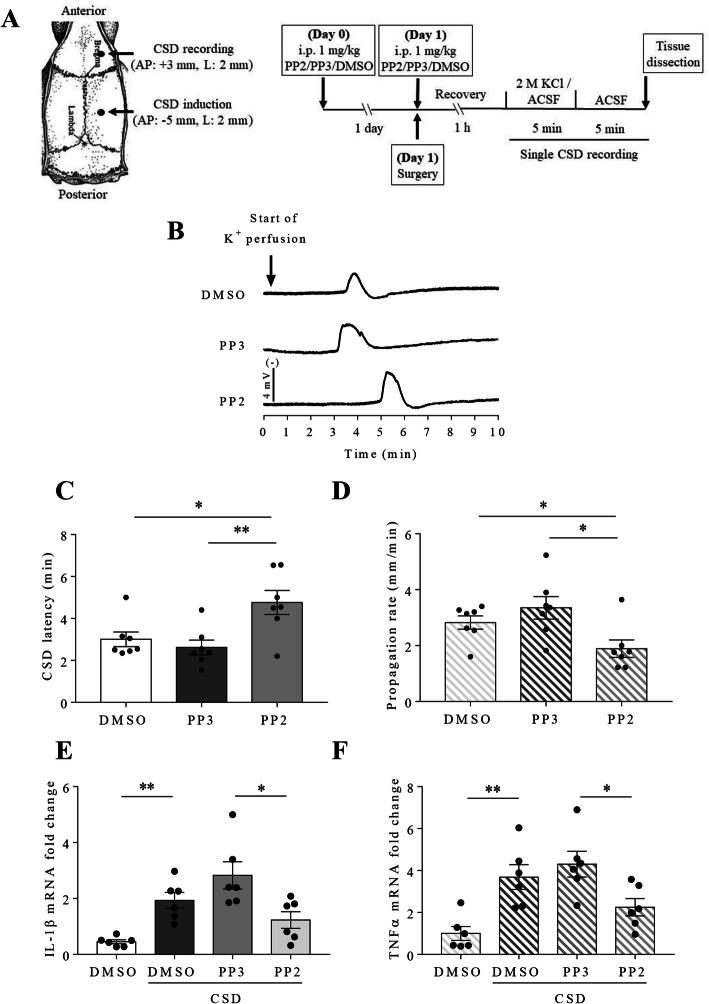
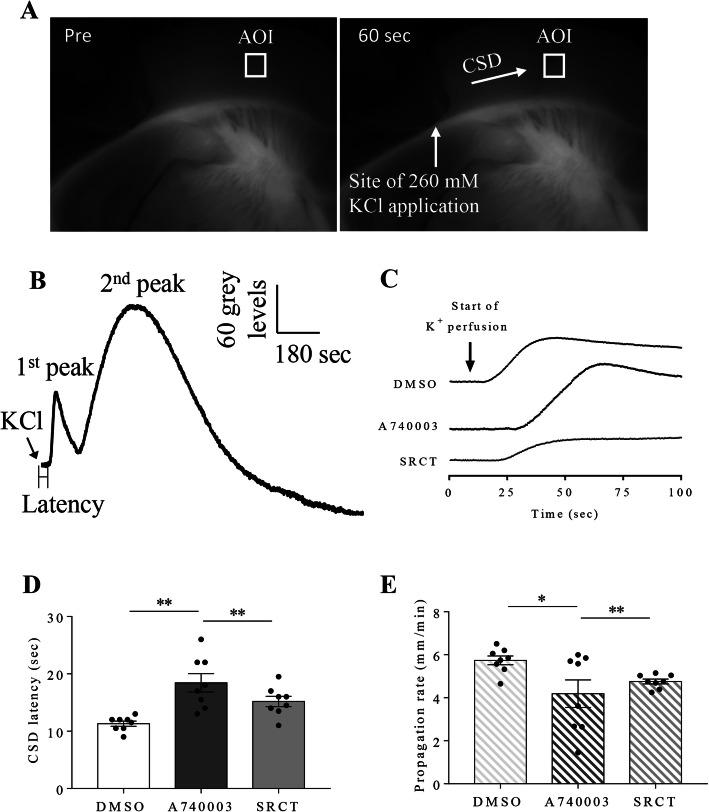
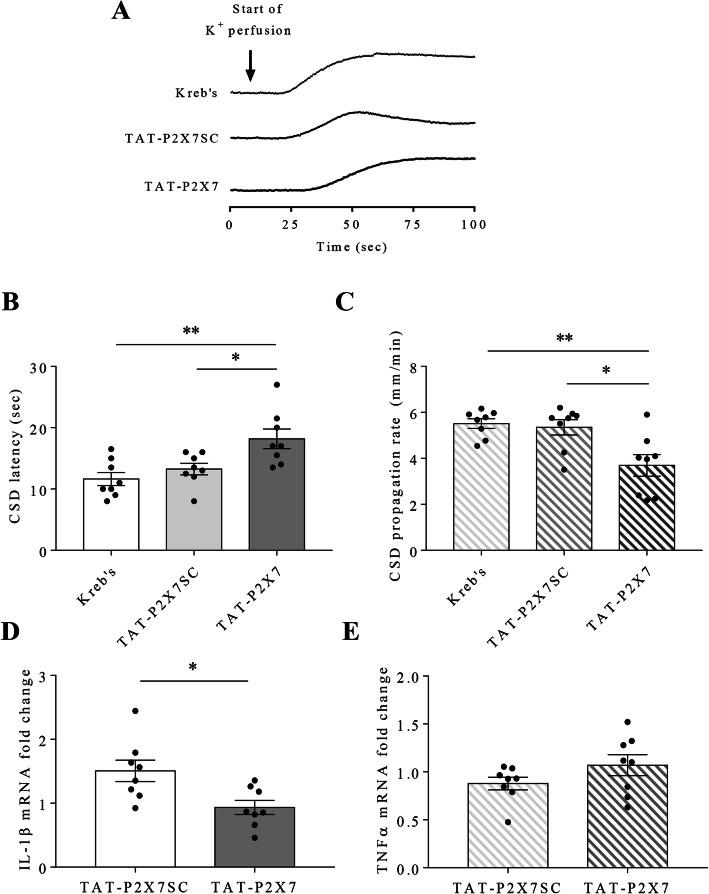
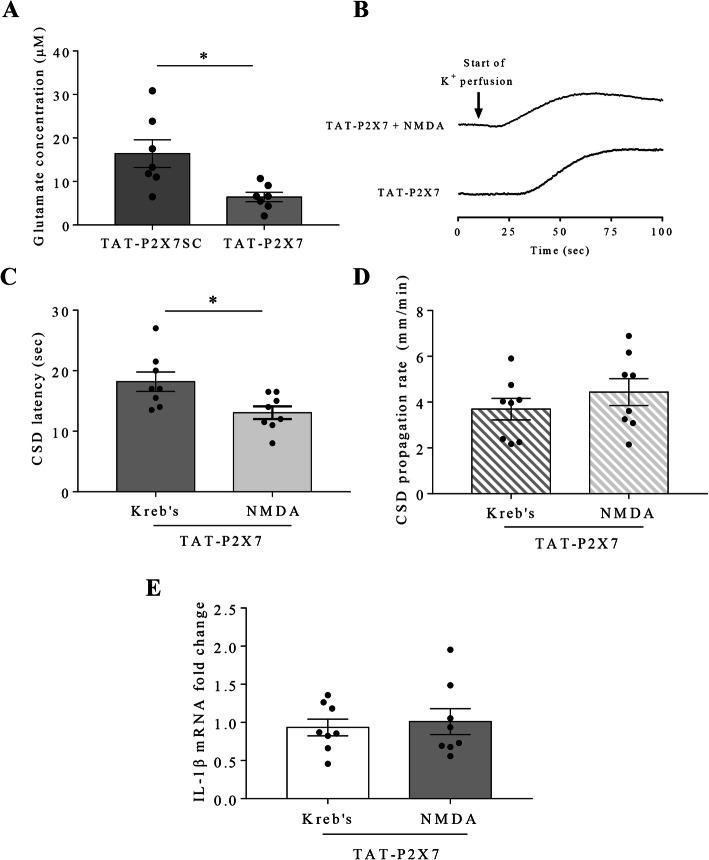
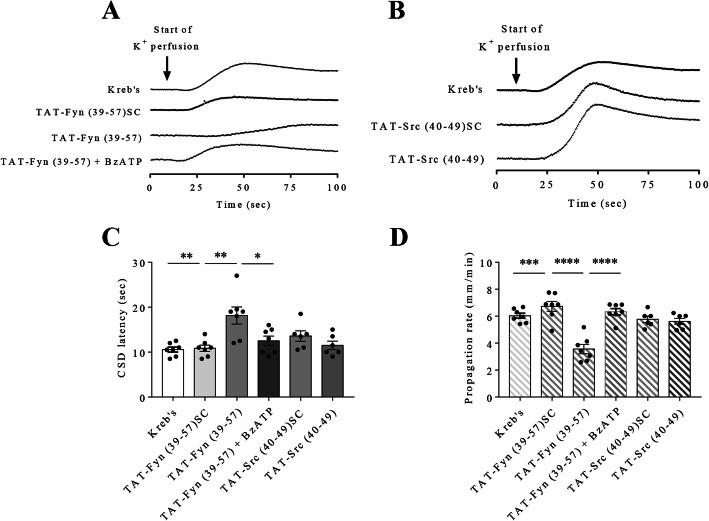
The data showed that deactivation of SFKs by systemic injection of PP2 reduced cortical susceptibility to CSD in rats and CSD-induced IL-1β and TNF-α gene expression in rat ipsilateral cortices. Consistently, in mouse brain slices, inhibition of SFKs activity by saracatinib and P2X7 receptor by A740003 similarly reduced cortical susceptibility to CSD. When the interaction of P2X7 receptor and SFKs was disrupted by TAT-P2X7, a marked reduction of cortical susceptibility to CSD, IL-1β gene expression and glutamate release after CSD induction were observed in mouse brain slices. The reduced cortical susceptibility to CSD by TAT-P2X7 was restored by NMDA, and disrupting the Fyn-NMDA interaction using TAT-Fyn (39-57) but not disrupting Src-NMDA receptor interaction using TAT-Src (40-49) reduced cortical susceptibility to CSD. Furthermore, activation of P2X7 receptor by BzATP restored the TAT-Fyn (39-57)-reduced cortical susceptibility to CSD.
CONCLUSION
This study reveals that SFKs activity transmits P2X7 receptor signaling to facilitate CSD propagation via glutamatergic pathway and promote neuroinflammation, which is of particular relevance to migraine.
背景
嘌呤能 P2X7 受体在偏头痛病理生理学中发挥重要作用。然而,P2X7R 信号在偏头痛中的精确分子机制尚不清楚。本研究旨在探讨 P2X7 受体在皮质扩散性抑制(CSD)和 CSD 后神经炎症期间向 Src 家族激酶(SFKs)传递信号的假说。
方法
采用大鼠皮质电生理学和小鼠脑片内光学成像记录 CSD;采用 qPCR 检测皮质白细胞介素-1β(IL-1β)和肿瘤坏死因子-α(TNFα)mRNA 水平;采用谷氨酸测定法检测小鼠脑片谷氨酸释放。
结果
研究数据表明,全身注射 PP2 使 SFKs 失活可降低大鼠皮质对 CSD 的易感性,并降低大鼠对侧皮质 CSD 诱导的 IL-1β 和 TNFα 基因表达。同样,在小鼠脑片中,使用 saracatinib 和 A740003 抑制 SFKs 活性和 P2X7 受体也可降低皮质对 CSD 的易感性。当 TAT-P2X7 破坏 P2X7 受体和 SFKs 之间的相互作用时,观察到 CSD 诱导后皮质对 CSD 的易感性、IL-1β 基因表达和谷氨酸释放明显减少。用 NMDA 恢复 TAT-P2X7 降低的皮质对 CSD 的易感性,而用 TAT-Fyn(39-57)而非 TAT-Src(40-49)破坏 Fyn-NMDA 相互作用可降低皮质对 CSD 的易感性。此外,BzATP 激活 P2X7 受体可恢复 TAT-Fyn(39-57)降低的皮质对 CSD 的易感性。
结论
本研究揭示了 SFKs 活性通过谷氨酸能途径传递 P2X7 受体信号,促进 CSD 传播并促进神经炎症,这与偏头痛尤其相关。

 Zotero 插件