
细胞外囊泡分子特征可表征卵巢癌转移动态性
Extracellular Vesicle Molecular Signatures Characterize Metastatic Dynamicity in Ovarian Cancer.
作者信息
Gonda Amber, Zhao Nanxia, Shah Jay V, Siebert Jake N, Gunda Srujanesh, Inan Berk, Kwon Mijung, Libutti Steven K, Moghe Prabhas V, Francis Nicola L, Ganapathy Vidya
机构信息
Department of Biomedical Engineering, Rutgers University, Piscataway, NJ, United States.
Department of Chemical and Biochemical Engineering, Rutgers University, Piscataway, NJ, United States.
出版信息
Front Oncol. 2021 Nov 18;11:718408. doi: 10.3389/fonc.2021.718408. eCollection 2021.
BACKGROUND
Late-stage diagnosis of ovarian cancer, a disease that originates in the ovaries and spreads to the peritoneal cavity, lowers 5-year survival rate from 90% to 30%. Early screening tools that can: i) detect with high specificity and sensitivity before conventional tools such as transvaginal ultrasound and CA-125, ii) use non-invasive sampling methods and iii) longitudinally significantly increase survival rates in ovarian cancer are needed. Studies that employ blood-based screening tools using circulating tumor-cells, -DNA, and most recently tumor-derived small extracellular vesicles (sEVs) have shown promise in non-invasive detection of cancer before standard of care. Our findings in this study show the promise of a sEV-derived signature as a non-invasive longitudinal screening tool in ovarian cancer.
METHODS
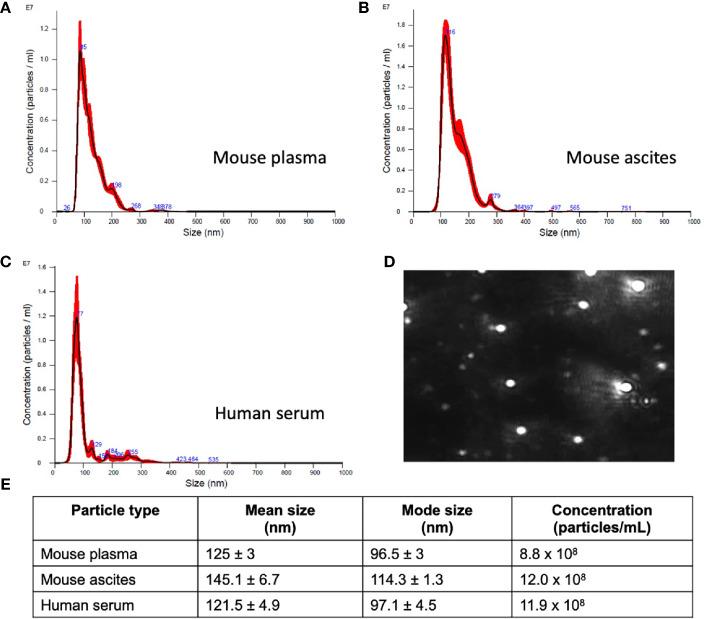
Human serum samples as well as plasma and ascites from a mouse model of ovarian cancer were collected at various disease stages. Small extracellular vesicles (sEVs) were extracted using a commercially available kit. RNA was isolated from lysed sEVs, and quantitative RT-PCR was performed to identify specific metastatic gene expression.
CONCLUSION
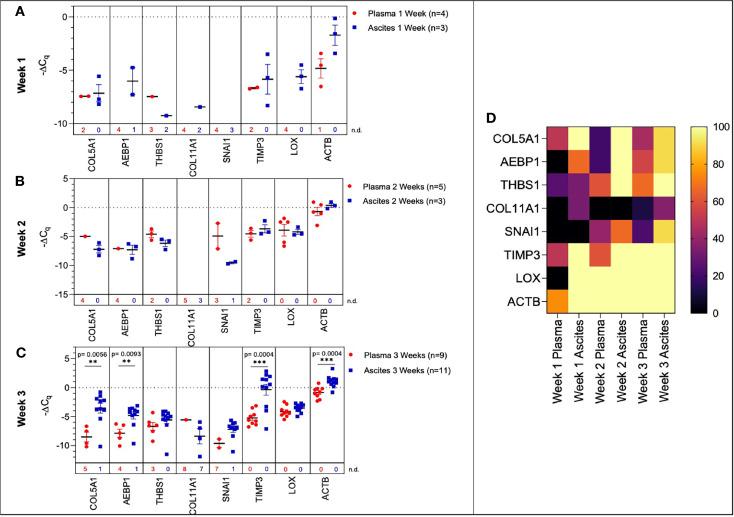
This paper highlights the potential of sEVs in monitoring ovarian cancer progression and metastatic development. We identified a 7-gene panel in sEVs derived from plasma, serum, and ascites that overlapped with an established metastatic ovarian carcinoma signature. We found the 7-gene panel to be differentially expressed with tumor development and metastatic spread in a mouse model of ovarian cancer. The most notable finding was a significant change in the ascites-derived sEV gene signature that overlapped with that of the plasma-derived sEV signature at varying stages of disease progression. While there were quantifiable changes in genes from the 7-gene panel in serum-derived sEVs from ovarian cancer patients, we were unable to establish a definitive signature due to low sample number. Taken together our findings show that differential expression of metastatic genes derived from circulating sEVs present a minimally invasive screening tool for ovarian cancer detection and longitudinal monitoring of molecular changes associated with progression and metastatic spread.
背景
卵巢癌起源于卵巢并扩散至腹腔,晚期诊断会使5年生存率从90%降至30%。因此,需要一种早期筛查工具,该工具能够:i)在经阴道超声和CA - 125等传统工具之前进行高特异性和高灵敏度检测;ii)采用非侵入性采样方法;iii)在卵巢癌中显著提高纵向生存率。使用基于血液的筛查工具,检测循环肿瘤细胞、肿瘤DNA以及最近的肿瘤来源小细胞外囊泡(sEV)的研究,在癌症的非侵入性检测方面已显示出优于标准护理的前景。我们在本研究中的发现表明,sEV衍生的标志物有望作为卵巢癌的非侵入性纵向筛查工具。
方法
在不同疾病阶段收集人血清样本以及卵巢癌小鼠模型的血浆和腹水。使用市售试剂盒提取小细胞外囊泡(sEV)。从裂解的sEV中分离RNA,并进行定量RT - PCR以鉴定特定转移基因的表达。
结论
本文强调了sEV在监测卵巢癌进展和转移发展方面的潜力。我们在源自血浆、血清和腹水的sEV中鉴定出一个7基因组合,该组合与已确立的转移性卵巢癌标志物重叠。我们发现该7基因组合在卵巢癌小鼠模型中随肿瘤发展和转移扩散而差异表达。最显著的发现是,在疾病进展的不同阶段,腹水中衍生的sEV基因标志物与血浆中衍生的sEV标志物发生了显著变化。虽然卵巢癌患者血清中衍生的sEV的7基因组合中的基因存在可量化变化,但由于样本数量少,我们无法确定一个明确的标志物。综上所述,我们的研究结果表明,循环sEV衍生的转移基因的差异表达为卵巢癌检测以及与进展和转移扩散相关的分子变化的纵向监测提供了一种微创筛查工具。



 Zotero 插件