
可溶性 PD-L1 通过可变聚腺苷酸化在肺癌免疫治疗中充当诱饵。
Soluble PD-L1 works as a decoy in lung cancer immunotherapy via alternative polyadenylation.
机构信息
Division of Experimental Chemotherapy, Cancer Chemotherapy Center, Japanese Foundation for Cancer Research (JFCR), Ariake, Koto-ku, Tokyo, Japan.
Department of Respiratory Medicine, Tokyo Medical and Dental University, Yushima, Bunkyo-ku, Tokyo, Japan.
出版信息
JCI Insight. 2022 Jan 11;7(1):e153323. doi: 10.1172/jci.insight.153323.
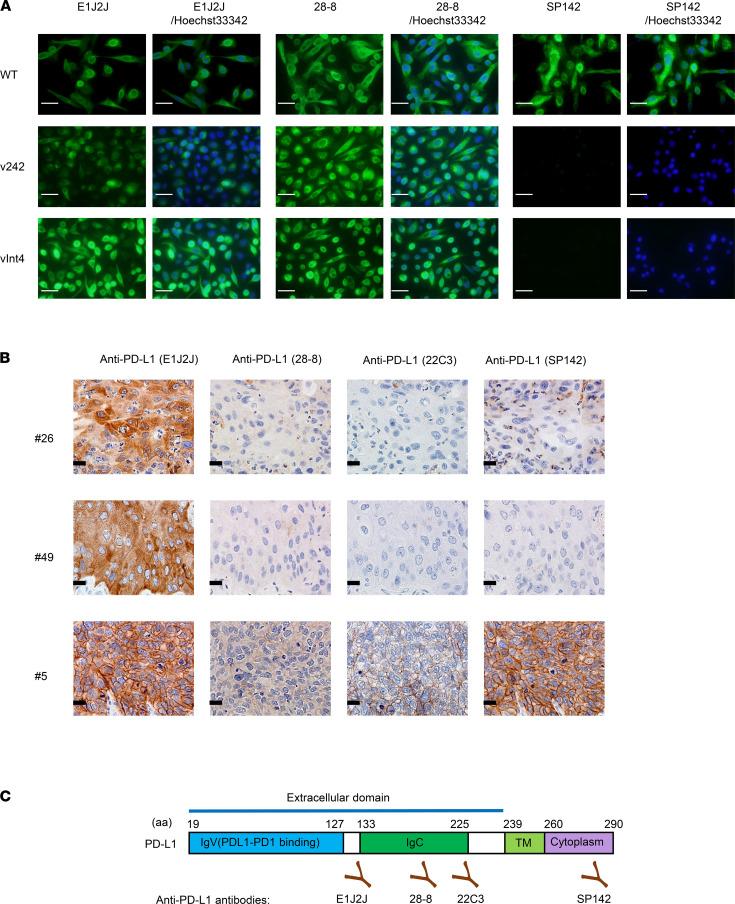
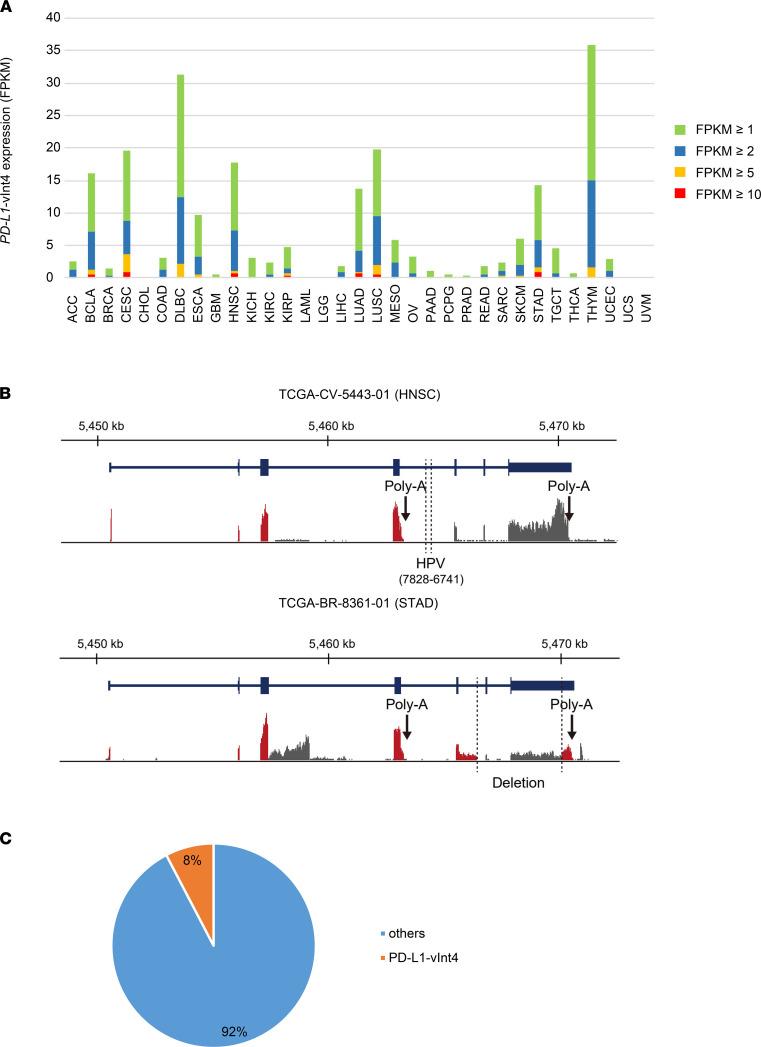
Immune checkpoint therapy targeting the PD-1/PD-L1 axis is a potentially novel development in anticancer therapy and has been applied to clinical medicine. However, there are still some problems, including a relatively low response rate, innate mechanisms of resistance against immune checkpoint blockades, and the absence of reliable biomarkers to predict responsiveness. In this study of in vitro and in vivo models, we demonstrate that PD-L1-vInt4, a splicing variant of PD-L1, plays a role as a decoy in anti-PD-L1 antibody treatment. First, we showed that PD-L1-vInt4 was detectable in clinical samples and that it was possible to visualize the secreting variants with IHC. By overexpressing the PD-L1-secreted splicing variant on MC38 cells, we observed that an immune-suppressing effect was not induced by their secretion alone. We then demonstrated that PD-L1-vInt4 secretion resisted anti-PD-L1 antibody treatment, compared with WT PD-L1, which was explicable by the PD-L1-vInt4's decoying of the anti-PD-L1 antibody. The decoying function of PD-L1 splicing variants may be one of the reasons for cancers being resistant to anti-PD-L1 therapy. Measuring serum PD-L1 levels might be helpful in deciding the therapeutic strategy.
免疫检查点疗法靶向 PD-1/PD-L1 轴是癌症治疗中一种潜在的新进展,已应用于临床医学。然而,仍存在一些问题,包括相对较低的反应率、对免疫检查点阻断的固有抵抗机制以及缺乏可靠的生物标志物来预测反应性。在本研究的体外和体内模型中,我们证明 PD-L1-vInt4,即 PD-L1 的剪接变体,在抗 PD-L1 抗体治疗中充当诱饵。首先,我们表明 PD-L1-vInt4 在临床样本中可检测到,并且可以通过 IHC 可视化分泌变体。通过在 MC38 细胞上过表达 PD-L1 分泌的剪接变体,我们观察到其单独分泌不会诱导免疫抑制作用。然后,我们证明与 WT PD-L1 相比,PD-L1-vInt4 的分泌能抵抗抗 PD-L1 抗体治疗,这可以用 PD-L1-vInt4 对抗 PD-L1 抗体的诱饵作用来解释。PD-L1 剪接变体的诱饵功能可能是癌症对抗 PD-L1 治疗产生耐药性的原因之一。测量血清 PD-L1 水平可能有助于决定治疗策略。




 Zotero 插件