
评估 Deep Neural Network ProSPr 对 CASP14 目标的蛋白质距离的准确预测。
Evaluation of Deep Neural Network ProSPr for Accurate Protein Distance Predictions on CASP14 Targets.
机构信息
Department of Physics and Astronomy, Brigham Young University, Provo, UT 84602, USA.
Department of Computer Science, Brigham Young University, Provo, UT 84602, USA.
出版信息
Int J Mol Sci. 2021 Nov 27;22(23):12835. doi: 10.3390/ijms222312835.
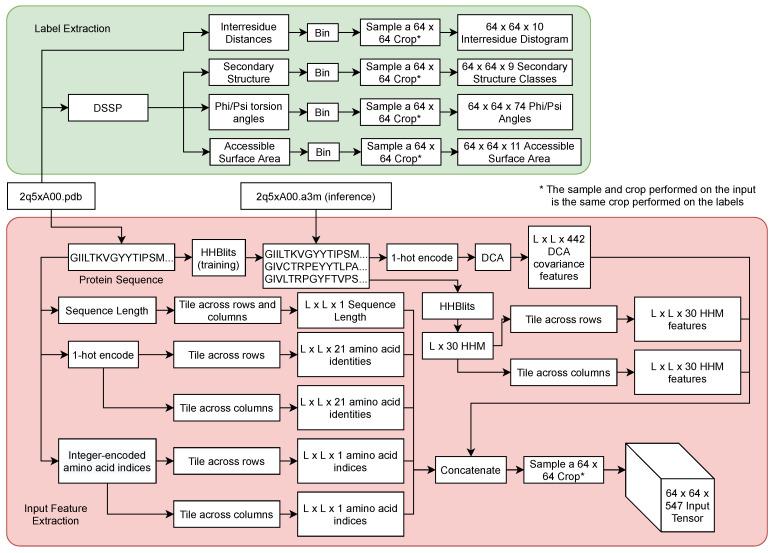
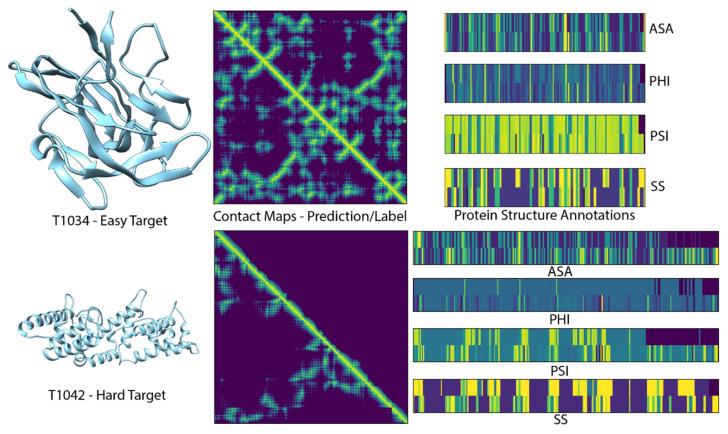
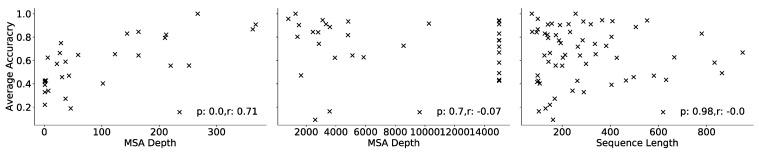
The field of protein structure prediction has recently been revolutionized through the introduction of deep learning. The current state-of-the-art tool AlphaFold2 can predict highly accurate structures; however, it has a prohibitively long inference time for applications that require the folding of hundreds of sequences. The prediction of protein structure annotations, such as amino acid distances, can be achieved at a higher speed with existing tools, such as the ProSPr network. Here, we report on important updates to the ProSPr network, its performance in the recent Critical Assessment of Techniques for Protein Structure Prediction (CASP14) competition, and an evaluation of its accuracy dependency on sequence length and multiple sequence alignment depth. We also provide a detailed description of the architecture and the training process, accompanied by reusable code. This work is anticipated to provide a solid foundation for the further development of protein distance prediction tools.
近年来,深度学习的引入彻底改变了蛋白质结构预测领域。目前最先进的工具 AlphaFold2 可以预测出高度精确的结构;然而,对于需要折叠数百个序列的应用程序来说,其推理时间过长。现有的 ProSPr 网络等工具可以更快地预测蛋白质结构注释,例如氨基酸距离。在这里,我们报告了 ProSPr 网络的重要更新、它在最近的蛋白质结构预测技术评估 (CASP14) 竞赛中的表现,以及对其准确性对序列长度和多重序列比对深度的依赖性的评估。我们还提供了对体系结构和训练过程的详细描述,并提供了可重复使用的代码。这项工作有望为进一步开发蛋白质距离预测工具奠定坚实的基础。

 Zotero 插件