
与抗吸收药物相比,罗莫单抗对绝经后骨质疏松症女性小梁骨评分的影响。
Effect of Romosozumab on Trabecular Bone Score Compared to Anti-Resorptive Agents in Postmenopausal Women with Osteoporosis.
作者信息
Jeong Chaiho, Kim Jinyoung, Lim Yejee, Ha Jeonghoon, Kang Moo Il, Baek Ki-Hyun
机构信息
Division of Endocrinology and Metabolism, Department of Internal Medicine, Uijeongbu St. Mary's Hospital, College of Medicine, The Catholic University of Korea, Seoul, Korea.
Division of Endocrinology and Metabolism, Department of Internal Medicine, Yeouido St. Mary's Hospital, College of Medicine, The Catholic University of Korea, Seoul, Korea.
出版信息
J Bone Metab. 2021 Nov;28(4):317-323. doi: 10.11005/jbm.2021.28.4.317. Epub 2021 Nov 30.
BACKGROUND
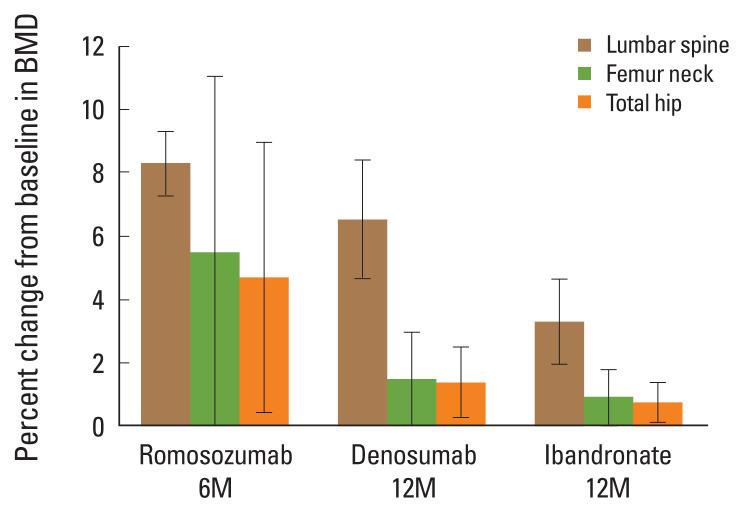
Romosozumab has shown significant improvement in bone mineral density (BMD) in previously reported trials. However, BMD reflects only bone strength and does not offer insight into the bone microarchitecture. The trabecular bone score (TBS) is a non-invasive tool used to assess bone microarchitecture. Several previous studies have evaluated the efficacy of anti-osteoporotic agents using the TBS. However, data regarding the potency of romosozumab based on the TBS is lacking. This retrospective observational cohort study demonstrated the impact of romosozumab use on the TBS.
METHODS
The primary outcome was the percentage change in the TBS from baseline to post-treatment. Postmenopausal osteoporosis patients were followed up for 6 and 12 months after romosozumab (210 mg monthly, N =10) and denosumab (60 mg every 6 months, N=21) or ibandronate (150 mg monthly, N=24) treatments, respectively. Patients who had previously used osteoporosis medications were included, if any the washout period was sufficient.
RESULTS
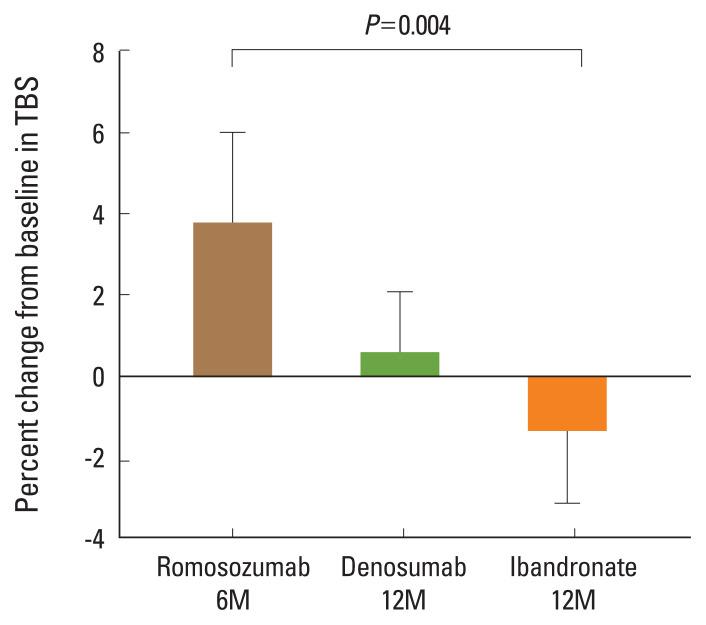
The percentage change in TBS from baseline to post-treatment was 2.53±2.98% (6 months, N=10; P=0.04), 0.59%±3.26% (12 months, N=21; P=0.48), and -0.45±3.66% (12 months, N=24; P=0.51) in the romosozumab, denosumab, and ibandronate groups, respectively. Romosozumab demonstrated a noticeable increase in TBS, although it did not reach the least significant change (5.8%) in TBS.
CONCLUSIONS
Romosozumab improved the TBS in postmenopausal women with osteoporosis. TBS may be potentially useful for monitoring romosozumab treatment.
背景
在先前报道的试验中,罗莫单抗已显示出骨矿物质密度(BMD)有显著改善。然而,BMD仅反映骨强度,无法深入了解骨微结构。小梁骨评分(TBS)是一种用于评估骨微结构的非侵入性工具。先前的几项研究已使用TBS评估抗骨质疏松药物的疗效。然而,缺乏基于TBS的罗莫单抗效力的数据。这项回顾性观察队列研究证明了使用罗莫单抗对TBS的影响。
方法
主要结局是从基线到治疗后的TBS百分比变化。绝经后骨质疏松症患者在接受罗莫单抗(每月210mg,N = 10)、地诺单抗(每6个月60mg,N = 21)或伊班膦酸钠(每月150mg,N = 24)治疗后分别随访6个月和12个月。纳入曾使用过骨质疏松症药物的患者,若有,洗脱期足够。
结果
罗莫单抗、地诺单抗和伊班膦酸钠组从基线到治疗后的TBS百分比变化分别为2.53±2.98%(6个月,N = 10;P = 0.04)、0.59%±3.26%(12个月,N = 21;P = 0.48)和 - 0.45±3.66%(12个月,N = 24;P = 0.51)。罗莫单抗显示TBS有明显增加,尽管未达到TBS的最小显著变化(5.8%)。
结论
罗莫单抗改善了绝经后骨质疏松症女性的TBS。TBS可能对监测罗莫单抗治疗有潜在作用。
 Zotero 插件