
结肠镜检查中异丙酚镇静期间的低血压:回顾性探索性分析和荟萃分析。
Hypotension during propofol sedation for colonoscopy: a retrospective exploratory analysis and meta-analysis.
机构信息
Faculty of Medicine and Dentistry, University of Plymouth, Plymouth, UK.
Department of Anesthesiology, University Medical Center Groningen, University of Groningen, Groningen, the Netherlands.
出版信息
Br J Anaesth. 2022 Apr;128(4):610-622. doi: 10.1016/j.bja.2021.10.044. Epub 2021 Dec 13.
BACKGROUND
Intraoperative and postoperative hypotension occur commonly and are associated with organ injury and poor outcomes. Changes in arterial blood pressure (BP) during procedural sedation are not well described.
METHODS
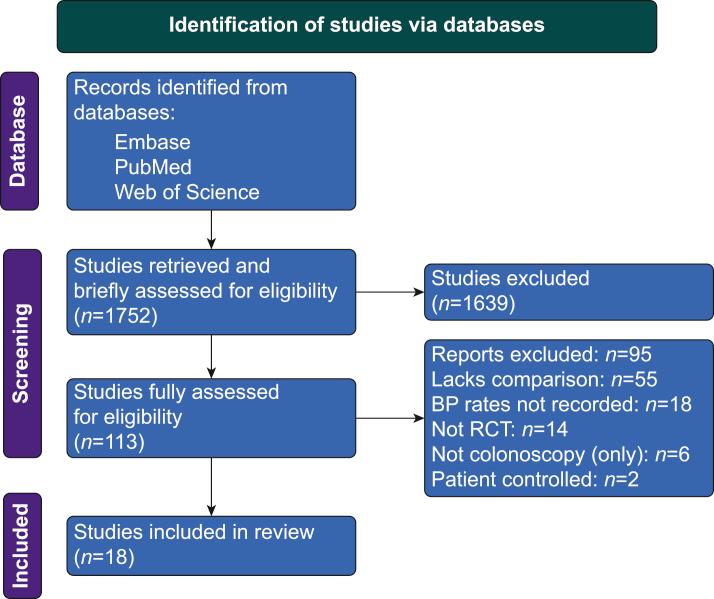
Individual patient data from five trials of propofol sedation for colonoscopy and a clinical database were pooled and explored with logistic and linear regression. A literature search and focused meta-analysis compared the incidence of hypotension with propofol and alternative forms of procedural sedation. Hypotensive episodes were characterised by the original authors' definitions (typically systolic BP <90 mm Hg).
RESULTS
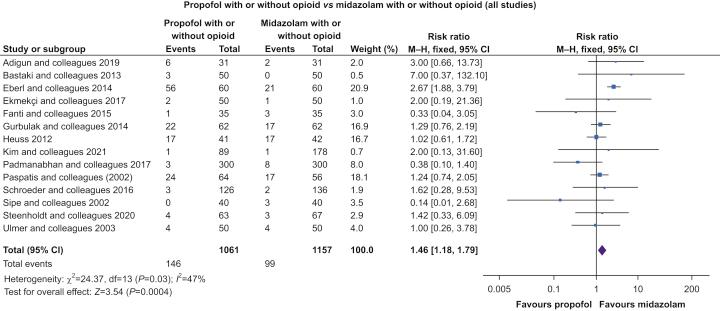
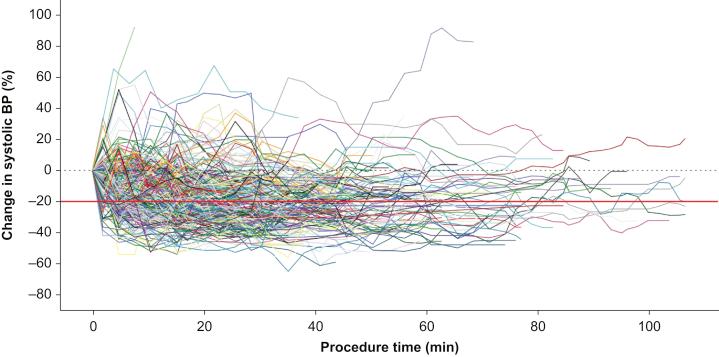
In pooled individual patient data (n=939), 36% of procedures were associated with episodes of hypotension. Longer periods of propofol sedation and larger propofol doses were associated with longer-lasting and more-profound hypotension. Amongst 380 patients for whom individual BP measurements were available, 107 (28%) experienced systolic BP <90 mm Hg for >5 min, and in 89 (23%) the episodes exceeded 10 min. Meta-analysis of 18 RCTs identified an increased risk ratio for the development of hypotension in procedures where propofol was used compared with the use of etomidate (two studies; n=260; risk ratio [RR] 2.0 [95% confidence interval: 1.37-2.92]; P=0.0003), remimazolam (one study; n=384; RR 2.15 [1.61-2.87]; P=0.0001), midazolam (14 studies; n=2218; RR 1.46 [1.18-1.79]; P=0.0004), or all benzodiazepines (15 studies; n=2602; 1.67 [1.41-1.98]; P<0.00001). Hypotension was less likely with propofol than with dexmedetomidine (one study; n=60; RR 0.24 [0.09-0.62]; P=0.003).
CONCLUSIONS
Hypotension is common during propofol sedation for colonoscopy and of a magnitude and duration associated with harm in surgical patients.
背景
术中及术后低血压较为常见,与器官损伤和不良预后相关。程序性镇静期间的动脉血压(BP)变化尚未得到很好的描述。
方法
将异丙酚镇静结肠镜检查的五项试验的个体患者数据和临床数据库进行汇总,并通过逻辑回归和线性回归进行探索。文献检索和重点荟萃分析比较了异丙酚与其他形式的程序性镇静的低血压发生率。低血压发作由原始作者的定义来描述(通常为收缩压<90mmHg)。
结果
在汇总的个体患者数据(n=939)中,36%的手术与低血压发作有关。较长的异丙酚镇静时间和较大的异丙酚剂量与持续时间更长和程度更深的低血压相关。在 380 名可获得个体血压测量值的患者中,107 名(28%)患者的收缩压<90mmHg持续时间超过 5 分钟,89 名(23%)患者的发作时间超过 10 分钟。18 项 RCT 的荟萃分析确定,与使用依托咪酯(两项研究;n=260;风险比[RR]2.0[95%置信区间:1.37-2.92];P=0.0003)、瑞马唑仑(一项研究;n=384;RR 2.15[1.61-2.87];P=0.0001)、咪达唑仑(14 项研究;n=2218;RR 1.46[1.18-1.79];P=0.0004)或所有苯二氮䓬类药物(15 项研究;n=2602;RR 1.67[1.41-1.98];P<0.00001)相比,使用异丙酚更易发生低血压。与右美托咪定(一项研究;n=60;RR 0.24[0.09-0.62];P=0.003)相比,异丙酚引起的低血压较少。
结论
异丙酚镇静用于结肠镜检查时,低血压较为常见,其程度和持续时间与手术患者的危害相关。
 Zotero 插件