
柬埔寨的纵向监测表明,三种蝙蝠的幼年和未成熟个体中甲型和乙型冠状病毒的循环频率更高。
Longitudinal monitoring in Cambodia suggests higher circulation of alpha and betacoronaviruses in juvenile and immature bats of three species.
机构信息
CIRAD, UMR ASTRE (Animal, Santé, Territoires, Risques, Ecosystèmes), TA A 117/E, Campus International de Baillarguet, 34398, Montpellier CEDEX 5, France.
ASTRE, CIRAD, INRAE, Univ Montpellier, Montpellier, France.
出版信息
Sci Rep. 2021 Dec 17;11(1):24145. doi: 10.1038/s41598-021-03169-z.
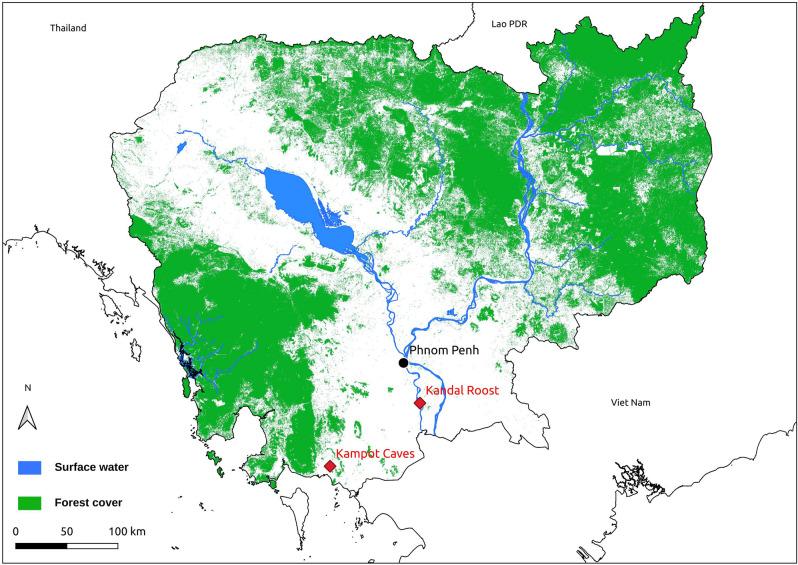
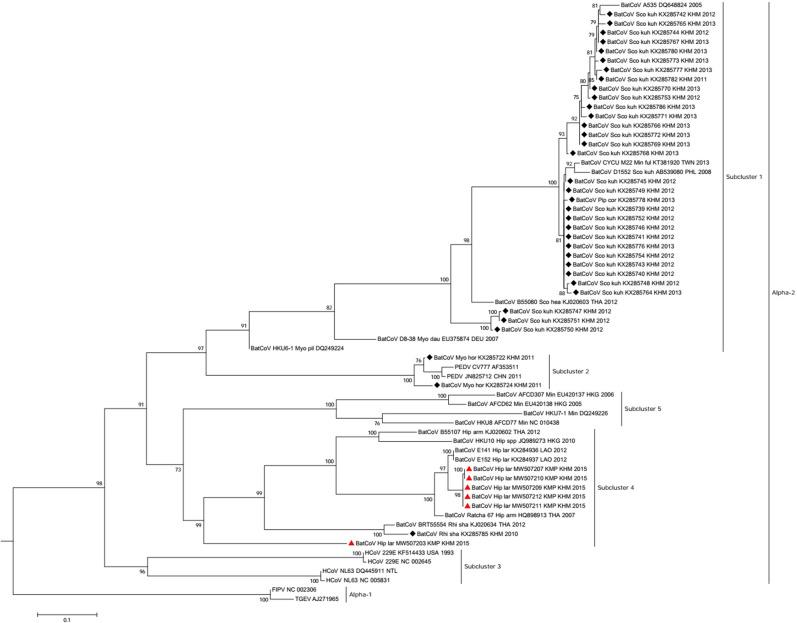
Recent studies suggest that coronaviruses circulate widely in Southeast Asian bat species and that the progenitors of the SARS-Cov-2 virus could have originated in rhinolophid bats in the region. Our objective was to assess the diversity and circulation patterns of coronavirus in several bat species in Southeast Asia. We undertook monthly live-capture sessions and sampling in Cambodia over 17 months to cover all phases of the annual reproduction cycle of bats and test specifically the association between their age and CoV infection status. We additionally examined current information on the reproductive phenology of Rhinolophus and other bat species presently known to occur in mainland southeast China, Vietnam, Laos and Cambodia. Results from our longitudinal monitoring (573 bats belonging to 8 species) showed an overall proportion of positive PCR tests for CoV of 4.2% (24/573) in cave-dwelling bats from Kampot and 4.75% (22/463) in flying-foxes from Kandal. Phylogenetic analysis showed that the PCR amplicon sequences of CoVs (n = 46) obtained clustered in Alphacoronavirus and Betacoronavirus. Interestingly, Hipposideros larvatus sensu lato harbored viruses from both genera. Our results suggest an association between positive detections of coronaviruses and juvenile and immature bats in Cambodia (OR = 3.24 [1.46-7.76], p = 0.005). Since the limited data presently available from literature review indicates that reproduction is largely synchronized among rhinolophid and hipposiderid bats in our study region, particularly in its more seasonal portions (above 16° N), this may lead to seasonal patterns in CoV circulation. Overall, our study suggests that surveillance of CoV in insectivorous bat species in Southeast Asia, including SARS-CoV-related coronaviruses in rhinolophid bats, could be targeted from June to October for species exhibiting high proportions of juveniles and immatures during these months. It also highlights the need to develop long-term longitudinal surveys of bats and improve our understanding of their ecology in the region, for both biodiversity conservation and public health reasons.
最近的研究表明,冠状病毒广泛存在于东南亚的蝙蝠物种中,而 SARS-CoV-2 病毒的前体可能起源于该地区的菊头蝠。我们的目的是评估几种东南亚蝙蝠物种中冠状病毒的多样性和循环模式。我们在柬埔寨进行了为期 17 个月的每月活体捕获和采样,以覆盖蝙蝠每年繁殖周期的所有阶段,并特别测试它们的年龄与 CoV 感染状况之间的关系。我们还检查了目前关于菊头蝠和其他在中国大陆东南地区、越南、老挝和柬埔寨已知出现的蝙蝠物种的生殖物候学的信息。我们的纵向监测结果(来自 8 个物种的 573 只蝙蝠)显示,来自贡布的洞穴蝙蝠的总体 CoV PCR 检测阳性率为 4.2%(24/573),来自干丹的飞狐的阳性率为 4.75%(22/463)。系统发育分析显示,从 CoV 获得的 PCR 扩增子序列(n=46)聚类在α冠状病毒和β冠状病毒中。有趣的是,宽耳蝠属蝙蝠携带来自这两个属的病毒。我们的结果表明,在柬埔寨,冠状病毒的阳性检测与幼年和未成年蝙蝠有关(OR=3.24[1.46-7.76],p=0.005)。由于从文献综述中获得的有限数据表明,在我们的研究区域,特别是在季节性较强的地区(北纬 16 度以上),菊头蝠和蹄蝠的繁殖高度同步,这可能导致冠状病毒循环呈季节性模式。总体而言,我们的研究表明,对包括菊头蝠中与 SARS-CoV 相关的冠状病毒在内的东南亚食虫蝙蝠物种中的 CoV 进行监测,可以针对在这些月份中幼年和未成年个体比例较高的物种,于 6 月至 10 月进行。它还强调了需要制定长期的蝙蝠纵向调查,并提高我们对该地区蝙蝠生态的理解,这既是为了生物多样性保护,也是为了公共卫生的原因。


 Zotero 插件