
脊髓损伤患者使用独立式机器人外骨骼进行物理治疗:一项可行性研究。
Physiotherapy using a free-standing robotic exoskeleton for patients with spinal cord injury: a feasibility study.
机构信息
University of Newcastle, Callaghan, Australia.
Hunter Medical Research Institute, New Lambton Heights, Australia.
出版信息
J Neuroeng Rehabil. 2021 Dec 25;18(1):180. doi: 10.1186/s12984-021-00967-4.
BACKGROUND
Evidence is emerging for the use of overground lower limb robotic exoskeletons in the rehabilitation of people with spinal cord injury (SCI), with suggested benefits for gait speed, bladder and bowel function, pain management and spasticity. To date, research has focused on devices that require the user to support themselves with a walking aid. This often precludes use by those with severe trunk, postural or upper limb deficits and places the user in a suboptimal, flexed standing position. Free-standing exoskeletons enable people with higher level injuries to exercise in an upright position. This study aimed to evaluate the feasibility of therapy with a free-standing exoskeleton for those with SCI, and to determine the potential health-related benefits of this intervention.
METHODS
This 12-week intervention study with 12-week waitlist control and 12-week follow up, provided people with SCI scoring < 5 on the mobility section of the spinal cord independence measure (SCIM-III) twice weekly therapy in the REX (Rex Bionics, Auckland, NZ), a free-standing lower limb robotic exoskeleton. The primary outcome measure of interest was function, as measured on the SCIM-III. A battery of secondary outcomes was included. Participants also completed a survey on their perceptions of this treatment modality, to determine acceptability.
RESULTS
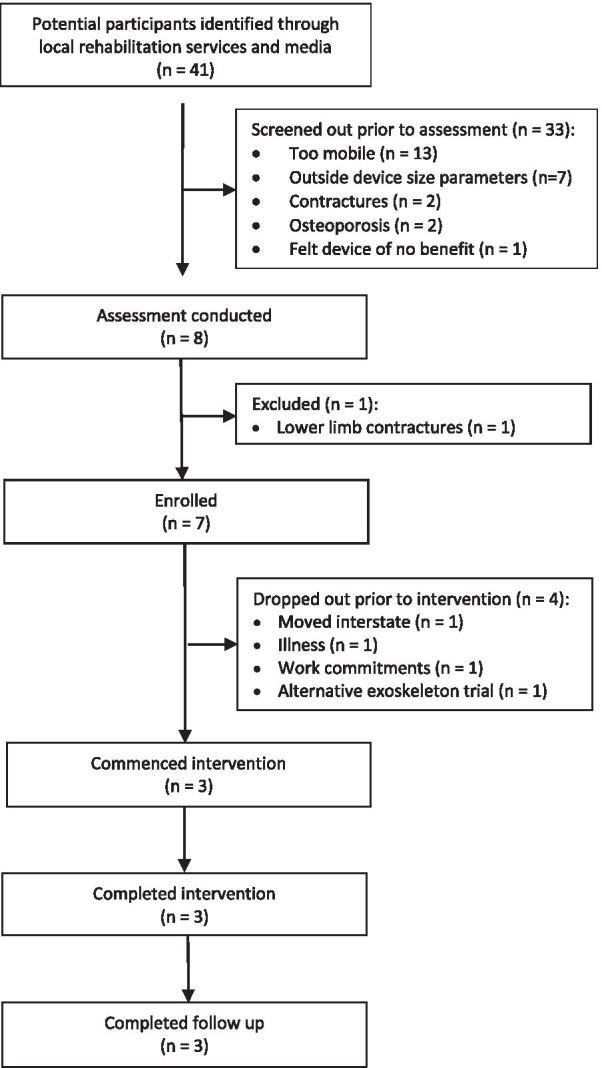
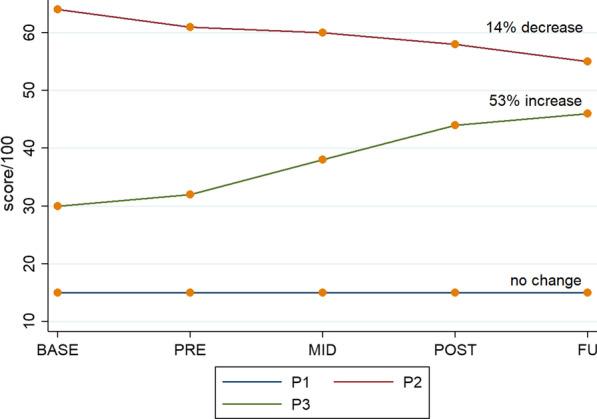
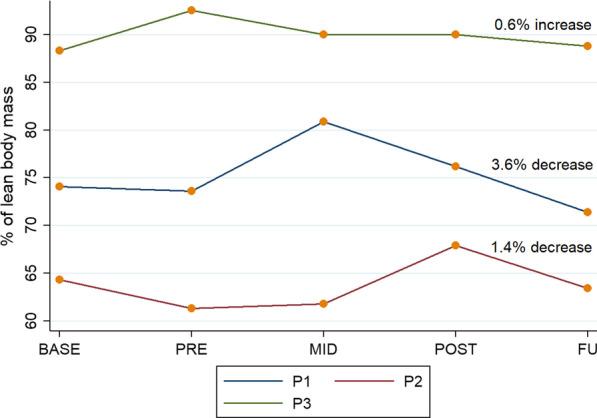
Forty-one potential participants were screened for eligibility. Two females (one ASIA A, one ASIA C) and one male (ASIA B) completed all 24 intervention sessions, and the follow up assessment. One participant showed positive trends in function, fatigue, quality of life and mood during the intervention phase. Grip and quadriceps strength, and lower limb motor function improved in another. Two improved their percentage of lean body mass during the intervention phase. Remaining results were varied across patients, time points and outcomes. The intervention was highly acceptable to all participants.
CONCLUSION
With three of 41 potential participants being eligible and completing this study, our results show that there are potential benefits of exercise in a free-standing exoskeleton for people with severe mobility impairment due to SCI, for a small subset of patients. Further research is warranted to determine those most likely to benefit, and the type of benefit depending on the patient characteristics. Trial registration The trial was registered prospectively on 20 April 2018 at www.anzctr.org.au/ (ACTRN12618000626268).
背景
越来越多的证据表明,使用地面下肢机器人外骨骼可以帮助脊髓损伤(SCI)患者康复,这可能有益于提高步行速度、改善膀胱和肠道功能、减轻疼痛和控制痉挛。迄今为止,研究主要集中在需要使用者用助行器支撑自己的设备上。这通常排除了那些严重躯干、姿势或上肢缺陷的患者的使用,并且使患者处于不理想的、弯曲的站立姿势。自支撑外骨骼使较高水平损伤的患者能够直立进行锻炼。本研究旨在评估使用自支撑外骨骼对 SCI 患者进行治疗的可行性,并确定这种干预措施的潜在健康益处。
方法
这项为期 12 周的干预研究包括 12 周的等待期对照和 12 周的随访,为脊髓损伤功能独立性测量(SCIM-III)运动部分评分<5 的 SCI 患者每周两次提供 REX(Rex Bionics,奥克兰,新西兰)治疗,REX 是一种自支撑下肢机器人外骨骼。主要观察指标为 SCIM-III 上的功能。还包括了一系列次要结果。参与者还完成了一份关于他们对这种治疗方式的看法的调查,以确定可接受性。
结果
对 41 名潜在参与者进行了筛选,以确定其是否符合资格。两名女性(一名 ASIA A,一名 ASIA C)和一名男性(ASIA B)完成了所有 24 次干预和随访评估。一名参与者在干预阶段表现出功能、疲劳、生活质量和情绪方面的积极趋势。另一名参与者的握力和股四头肌力量以及下肢运动功能得到了改善。两名参与者在干预阶段增加了瘦体重的百分比。其余结果因患者、时间点和结果而异。所有参与者都非常接受这种干预。
结论
在 41 名潜在参与者中,有 3 名符合条件并完成了这项研究,我们的结果表明,对于因 SCI 而导致严重运动障碍的一小部分患者来说,在自支撑外骨骼中进行运动可能有潜在的益处。需要进一步的研究来确定最有可能受益的人群,以及取决于患者特征的受益类型。
试验注册
该试验于 2018 年 4 月 20 日在 www.anzctr.org.au/(ACTRN12618000626268)前瞻性注册。

 Zotero 插件